

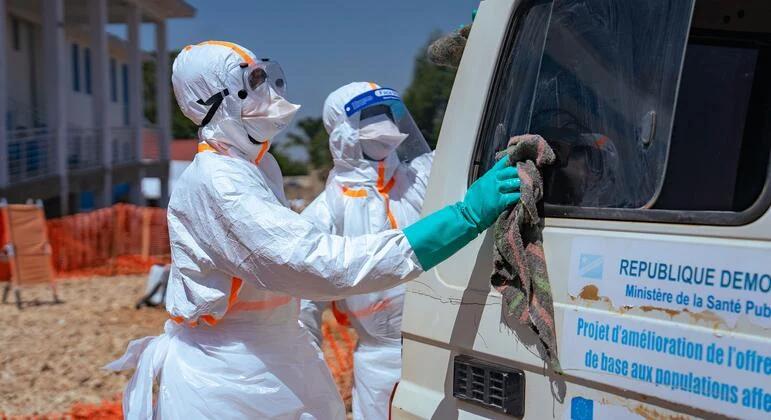
Executive Summary: A Race Against Time
The World Health Organization (WHO) has issued an urgent, high-level alert regarding the escalating Ebola virus disease (EVD) outbreak in the Democratic Republic of the Congo (DRC). During a press briefing in Geneva, WHO Director-General Dr. Tedros Adhanom Ghebreyesus cautioned that the current epidemic is rapidly outpacing international containment efforts. Despite a multi-agency response involving the DRC government, the Africa Centres for Disease Control and Prevention (Africa CDC), and global health partners, the virus continues to spread at an alarming rate.
With 2,273 reported cases and a harrowing death toll of 796, the current outbreak is moving with unprecedented speed. To put the gravity of the situation into perspective, it took the 2018–2019 DRC Ebola outbreak more than ten months to reach the 2,000-case threshold; the current crisis reached similar levels in a mere two months. The international community now faces a critical juncture where the lack of financial resources and the volatility of the operational environment threaten to turn a manageable crisis into a protracted regional catastrophe.
Chronology and Evolution of the Crisis
The current outbreak, concentrated in the restive eastern provinces of the DRC, has defied initial containment strategies. While early identification and contact tracing were initially successful, the virus has moved into high-density and volatile zones, complicating medical intervention.
The Ituri Province Hotspot
The most significant concern for health officials remains the Ituri province. Unlike more stable regions, Ituri is plagued by active armed conflict, which severely restricts the movement of medical personnel and the establishment of stable treatment infrastructure. The intelligence gathered by the WHO indicates that over 80 percent of new infections are now being detected outside of known contact lists. This statistical shift is a major red flag, signifying that the "chain of transmission"—the movement of the virus from person to person—is occurring in the shadows, outside the view of surveillance teams.
The Attack on Medical Infrastructure
The security situation reached a nadir this week when a primary Ebola treatment centre in Bunia was targeted in an armed attack. Such incidents do more than destroy physical property; they shatter the trust between humanitarian responders and the local population. When medical facilities become targets, patients are less likely to seek care, and health workers are forced to withdraw, creating a dangerous vacuum that the virus inevitably exploits.
Supporting Data and Medical Trends
While the overall trajectory is concerning, medical experts maintain that the disease is not insurmountable. Data from the field provides a nuanced view of both the obstacles and the potential for recovery.
The "Survival" Narrative
Dr. Tedros emphasized a crucial message: "This disease can be survived." Despite the lack of fully approved vaccines or specialized therapeutics in certain sectors, 377 individuals have successfully recovered from the infection. This underscores the efficacy of early diagnosis and the importance of professional medical care.
Infrastructure Milestones
The response effort has achieved significant logistical gains over the past sixty days:
- Treatment Capacity: Total bed capacity has expanded to over 800.
- Laboratory Network: Diagnostic capabilities have grown from a single facility to a robust network of 16 laboratories, drastically reducing the time required to confirm cases.
- Community Engagement: Over 21,000 community health workers are currently being trained in surveillance, triage, and the implementation of safe and dignified burial practices, which are essential to breaking transmission cycles.
- Contact Follow-up: Surveillance teams have managed to reach an 80 percent success rate in following up on known contacts.
However, these gains are being diluted by the sheer velocity of the outbreak. The fact that two-thirds of deaths still occur outside of health facilities suggests that, despite the increased infrastructure, there is a profound disconnect between the medical system and the communities most at risk.
Regional Developments: The Uganda Success Story
In contrast to the dire situation in the DRC, the neighboring nation of Uganda has provided a blueprint for successful containment. Following the declaration of an Ebola outbreak on May 15, Uganda implemented a rapid, highly coordinated response that appears to have yielded success.
As of Thursday, the last confirmed Ebola patient in Uganda was discharged after returning two consecutive negative tests. This event triggers the start of a mandatory 42-day observation period before the WHO can officially declare the country "Ebola-free." Uganda’s experience—which involved 20 confirmed cases and two deaths—highlights the importance of preparedness. Fifteen of these cases were imported from the DRC, but the country’s ability to limit local transmission to only five cases serves as a testament to the commitment of Ugandan health workers and local communities. Dr. Kasonde Mwinga, the WHO Representative in Uganda, noted that while the milestone is encouraging, the country remains in a state of high vigilance given the porous nature of the border.
Official Responses and the Funding Crisis
The most pressing challenge identified by both the WHO and UNICEF is not a lack of medical knowledge or technical expertise, but a staggering deficiency in global funding.
The $400 Million Gap
The WHO and the Africa CDC have developed a joint continental preparedness and response plan that is currently underfunded by more than $400 million. Dr. Tedros was blunt in his assessment during the briefing: "This is not charity. It’s an investment in national security." He urged international donors to view the funding not as an optional act of benevolence, but as a mandatory insurance policy against the regional destabilization that follows an uncontrolled epidemic.
The UNICEF Perspective
UNICEF has joined the chorus of alarm, reporting that only 25 percent of the funds required for its specific portion of the Ebola response have been secured. Gilles Fagninou, UNICEF Regional Director, who recently conducted an assessment visit to Ituri, stressed that the epidemic remains containable. "We know how to stop this epidemic," Fagninou stated. "The challenge is not the lack of solutions, but the lack of funding to deploy them at the scale needed."
Implications for Global Health Security
The situation in the DRC and the surrounding Great Lakes region poses a significant test for the international community. The rapid acceleration of cases in the DRC serves as a sobering reminder that the transition from a localized cluster to a regional epidemic can happen in weeks, not months.
Strategic Recommendations
- Resource Mobilization: International donors must immediately bridge the $400 million gap to allow for the scaling of rapid response teams.
- Security Coordination: There must be a concerted effort to provide safe corridors for medical humanitarian aid, ensuring that treatment centres are not caught in the crossfire of local insurgencies.
- Community Trust: Strengthening the role of local leaders and community health workers is paramount. The high rate of deaths occurring in the community suggests that current outreach programs need to be further localized to address cultural barriers and fear.
- Integrated Surveillance: Learning from the Ugandan model, neighboring countries must implement rigorous border screening and integrated surveillance systems to prevent further cross-border importation.
Conclusion: A Call to Action
The Ebola outbreak is at a critical inflection point. While the technical capacity to diagnose and treat the disease has improved, the geographic spread and the security challenges in eastern DRC are outpacing current interventions. The WHO’s warning is a clear signal that the window of opportunity to prevent a wider, more devastating epidemic is closing.
The path forward requires a shift in political will. By treating the response as a fundamental component of global security rather than a peripheral humanitarian issue, the international community can provide the resources necessary to bring this outbreak under control. The survival of hundreds of individuals serves as proof that the tools to defeat Ebola exist; the only question remaining is whether the global community has the collective resolve to use them before the situation deteriorates further.
 Lina Hope
 Asro
Asro
 Layla Zulfa
