

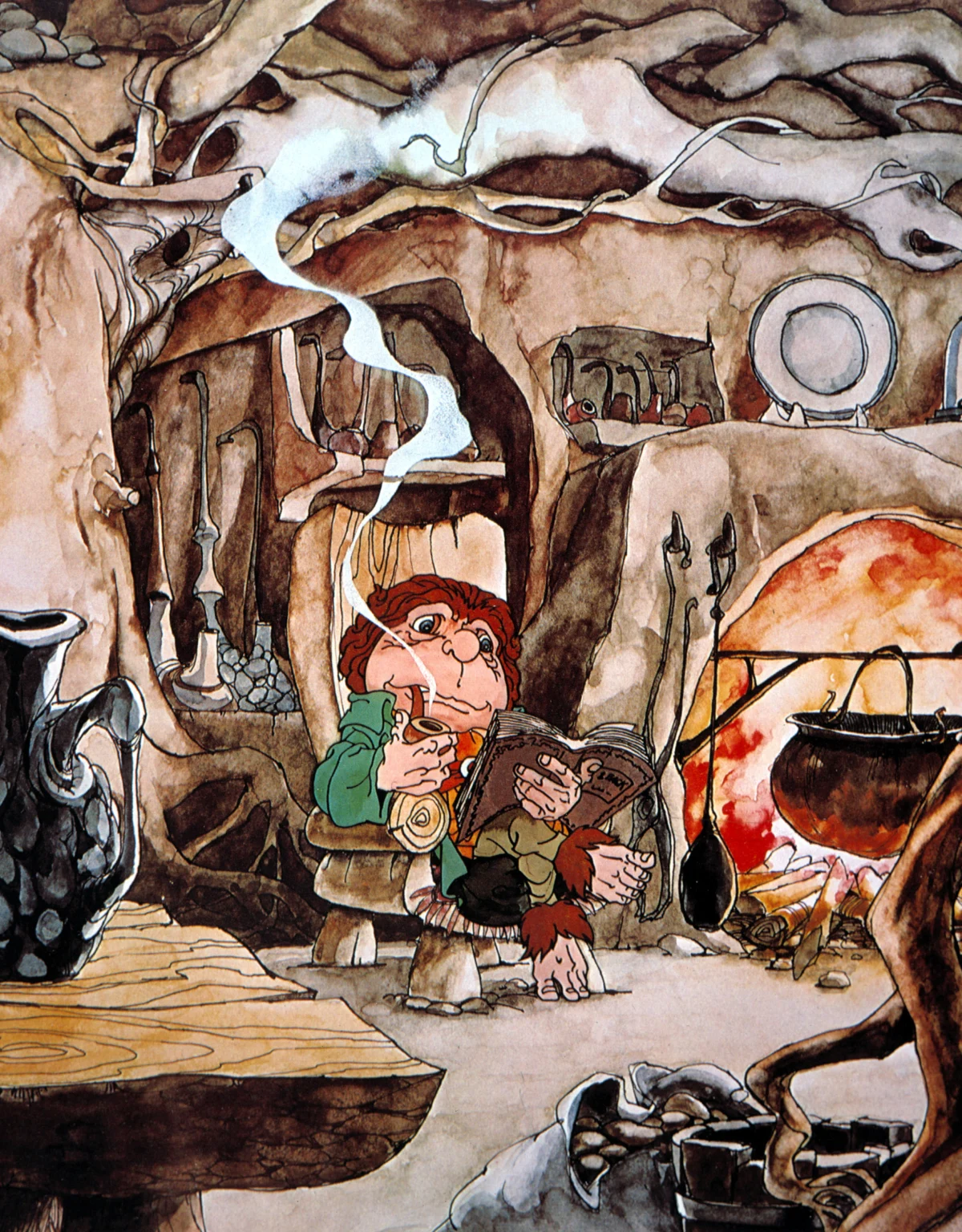
LOS ANGELES — As the global box office reels from the seismic release of Christopher Nolan’s IMAX 70mm epic The Odyssey, a burgeoning counter-movement in film criticism is looking backward to find the "fantasy" missing from modern prestige cinema. In the latest installment of IndieWire’s "After Dark" series—a curated exploration of fringe and cult cinema in the streaming era—critics have signaled a return to the whimsical, hand-drawn roots of the genre by spotlighting the 1977 animated television special The Hobbit.
The selection comes at a pivotal cultural moment. While Nolan’s The Odyssey has been lauded for its psychological depth and "muted colors of reluctant determination," it has also sparked a debate regarding the loss of the "fairy-story" element in high-budget adaptations. By contrast, the 1977 Rankin/Bass production of The Hobbit is being championed as a vital relic of an era that prioritized vivid imagination and accessible wonder over the "gravity of inexpressible guilt" that defines the current cinematic landscape of 2026.

Chronology: From Middle-earth to the Small Screen
The journey of The Hobbit from J.R.R. Tolkien’s 1937 novel to the 1977 animated special is a storied chapter in the history of fantasy media. Produced by Arthur Rankin Jr. and Jules Bass, the film was originally conceived as a high-profile television event for NBC. It arrived during a transitional period for the fantasy genre, preceding Ralph Bakshi’s 1978 The Lord of the Rings and decades before Peter Jackson’s transformative live-action trilogies.
In the early 2000s, Jackson’s The Lord of the Rings set a new benchmark for technological achievement in film, effectively moving the industry toward a gritty, "realistic" fantasy aesthetic. However, the subsequent Hobbit trilogy (2012–2014) was criticized by purists for being "stretched on the rack," bloated by CGI and unnecessary subplots. This led to a gradual re-appreciation of the 1977 version, which, at a lean 78 minutes, captures the brisk, episodic nature of Tolkien’s original "there and back again" narrative.
As of 2026, the Tolkien legendarium remains a contentious ground. With recent announcements regarding The Hunt for Gollum and ongoing debates over the fidelity of modern adaptations, the 1977 film stands as a "palate cleanser"—a reminder of a time when Middle-earth was rendered through watercolors rather than motion-capture suits.

Supporting Data: The Technical and Artistic Pedigree of 1977
The 1977 Hobbit is often remembered for its unique "hippie-vibe" and folk-infused score, but its technical pedigree is significant. The animation was outsourced to TopCraft, a Japanese studio that would later become the foundational core of Studio Ghibli. Many of the animators who worked on The Hobbit later contributed to Hayao Miyazaki’s Nausicaä of the Valley of the Wind (1984).
Key Production Details:
- Aesthetic Style: The film utilizes a blend of strong linework and expressive watercolor landscapes, creating a visual style that critics describe as a cross between a stained-glass window and a classic storybook.
- Iconography: The creature designs, particularly the dragon Smaug, utilize a fusion of Western and Eastern dragon motifs, creating a look that is both alien and ancient.
- Voice Cast: The production featured a "heavyweight" voice cast, including Academy Award-winning director John Huston as Gandalf the Grey and the legendary Otto Preminger as the Elf King (Thranduil). Orson Bean provided the voice for Bilbo Baggins, imbuing the character with a relatability that modern critics argue surpasses more recent portrayals.
- The Score: The music, composed by Maury Laws with lyrics adapted directly from Tolkien’s poems, emphasizes the "folksy" and "earnest" nature of the source material, a sharp contrast to the operatic, brass-heavy scores of the 21st century.
Critical Context: Fantasy vs. The "Nolan-ization" of Myth
The current resurgence of interest in the 1977 Hobbit is inextricably linked to the reception of Christopher Nolan’s The Odyssey. Critics at IndieWire argue that while Nolan excels at depicting the supernatural as a form of "psychological horror," he often strips away the joyful, imaginative core that makes epics endure for younger audiences.

Renowned translator Emily Wilson has noted that the power of the Homeric epic lies in its accessibility to the "eight-year-old in all of us." This sentiment is echoed by J.R.R. Tolkien in his seminal essay On Fairy-Stories, where he argues that "fantasy is a natural human activity" that provides "recovery" (a regaining of a clear view) and "escape" (from a world of hunger, thirst, and war).
The 1977 The Hobbit is being framed as a successful "fairy-story" because it does not attempt to ground its magic in pseudo-science or grim-dark realism. Instead, it presents a universe where the most important qualities are not martial prowess or strategic genius, but "food and cheer above hoarded wealth." This moral simplicity is increasingly viewed as a necessary antidote to the "existential dread" prevalent in 2026’s blockbuster offerings.
Implications: Film Preservation and the "Hero’s Choice"
The discussion surrounding The Hobbit also touches on the broader issue of film preservation and the accessibility of "fringe" media. As streaming platforms continue to consolidate and physical media becomes a niche market, works like the Rankin/Bass specials risk falling into obscurity. The "After Dark" initiative emphasizes that protecting these older works is not merely an act of nostalgia, but a defense of artistic diversity.

Furthermore, the psychological impact of the 1977 film’s narrative structure is being re-evaluated. A key scene highlighted by critics involves Bilbo Baggins facing a "fork in the road" before entering Smaug’s lair. Unlike the relentless forward momentum of modern action heroes, Bilbo’s victory comes from a conscious internal choice to face the unknown despite his paralyzing fear.
Social and Industry Implications:
- The Demand for "Earnestness": There is a measurable shift in audience sentiment toward "earnest" storytelling. After years of "meta-irony" and "dark reboots," viewers are showing a preference for stories that offer genuine emotional resolution.
- Animation as a Serious Medium: The link between TopCraft and Studio Ghibli reinforces the argument that television animation of the 1970s was a sophisticated art form that paved the way for the global dominance of anime.
- Preservation as Advocacy: The ongoing effort to keep "fringe" films like the 1977 Hobbit on major streaming services (currently available on HBO Max) is seen as a bellwether for the health of the film industry’s back-catalog.
Official Responses and Closing Thoughts
While representatives for the Tolkien Estate have not issued a new statement regarding the 1977 film in light of the 2026 cinematic landscape, the "After Dark" column suggests that the film’s endurance is its own testament. Critics Alison Foreman and Sarah Shachat conclude that the "greatest adventure" for modern audiences might not be the next $300 million blockbuster, but a return to the "dusty little hobbit holes" of the past.

"Sometimes the quests that define us aren’t the ones we set out to find," Foreman writes. "They’re the ones that show up unexpectedly—asking who we are willing to become to survive them."
As The Odyssey continues its run in IMAX theaters, the 78-minute journey of a watercolor Bilbo Baggins remains a potent reminder that in cinema, as in Middle-earth, the smallest things can change the course of the future.
‘The Hobbit’ (1977) is currently available for streaming on HBO Max and for purchase on various VOD platforms.
 Sagoh
Sagoh
 rifanmuazin
 Neng Nana
