

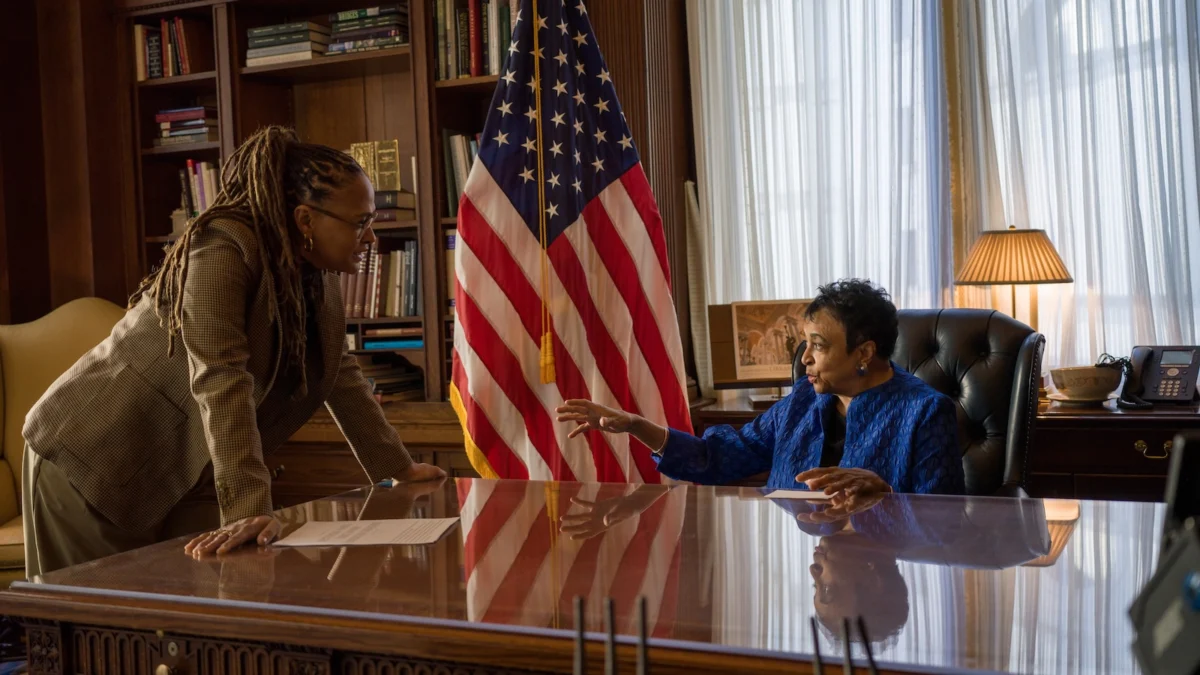
In an era defined by shifting legal landscapes and heightened discourse surrounding national identity, Academy Award-nominated filmmaker Ava DuVernay has announced her latest project: a definitive documentary exploration of the 14th Amendment to the U.S. Constitution. Titled simply 14th, the film serves as a spiritual and thematic successor to her 2016 masterpiece 13th, which fundamentally altered the public conversation regarding the American carceral state.
The announcement comes at a moment of profound judicial consequence. Just weeks ago, the Supreme Court of the United States issued a landmark ruling striking down an executive order that sought to terminate birthright citizenship for children born to parents residing in the country illegally or on temporary visas. This legal volatility provides the urgent backdrop for DuVernay’s return to documentary filmmaking, as she seeks to bridge the gap between 19th-century Reconstruction-era promises and the 21st-century reality of American life.
Main Facts: A New Chapter in the Constitutional Trilogy
14th is set to debut on Netflix later this year, marking a significant continuation of the creative partnership between the streaming giant and DuVernay’s ARRAY banner. While 13th focused on the loophole in the 13th Amendment that allowed for the "legal" enslavement of prisoners, 14th shifts the lens toward the concept of belonging.
The documentary aims to synthesize 150 years of legal and social conflict into a cohesive narrative. It features a formidable roster of over 50 interviewees, ranging from firebrand politicians and constitutional scholars to cultural critics and Pulitzer Prize-winning historians. By examining the 14th Amendment—which guarantees citizenship, due process, and equal protection under the law—DuVernay explores the fundamental question of who is considered "American" and who possesses the power to define that status.
The film is produced by DuVernay alongside long-time collaborators Spencer Averick, Tammy Garnes, and Paul Garnes. As the nation grapples with questions of immigration, voting rights, and the limits of executive power, 14th arrives as a vital piece of civic media intended to demystify the "rules" of the American experiment.
Chronology: From the Ashes of War to the Digital Age
To understand the weight of DuVernay’s new project, one must look at both the history of the amendment itself and the evolution of DuVernay’s filmography.
The Birth of the 14th Amendment (1866–1868)
Ratified in 1868, the 14th Amendment was the centerpiece of the Reconstruction Amendments. Following the Civil War, the nation faced the existential crisis of how to integrate four million formerly enslaved people into the body politic. The amendment was designed to overrule the infamous Dred Scott decision, which had declared that Black people could never be citizens. By establishing that all persons born or naturalized in the United States are citizens, the amendment created a new, inclusive definition of American identity.

DuVernay’s Documentary Evolution (2014–2024)
Ava DuVernay’s trajectory toward this moment began with Selma (2014), which dramatized the fight for the Voting Rights Act. She followed this with 13th (2016), a documentary that traced the lineage from slavery to mass incarceration. Since then, her work has consistently interrogated the intersection of law and humanity.
- 2019: DuVernay released When They See Us, a limited series detailing the systemic failure of the justice system in the Central Park Five case.
- 2023: She released Origin, an ambitious adaptation of Isabel Wilkerson’s Caste: The Origins of Our Discontents, which explored the global hierarchies that underpin racism.
- 2024: The announcement of 14th completes a decade-long arc of storytelling that treats the U.S. Constitution not as a static document, but as a living, breathing, and often contested battlefield.
Supporting Data: The High Stakes of Birthright Citizenship
The timing of the film’s release is bolstered by contemporary legal data and recent executive maneuvers. The 14th Amendment’s Citizenship Clause—"All persons born or naturalized in the United States, and subject to the jurisdiction thereof, are citizens of the United States"—has been the target of various political administrations seeking to curb immigration.
According to legal analysts, the recent Supreme Court challenge to birthright citizenship was the most significant threat to the 14th Amendment’s foundational principle in over a century. Proponents of the executive order argued that the phrase "subject to the jurisdiction thereof" should exclude children of those not lawfully present. However, the Court’s decision to strike down the order reaffirmed the precedent set in United States v. Wong Kim Ark (1898), which established that birth on U.S. soil is the primary determinant of citizenship, regardless of parental status.
Furthermore, the "Equal Protection" and "Due Process" clauses of the 14th Amendment remain the most litigated portions of the Constitution. They have been the legal basis for nearly every major civil rights victory, from Brown v. Board of Education (ending school segregation) to Obergefell v. Hodges (legalizing same-sex marriage). DuVernay’s film arrives as these precedents are being re-examined by a conservative-leaning judiciary, making the documentary’s educational component a matter of public interest.
Official Responses: Voices from the Production
The announcement of 14th has been met with significant anticipation from both the industry and the political sphere. In a statement released through Netflix, DuVernay articulated the film’s central philosophy, distinguishing it from a mere history lesson.
"If 13th asked who gets caged, then 14th asks who gets counted," DuVernay said. "This is not a film about the past tense of freedom. I’m not interested in asking you to look back. The film asks what kind of country is being written beneath our feet now… while we’re busy believing the stories we’ve all been told."
Adam Del Deo, Vice President of Documentary Film and Series at Netflix, emphasized the importance of DuVernay’s voice in the current cultural climate. "Ava’s remarkable ability to bring history into conversation with the present made her last documentary, the seminal BAFTA-winning and Academy Award-nominated 13th, a cultural touchstone of the last quarter century," Del Deo stated. "With 14th, she delivers another ambitious and thought-provoking documentary with the depth, artistry, and humanity that have come to define her work."

The film’s list of interviewees suggests a balanced but rigorous inquiry. By including both progressive figures like Alexandria Ocasio-Cortez and Stacey Abrams alongside conservative voices like Anna Paulina Luna and Jeff Flake, DuVernay signals an intent to explore the amendment as a shared, albeit contested, national inheritance.
Implications: The Future of the American "We"
The release of 14th carries implications that extend far beyond the streaming platform. As the United States moves toward a pivotal election cycle, the documentary is poised to become a central tool for civic engagement.
The Battle for Interpretation
The documentary highlights the tension between "originalism"—the judicial philosophy that the Constitution should be interpreted as the founders intended—and the "living Constitution" theory. By interviewing scholars like Eric Foner and David Blight, DuVernay underscores that the 14th Amendment was a radical attempt to "remake" America. The implication is that the current struggle over birthright citizenship and equal protection is not a new conflict, but the continuation of a 150-year-old war over the soul of the country.
Cultural and Social Belonging
Beyond the legalities, 14th addresses the psychological impact of being "counted." In an era of social media polarization, the film’s inclusion of cultural critics like Hasan Piker suggests an attempt to reach younger audiences who consume political information through non-traditional channels. The film implies that if the public does not understand the protections afforded by the 14th Amendment, those protections are more easily eroded.
A Call to Vigilance
Ultimately, DuVernay’s 14th serves as a warning. By focusing on the "rules being written beneath our feet," the film suggests that the rights many Americans take for granted—citizenship by birth, equal treatment under the law, and the right to due process—are subject to the whims of political and judicial power.
As the documentary prepares for its global debut, it stands as a testament to the power of film to act as a mirror to democracy. If 13th was an exposé on the machinery of punishment, 14th promises to be an exploration of the machinery of identity, challenging every viewer to consider what it truly means to be a citizen in a changing world.
 Jia Lissa
 Lina Irawan
 Iffa Jayyana
