

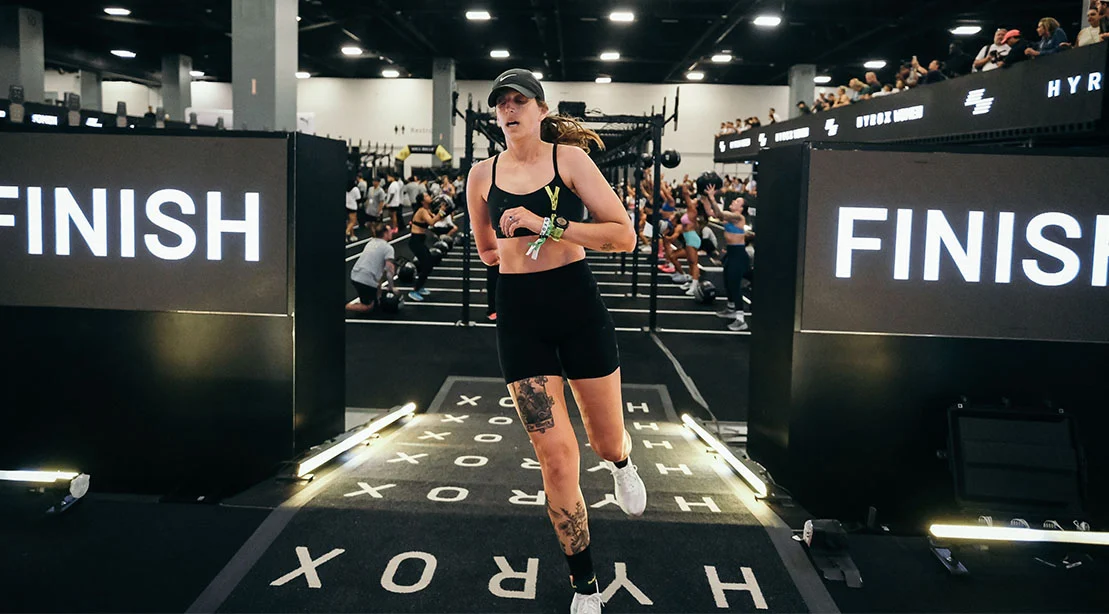
In the high-stakes world of functional fitness, where margins of victory are measured in seconds and sweat, Katie Thomas is rapidly becoming a household name. To the casual observer, she is the viral sensation who famously quipped that she was giving a police officer "the hand of God" during a routine traffic stop. However, to the athletic community, Thomas is a formidable competitor, an adaptive HYROX champion, and a trailblazing voice for inclusion in sports.
Thomas, who was born with a limb difference affecting her right arm, has spent her life dismantling the word "can’t." Today, she is not merely chasing personal records; she is actively dismantling the barriers that have historically kept athletes with limb differences on the sidelines.
The Foundation of Independence
Katie Thomas’s journey did not begin in a weight room; it began in a home where boundaries were nonexistent. Raised in Florida, she was never coddled or sheltered from the realities of her physical circumstances. Her parents adopted a philosophy of radical problem-solving, encouraging her to engage in every activity she felt drawn to—from youth soccer and baseball to the demanding arena of rodeo riding.
"My dad very much believed in me and never told me no," Thomas recalls. "If I wanted to do gymnastics, I was in gymnastics. He never let anyone tell me I couldn’t do something, and that changed the entire trajectory of my life."
This upbringing cultivated an analytical, "how can I make this work?" mindset. It was this foundation that eventually led her to earn a degree in exercise science and become a certified personal trainer, providing her with the technical vocabulary to master the mechanics of movement despite having only one arm.
Chronology of an Athlete’s Rise
Thomas’s athletic evolution has been marked by a relentless pursuit of new challenges. After years of recreational soccer, sprint triathlons, and a brief stint exploring the CrossFit world, she discovered a sport that resonated with her unique blend of endurance and grit: HYROX.
Finding Her Niche: The HYROX Breakthrough
HYROX, the global fitness racing phenomenon, emphasizes functional strength and aerobic capacity over the highly technical Olympic lifts that often dominate other fitness disciplines. For Thomas, the format was a revelation.
Her debut at a Miami HYROX event was not just a participation milestone; it was a statement. Thomas secured first place in the adaptive upper-limb division. However, her reaction to the win was uncharacteristic of an athlete seeking validation. She began to analyze her performance, looking at the global leaderboard. She discovered she was sitting second in the United States and 16th in the world in her division.
"It was one of those moments where I thought, ‘Okay, yeah. This is real,’" Thomas says. "It wasn’t just that I had a good race. It showed me that I could actually compete at a high level."
The Viral Pivot
While her athletic prowess was growing, her public profile exploded overnight due to a viral social media moment. Her Instagram account, previously a niche collection of training clips, surged from 60 followers to over half a million. Yet, rather than pivot toward influencer culture, Thomas leveraged this sudden visibility to amplify the cause of adaptive athletics, showcasing the reality of her training and the necessity of representation.
Supporting Data and Training Methodology
Thomas’s training is a masterclass in sports science. Because traditional exercise modalities are designed for bilateral symmetry, she constantly adapts her approach to achieve the same physiological stimuli.
The Science of Adaptation
Rather than forcing her body to mirror traditional technique, Thomas focuses on the intent of the movement. "If something like a snatch or a clean and jerk comes up, I know that’s just not my movement," she explains. "Instead of trying to force it, I’ll figure out another exercise that’s targeting those same muscle groups."
Her training logs are a testament to this experimentation:
- Unilateral Optimization: Replacing traditional barbell work with specialized dumbbell variations or resistance bands to ensure balanced hypertrophy and strength.
- Aerobic Efficiency: Thomas has identified running as her primary lever for performance. By improving her cardiovascular threshold, she estimates she can shave four to six minutes off her total race time, moving her from "competitive" to "elite."
- Functional Versatility: From sled pushes to the SkiErg, she approaches every station as a puzzle, refining her grip and center of gravity to compensate for her limb difference without losing power.
New Horizons: Sitting Volleyball
Recently, Thomas has expanded her athletic portfolio by training for the U.S. Paralympic sitting volleyball team. This transition has forced her to focus on flexibility—a component of fitness she previously neglected. "If you’ve never watched sitting volleyball, go sit on the floor and try to move the way they move," she says. "It looks easy on TV, but it’s absolutely wild."
Official Perspectives on Inclusive Athletics
The rise of athletes like Thomas has forced a broader conversation within the fitness industry regarding accessibility. When asked about what gym owners can do to foster better environments, Thomas’s advice is simple yet profound: Visibility.
"Have an adaptive athlete working out in your gym," she asserts. She argues that the presence of an adaptive athlete in a public space does more to dismantle stigma than any piece of specialized equipment. For the younger generation, seeing someone like Thomas competing on a global stage provides a psychological anchor—a confirmation that they belong in the room.
Implications for the Future of Sport
The impact of Katie Thomas’s career extends far beyond the finish line of a race. Her story has become a touchstone for parents of children with limb differences.
Changing the Narrative
Thomas frequently shares stories of parents who contact her after seeing her content. One message, in particular, illustrates the weight of her influence: a mother of a young daughter who had recently undergone an amputation reached out, overwhelmed with fear for her child’s future. Upon watching Thomas’s training videos, the mother realized that her daughter’s life would not be limited by her physical difference.
This is the "real" victory for Thomas. She is not just competing against other athletes; she is competing against the societal perception of what a body is "supposed" to do.
A Path to the World Stage
Looking forward, Thomas’s sights are firmly set on the HYROX World Championships. Her goal is not just to qualify, but to perform at an elite level. She is currently refining her transitions, perfecting her pacing, and continuing to work with coaches who understand that her "adaptations" are not limitations—they are simply a different path to the same high-performance destination.
Conclusion: The Perpetual Finish Line
In many ways, Katie Thomas is creating a new blueprint for the modern athlete. She is a bridge between the niche world of adaptive sport and the mainstream fitness industry. Her career proves that endurance, strength, and competitive fire are not dependent on physical symmetry; they are functions of intent, discipline, and the refusal to accept artificial ceilings.
When asked how she wants to be remembered, Thomas is quick to move away from the viral fame that launched her into the public eye. "My goal has never been to chase likes or go viral again," she says. "I’m here for the people who need to see what I’m doing. That’s what matters to me."
For the next generation of athletes with limb differences, Katie Thomas is more than just a champion; she is a trailblazer who has made the world a little smaller, a little more accessible, and significantly more inclusive. As she continues her march toward the World Championships, she reminds us all that in the gym and in life, the only limits that truly exist are the ones we choose to accept.
For Katie, the finish line keeps moving—and she is more than ready to keep chasing it.
 Lina Hope
 rifanmuazin
 Laily UPN
