

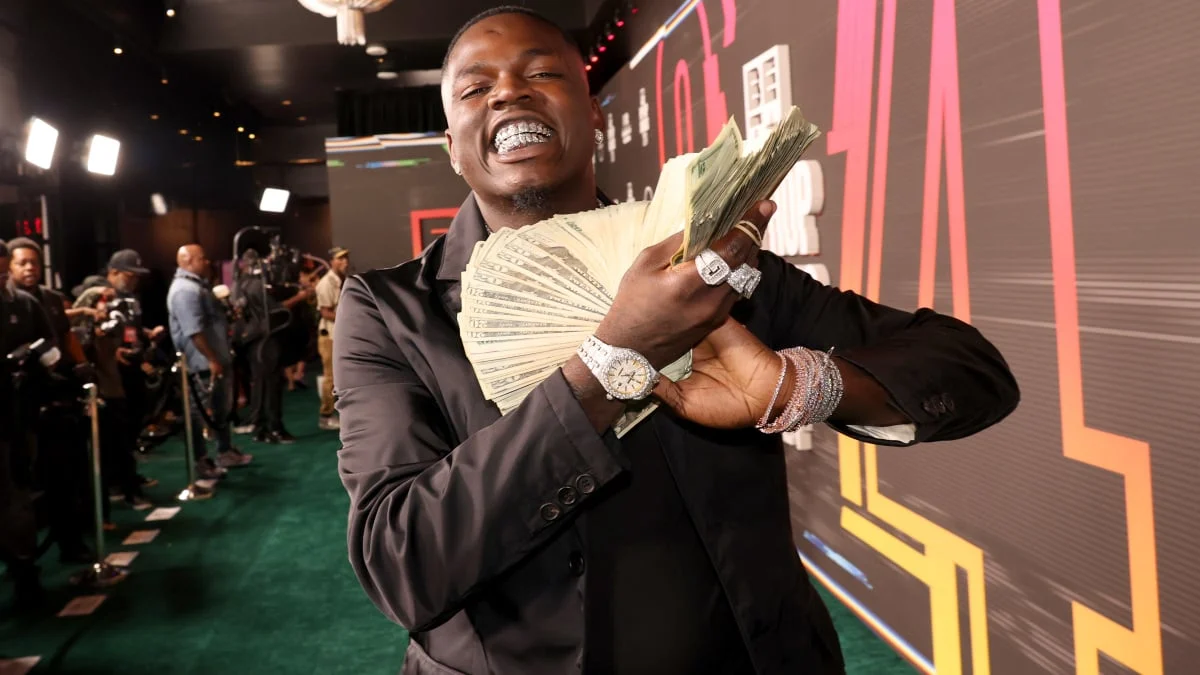
In the hyper-competitive ecosystem of modern hip-hop, the line between "street cred" and creative storytelling has always been porous. Artists frequently curate an aura of mythos, transforming their lived experiences—or sometimes their aspirations—into larger-than-life narratives designed to capture the listener’s imagination. It is a time-honored tradition in rap to embellish one’s history to solidify an image of authenticity. However, there is a distinct difference between artistic exaggeration and the kind of brazen, fact-defying fabrication that creates a digital firestorm.
For the past three years, Memphis rapper Big Boogie has found himself at the center of one of the internet’s most persistent, absurd, and undeniably hilarious viral myths. The saga, which involves a purported $15 million scholarship offer to serve as a collegiate drum major, serves as a masterclass in how modern social media can take a moment of blatant misinformation and turn it into a cross-platform cultural phenomenon.
The Genesis of a Myth: The Bootleg Kev Interview
The incident originated on February 17, 2023, during an appearance by Big Boogie on the Bootleg Kev podcast. Within the first three minutes of the 40-minute conversation, the rapper dropped a claim so specific and so outlandish that it immediately stalled the momentum of the show.
Boogie claimed that prior to his pursuit of a rap career, he had been scouted by a "big college in Jacksonville" to serve as their drum major. In the world of collegiate athletics and performing arts, a drum major is a leadership position—the individual responsible for conducting the marching band and maintaining tempo. It is a role requiring years of discipline, musical expertise, and, usually, a prior tenure within the band itself.
What followed was a masterclass in improvisational lying. Boogie told the host that he had been offered a scholarship worth $15 million to take on this role. When faced with a visible look of skepticism from Bootleg Kev, the rapper immediately pivoted, walking the figure down to $5 million before eventually settling on a vague "somewhere in the millions." To add to the absurdity, Boogie suggested that the offer was for a ten-year commitment—a timeframe that defies the reality of any undergraduate academic program.
The exchange remains a viral staple because of the sheer audacity on display. Bootleg Kev, clearly struggling to maintain his composure, found himself caught in a loop of trying to parse whether Boogie meant "drummer" or "drum major," while simultaneously trying to reconcile the impossibility of the financial figures being tossed around with such casual confidence.
Chronology: From Podcast Anecdote to Meme Status
The lifecycle of this story has been anything but linear. After the 2023 interview, the clip saw moderate circulation on platforms like TikTok and Twitter. However, in late 2024 and throughout 2025, the clip experienced a massive, inexplicable resurgence.
- February 2023: The original Bootleg Kev podcast airs. The clip circulates briefly in hip-hop news circles but is largely dismissed as typical rapper hyperbole.
- Late 2024: The clip is rediscovered by "clip farms"—accounts dedicated to reposting high-engagement content. It begins to trend on Instagram and TikTok, with users mocking the lack of logic in the story.
- 2025: The meme reaches peak saturation. It is no longer just a repost; it is a script. Creators begin using the audio as a backing track for skits, ranging from real estate agents "closing the biggest deal of their lives" to missionaries explaining why they rejected academic accolades.
- Ongoing: Dedicated fan accounts, such as "Big Band in Jacksonville," appear on social media. These accounts adopt the persona of the university’s social media team, doubling down on the lie with faux-official statements, further blurring the lines between irony and misinformation.
Deconstructing the Fiction: A Fact-Checker’s Nightmare
While the story was clearly meant to be a humorous fabrication, the level of scrutiny it has received is a testament to the modern appetite for fact-checking viral content. When subjected to even the most basic investigation, the "Big Boogie Scholarship" narrative collapses entirely.
The Institutional Reality
The largest higher education institution in Jacksonville, Florida State College at Jacksonville (FSCJ), does not possess a marching band. Even if one were to look at other regional institutions, the prospect of a school—even a major Division I university—allocating millions of dollars to a single student for a non-athletic performance role is fundamentally at odds with the economics of higher education.
The NIL Context
To put the $15 million figure into perspective, the highest-paid athletes in the NCAA, who benefit from Name, Image, and Likeness (NIL) deals, rarely exceed $5–$6 million in total valuation for a full season of elite-level play. These figures are tied to massive commercial markets, television contracts, and national branding. A drum major, regardless of their skill, does not generate the revenue required to justify a multi-million-dollar compensation package.
Endowment Realities
In 2019, the marching band program at The Ohio State University—widely considered the gold standard for collegiate band programs—operated on an endowment of approximately $15 million. For a university to offer $5 million to a single student for one position would mean sacrificing a third of an entire, world-class band department’s total long-term endowment.
The Eligibility Trap
Finally, the logistics are impossible. No college program recruits a freshman to be the lead drum major on "day one." At Ohio State, for example, students must navigate a rigorous multi-year pipeline, often serving as an assistant before earning the right to lead the band in their second or third year. The concept of a "ten-year" drum major scholarship is essentially a linguistic fantasy.
Official Responses and the "Correction"
The pressure of the viral spotlight eventually forced a response. In a 2024 follow-up appearance on the Bootleg Kev podcast, Big Boogie attempted to provide a "clarification."
In this follow-up, the narrative shifted. He admitted that the $15 million figure was a fabrication, stating plainly that he "wanted the clip to go viral." He conceded that while he may have been offered a legitimate opportunity to play drums or participate in a musical capacity, the astronomical sums were entirely made up to manufacture a "moment."
Yet, even in his attempt to "clear things up," the irony was palpable. By admitting to the lie, he actually increased the virality of the original clip. The audience was no longer laughing at a confused rapper; they were laughing at a calculated move that had backfired—or perhaps, succeeded beyond his wildest expectations.
The Cultural Implications: Why We Can’t Look Away
Why does this specific lie resonate so deeply? It taps into a shared cultural experience: we have all known that one person in middle school or high school who told outrageous, easily disprovable lies to seem impressive.
Big Boogie’s story represents a collision between the old-school hip-hop desire for myth-building and the new-school digital reality where every word is recorded, archived, and dissected. In the past, a rapper could tell a tall tale in a localized interview, and it would disappear into the ether. Today, the internet serves as a permanent, searchable archive.
Furthermore, the "Big Boogie" meme highlights the shift in how we consume celebrity content. We are no longer just listeners; we are active participants in the "bit." By creating fake university accounts to support the lie, the internet has turned a moment of embarrassment into a collaborative performance art piece.
In the end, Big Boogie’s $15 million scholarship story is a cautionary tale about the limits of credibility in the age of content creation. It serves as a reminder that while the truth might be the baseline for professional journalism, in the wild west of podcasting and social media, the most successful content is often the kind that is, quite literally, unbelievable. The rapper may have lost his claim to a million-dollar scholarship, but in the process, he accidentally bought himself a permanent place in the hall of fame of internet folklore.
 Ali Ikhwan
 Raul Delapena Setiawan
 Azzam Bilal Chamdy
