

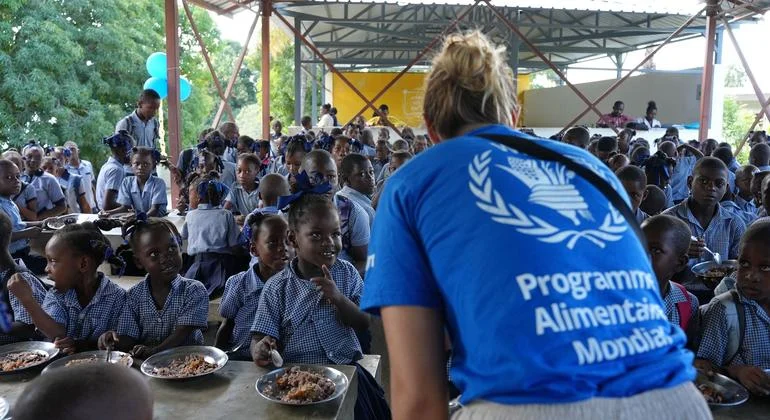
The latest edition of The State of Food Security and Nutrition in the World (SOFI) report, released this Tuesday by five leading United Nations agencies, presents a complex, dual-layered reality: while the global prevalence of hunger is finally trending downward, the structural barriers to food security remain deeply entrenched and unevenly distributed across the planet.
For the first time in recent history, Africa has surpassed Asia as the region harboring the largest absolute number of undernourished people. Despite a slight reduction in global hunger rates, the UN agencies warn that the dream of “Zero Hunger” by 2030—a central pillar of the Sustainable Development Goals (SDGs)—is slipping further out of reach due to a convergence of conflict, climate volatility, and economic instability.
Main Facts: A Global Snapshot of 2025
The 2025 data paints a picture of a world in transition. Roughly 645 million people, or 7.8% of the global population, faced chronic hunger last year. This represents a tangible improvement from 2024, when the rate stood at 8.1%, and a significant decline from the 8.6% recorded in 2022. In absolute terms, there are 14 million fewer hungry people than a year ago and 43 million fewer than in 2022.
However, the definition of food insecurity extends far beyond acute hunger. Broader measures indicate that 2.1 billion people—approximately 25.8% of the world’s population—experienced moderate or severe food insecurity in 2025. These individuals were forced to compromise on the quality or quantity of their nutritional intake, a state of existence that, while improved from the immediate post-pandemic period, remains stubbornly above pre-2020 levels.
Chronology: The Long Road to Recovery
To understand the current state of food security, one must view the data through the lens of recent history. The global food system has been buffeted by a series of cascading crises:
- 2020–2021: The COVID-19 pandemic shattered supply chains, halted school feeding programs, and triggered the first major spike in global food insecurity in decades.
- 2022: The onset of geopolitical conflicts, particularly in Eastern Europe, caused energy and fertilizer prices to soar, driving the global hunger rate to a peak of 8.6%.
- 2023–2024: A period of stabilization began, as supply chains normalized and global commodity prices cooled, allowing for the modest recovery observed in the current figures.
- 2025: A pivot point. While the global rate of hunger declined to 7.8%, the emergence of new regional crises, particularly in the Middle East and the Horn of Africa, began to test the resilience of these gains.
Supporting Data: The Regional Divide
The most striking revelation of the 2025 report is the shift in the epicenter of global hunger. Africa is now the continent with the highest number of hungry people, with 309 million individuals lacking sufficient nutrition, compared to 292 million in Asia.
Regional Prevalence of Food Insecurity
The disparity in access to food is stark when broken down by region:
- Africa: 56.6% of the population faces moderate or severe food insecurity.
- Asia: 20.3% of the population faces moderate or severe food insecurity.
- Latin America and the Caribbean: 22.9% of the population faces moderate or severe food insecurity.
- Northern America and Europe: 8.7% of the population faces moderate or severe food insecurity.
The cost of a healthy, nutritious diet has also risen globally. The average cost reached 4.28 purchasing power parity (PPP) dollars per person per day in 2025, up from 3.44 in 2021 and 2.94 in 2017. While the number of people unable to afford such a diet dropped from 2.97 billion to 2.69 billion over the last four years, the inequality remains profound: in Africa, 66.6% of the population cannot afford a healthy diet, a figure more than double that of Asia or Latin America.
Nutrition and the Paradox of Obesity
The report highlights a disturbing trend: while hunger persists, the quality of diets is failing to improve. Nutrition targets—covering child stunting, wasting, low birthweight, and exclusive breastfeeding—have seen only marginal progress.
Simultaneously, the world is facing an "obesity epidemic." Adult obesity has surged from 12.1% in 2012 to 16.2% in 2024. This coexistence of undernutrition and overnutrition—often referred to as the "double burden of malnutrition"—is compounded by the fact that only 30.8% of children aged 6 to 23 months worldwide consume a minimally diverse diet. With 150 million children under five still suffering from stunting, the long-term human capital cost to developing nations is catastrophic.
Official Responses: Warnings from the UN
The report is a joint effort by the Food and Agriculture Organization (FAO), the International Fund for Agricultural Development (IFAD), the UN Children’s Fund (UNICEF), the World Food Programme (WFP), and the World Health Organization (WHO).
Máximo Torero, the Chief Economist of the FAO, offered a somber assessment regarding the impact of ongoing conflict. He specifically pointed to the instability surrounding the Strait of Hormuz, noting that the resulting spikes in energy and fertilizer costs will inevitably degrade crop yields and drive up food inflation.
“Depending on the duration of the impact of the crisis on food inflation, we simulate that between 510 and 520 million people may still be facing hunger in 2030,” Torero stated. He further cautioned that these projections do not even account for the potential for severe weather events, such as the El Niño patterns forecasted for 2026 and 2027, which could exacerbate current supply constraints.
Implications: A Call for Structural Transformation
The SOFI report concludes that simply lowering food prices at the farm gate is an insufficient strategy. Because "post-farmgate activities"—including processing, logistics, and wholesale—account for 70% to 75% of the final price paid by consumers, systemic reform is mandatory.
The UN agencies are calling for a multi-pronged investment approach:
- Infrastructure and R&D: Increasing investment in irrigation and modern cold chains to reduce post-harvest losses.
- Regulatory Reform: Updating trade facilitation protocols and subsidy structures to ensure that healthy foods are not artificially expensive compared to calorie-dense, nutrient-poor alternatives.
- Localized Investment: Shifting away from a "one-size-fits-all" approach to ensure that regional specificities, particularly in sub-Saharan Africa, are addressed through localized agricultural solutions.
The authors of the report acknowledge that the road to 2030 is steep, noting that the sheer scale of the investment required is immense. However, they maintain that the cost of inaction is far higher.
"A world in which a healthy diet is no longer out of reach for nearly one in three people is a world worth building," the report states. For the 645 million people currently facing the daily reality of hunger, this is not merely a policy goal—it is a matter of survival. As the global community looks toward the end of the decade, the findings of this report serve as both a diagnostic of our current failures and a blueprint for the structural transformation necessary to secure the future of global nutrition.
 Azzam Bilal Chamdy
 Pevita Pearce
 Iffa Jayyana
