

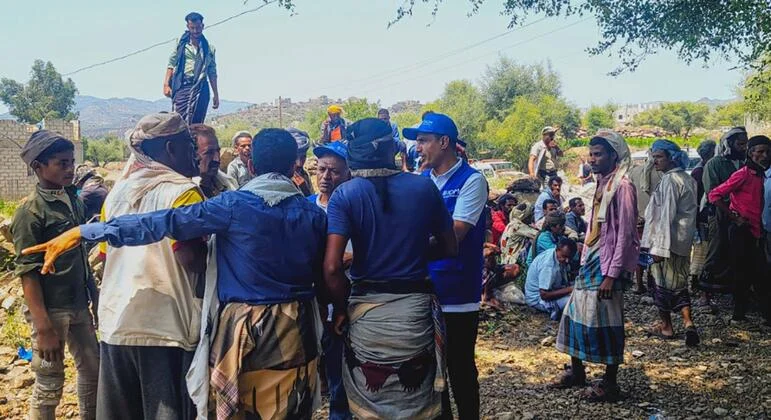
The Crisis at a Glance: An "Alarming" Escalation
A harrowing humanitarian catastrophe is unfolding in southwest Yemen, where the number of displaced persons has surged toward 50,000, a figure that officials warn is "alarmingly rising by the hour." The escalation, centered primarily on the West Coast and the volatile Taiz governorate, marks a devastating turn for a population already exhausted by years of intermittent conflict. As frontlines shift and fighting intensifies, tens of thousands of families are being forced to abandon their homes, often for the second or third time, carrying little more than the clothes on their backs.
The situation has been exacerbated by the recent fall of the strategically vital port city of Mokha to Houthi fighters. As the conflict spills into populated areas, the infrastructure of the region—already fragile—is buckling under the pressure of mass internal migration and the mounting needs of wounded civilians.
A Chronology of Conflict: From Relative Calm to Renewed Warfare
To understand the current urgency, one must look at the rapidly shifting political and military landscape. For several years, Yemen had experienced a period of relative, albeit fragile, stability. However, the equilibrium was shattered in July as the nation was violently dragged back into full-scale war.
This resurgence is intrinsically linked to broader regional instability, specifically the fallout from the US-Israeli offensive against Iran in late February. The regional tensions acted as a catalyst, reigniting the long-standing power struggle between Houthi rebels and the internationally recognized Yemeni government, which is supported by a Saudi Arabia-led coalition.
- Early August: Tensions reached a boiling point as skirmishes erupted across several governorates.
- Mid-August (August 6–24): A surge in military activity resulted in 67 confirmed deaths and 288 injuries across seven governorates, including Marib, Hadramout, Al-Hodeidah, Taiz, Shabwah, Al-Dhale’a, and Lahj.
- Late August: The fall of Mokha triggered a mass exodus. Simultaneously, pro-government forces withdrew from a critical island base in the Bab al-Mandab Strait. Following this retreat, militants issued explicit threats to continue targeting Saudi shipping in these narrow, vital international waterways.
Supporting Data: The Human and Systemic Toll
The scale of the crisis is reflected in the grim statistics provided by the United Nations and its partner agencies. The Office for the Coordination of Humanitarian Affairs (OCHA) reports that since the beginning of the month, at least 14 civilians—including two children—have been confirmed dead or wounded.
The health sector, already decimated by years of neglect and prior conflict, is now at a breaking point. According to the World Health Organization (WHO), only 60 percent of Yemen’s health facilities remain fully operational. The current influx of trauma patients has pushed these surviving institutions to their absolute limit.
- Hospital Strain: Facilities in Marib, Hadramaut, and Taiz are struggling to manage a massive influx of surgical and intensive care patients.
- Resource Reallocation: At the Marib General Hospital, the crisis has forced the temporary suspension of maternity and obstetrics services to repurpose wards for trauma care. The facility has also reported that the number of casualties has exceeded the morgue’s capacity.
- Supply Depletion: Emergency medical and humanitarian stocks were already critically low following recent, severe flood relief efforts, leaving aid agencies with almost no cushion to respond to the new wave of displacement.
Official Responses: Calls for Access and Protection
The International Organization for Migration (IOM) has been at the forefront of the response, struggling to reach those in need as the security environment deteriorates. Amy Pope, the Director General of the IOM, issued a stark warning regarding the plight of the displaced: "Families are being forced to flee for the second or third time since the start of this conflict, with almost nothing left. As fighting spreads, reaching people with lifesaving assistance is becoming harder."
The IOM has issued a formal appeal to all warring parties to:
- Guarantee safe and sustained humanitarian access to all affected governorates.
- Ensure the safety and neutrality of humanitarian workers, their premises, and their equipment across the country.
- Restore critical communication and transport routes, which are essential for the delivery of food, water, and emergency medical supplies.
The organization stresses that the most urgent requirements for the displaced populations include emergency shelter, potable water, food security, household goods, and comprehensive healthcare.
Implications: A Regional Powder Keg
The implications of this renewed fighting extend far beyond the immediate displacement of families in Taiz and the West Coast.
The Disruption of Supply Routes
The cutting off of the road linking Mokha to Taiz is not merely a local logistical issue; it is a strategic disaster. This route serves as a vital supply artery for food and medicine. With the road blocked, the host communities—who were already struggling to survive—are facing an imminent risk of famine and severe shortages of basic necessities.
Regional Instability and Maritime Security
The threats against shipping in the Bab al-Mandab Strait represent a significant escalation in the regional conflict. By targeting this narrow chokepoint, the warring parties have signaled that they are willing to jeopardize global maritime trade and energy supplies to gain leverage in their local struggle. This move has drawn the attention of international powers, raising fears that the conflict could expand into a broader regional confrontation.
The Collapse of Public Services
The current trajectory suggests a complete collapse of public health in the conflict zones. When hospitals are forced to abandon maternal care to treat combat injuries, the long-term demographic impact—including rising maternal and infant mortality rates—will be felt for generations. The "reallocation of resources" is a euphemism for the systemic failure of the state to provide even the most basic protections to its citizens.
Looking Ahead: An Uncertain Future
As the Houthis consolidate their control over the Red Sea port cities and the Saudi-led coalition recalibrates its military posture, the outlook for civilians remains grim. The movement of people north toward Ibb and into Lahj and Aden indicates that the displacement crisis is likely to widen rather than stabilize.
The international community now faces a critical juncture. Without a cessation of hostilities or at least a robust commitment to humanitarian corridors, the current "alarmingly rising" displacement numbers will likely evolve into a full-blown famine and health catastrophe.
For the people of Yemen, the cycle of violence is not just a political disagreement; it is a daily, visceral struggle for survival. As the fighting reaches closer to populated centers and the remaining health infrastructure gasps for air, the world is witnessing the rapid erosion of what little remained of Yemen’s resilience. The plea from aid agencies is clear: humanitarian access must be decoupled from the military objectives of the warring parties. If not, the current toll of 50,000 displaced individuals will be merely the prelude to a much larger and more profound human tragedy.
 Nana Muazin
 Azzam Bilal Chamdy
 Layla Zulfa
