

By Dominika Tomaszewska-Mortimer
Geneva, 29 September 2026
The Democratic Republic of the Congo (DRC) is currently grappling with the most severe Ebola outbreak in its history, a public health crisis that has now surpassed a harrowing threshold. According to the latest data released by Congolese authorities and the World Health Organization (WHO), the number of confirmed cases of the Bundibugyo virus has eclipsed 8,000. As the international community mobilizes to contain the spread, the WHO has issued a stark warning: the fight against this epidemic is not merely a battle of vaccines and containment, but a race against time for those already infected.
The core of the current crisis, according to WHO officials, is a persistent gap between the onset of symptoms and the receipt of clinical care. For patients suffering from this virulent hemorrhagic fever, every hour of delay significantly diminishes the probability of recovery.
The Scale of the Crisis: Main Facts and Current Situation
The figures emanating from the DRC are as sobering as they are urgent. Since the outbreak was formally declared in May, it has spread across 63 health zones within seven of the country’s 26 provinces. With 8,067 confirmed cases and 3,901 deaths, the case fatality rate—currently hovering at approximately 48%—serves as a grim reminder of the lethality of the Bundibugyo strain.
Dr. Janet Diaz, a leading voice within the WHO’s Health Emergencies Programme, addressed the press in Geneva this week, providing a sobering assessment of the situation on the ground. While she noted a tentative reduction in transmission rates in certain localized areas, she emphasized that the overall trajectory remains deeply concerning. "The number of cases remains high for this outbreak," Dr. Diaz stated. "We are dealing with a dynamic and challenging environment where the virus continues to exploit gaps in our public health infrastructure."
The geography of the outbreak adds a layer of complexity to the response. The virus has taken root in both densely populated urban centers and remote, hard-to-reach rural areas, forcing health workers to navigate logistical nightmares to deliver care.
A Chronology of the 2026 Outbreak
Understanding the progression of this crisis requires a look back at the timeline of events that have defined the last few months:
- May 2026: The Ebola outbreak, identified as the Bundibugyo strain, is officially declared in the DRC. Initial containment strategies are established.
- June–July 2026: The virus gains momentum, spreading across multiple provinces. WHO initiates large-scale international support, focusing on contact tracing and the establishment of basic treatment units.
- August 2026: The death toll begins to rise sharply. WHO begins a massive surge in clinical capacity, moving from rudimentary isolation units to formalized treatment centers.
- Mid-September 2026: Confirmed cases cross the 8,000 mark. A major training hub is launched in Bunia, the capital of Ituri province, to bolster the local health workforce.
- Late September 2026: WHO announces the allocation of 20,000 doses of the Ervebo vaccine for a targeted research program, marking a shift toward innovative, experimental interventions.
The Clinical Imperative: Oxygen as a Life-Saving Medicine
One of the most significant revelations from Dr. Diaz’s recent field visit to the epicentre in Bunia is the critical role of supportive care—specifically, the availability of oxygen. While vaccines and antiviral research often dominate the headlines, the day-to-day survival of patients is frequently decided by basic medical necessities.
"Early access to care can significantly improve chances of survival," Dr. Diaz explained. "Yet, in this outbreak, many people are still dying at home or in their communities because they are unable to reach health facilities on time."
The provision of oxygen is not as straightforward as it sounds in an emergency setting. In many of the affected provinces, oxygen is either unavailable or the supply chain is dangerously unreliable. Dr. Diaz highlighted that oxygen delivery is "about much more than cylinders or equipment." It necessitates:
- Robust Infrastructure: Ensuring power and storage facilities are functional in volatile regions.
- Skilled Human Resources: Training health workers not just to administer oxygen, but to monitor patients and manage complications in real-time.
- Sustainable Logistics: Establishing supply chains that can withstand the geographic and political challenges of the DRC’s interior.
Without these foundational elements, even the most modern equipment becomes useless. The WHO has credited previous, smaller-scale oxygen interventions in past Ebola and Marburg outbreaks as the reason current survival rates aren’t even lower.
Expanding the Frontline: Capacity and Training
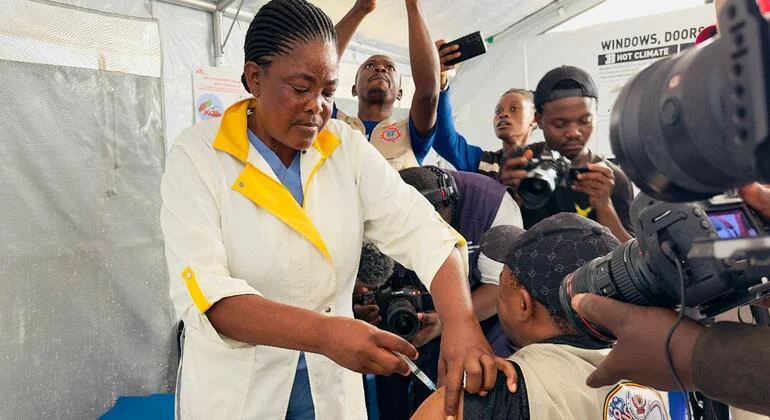
To combat the surge, the WHO and its humanitarian partners have embarked on a massive scaling effort. At the start of the outbreak, the DRC possessed only a handful of specialized beds for Ebola patients. Today, that capacity has been expanded to over 1,600 beds distributed across 50 treatment centers in the seven affected provinces. Plans are already in motion to expand this to 2,000 beds.
However, Dr. Diaz cautioned against viewing capacity solely through the lens of bed numbers. "Every patient bed requires a skilled workforce to provide safe, quality care around the clock," she stressed. The establishment of the training hub in Bunia represents a strategic pivot: investing in local human capital to ensure the sustainability of the response. Nearly 400 health workers have already undergone rigorous training in infection prevention, control, and supportive care protocols.
Scientific Innovation: The Vaccine Frontier
The current outbreak is caused by the Bundibugyo virus, for which there is currently no globally approved vaccine. This lack of a silver bullet has forced researchers to look toward existing tools that have proven effective against other strains, such as the Ebola Zaire virus.
In a move intended to provide a pathway toward immunization, the WHO announced that 20,000 doses of the Ervebo vaccine have been earmarked for the Ituri province. This is not a mass-vaccination campaign in the traditional sense, but rather a research vaccination program designed to gather data on the efficacy of Ervebo against the Bundibugyo strain. It represents a glimmer of hope, though officials remain cautious, reminding the public that vaccines are only one component of a holistic public health strategy.
Implications: The Path Forward
The situation in the DRC serves as a sobering case study for global health security. The implications of this outbreak are threefold:
- The Fragility of Health Systems: The crisis highlights that infectious disease outbreaks do not occur in a vacuum. They are exacerbated by weak health infrastructure, which makes basic, life-saving interventions like oxygen delivery a logistical challenge.
- The Necessity of Community Trust: The fact that many patients are dying at home suggests that barriers to care—be they fear, lack of transport, or distrust of formal health systems—remain prevalent. The response must continue to focus on community engagement to encourage early reporting.
- The Need for Long-term Investment: The current reliance on emergency hubs and rapid training illustrates a need for permanent, resilient health systems that can absorb shocks without needing to reinvent the wheel every time a new outbreak occurs.
As the WHO and the Congolese government continue their work, the primary objective remains clear: to shorten the interval between the onset of the first symptoms and the moment a patient receives professional, oxygen-supported care. As Dr. Diaz noted, the survival of the patient often rests on that precise, critical window.
The international community is urged to maintain its focus and funding, as the DRC’s battle against Ebola is far from over. The path to defeating this virus requires not only the latest scientific advancements but a steadfast commitment to the basic, human-centric delivery of care.
For daily updates on the situation in the DRC, residents and international stakeholders are encouraged to subscribe to the WHO and UN News newsletters, or download the UN News app for real-time alerts.
 Lina Hope
 Asro
Asro
 Layla Zulfa
