

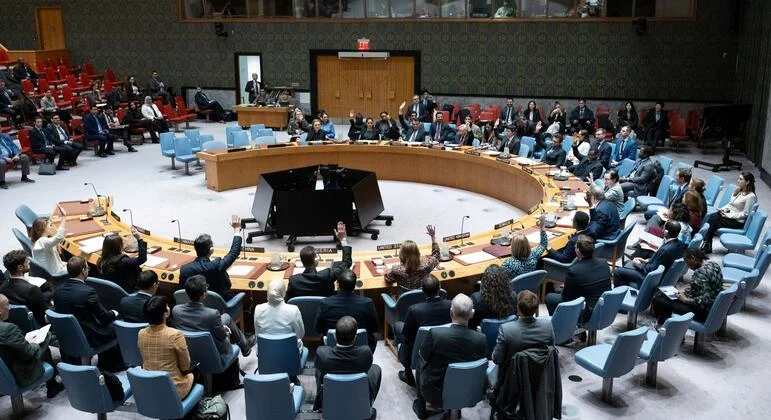
UNITED NATIONS, New York — Twenty-five years to the day after the catastrophic attacks of September 11, 2001, reshaped the global geopolitical landscape, the United Nations Security Council convened a high-stakes session to reassess the international counter-terrorism architecture. While the solemnity of the anniversary anchored the proceedings, the tone of the chamber was defined by a stark, forward-looking urgency.
Ambassadors from the 15-member Council met not merely to reflect on the legacy of the post-9/11 era, but to confront a reality that has evolved far beyond the traditional insurgency models of the early 21st century. The session centered on the dual threats of weaponized artificial intelligence (AI) and the proliferation of unmanned aerial systems (drones), which are rapidly replacing traditional logistics in the arsenals of non-state actors.
The Changing Face of Global Terrorism
Since the adoption of the landmark Security Council Resolution 1373 in 2001—which established the Counter-Terrorism Committee (CTC) and mandated that all member states criminalize the financing of terrorism—the "machinery" of global security has been in a constant race to keep pace with technological advancement.
In the immediate aftermath of 9/11, the primary focus was on state-sponsored or state-harbored networks, financial tracing, and border control. Today, however, the threat has become decentralized, digitized, and increasingly automated. Briefers before the Council highlighted that the "democratization of destruction"—the ease with which militant groups can now access sophisticated technology—has created a volatile environment that current international frameworks struggle to contain.
The meeting culminated in the adoption of a formal presidential statement—the Council’s first dedicated solely to the topic of terrorism in half a decade. The document, which followed days of rigorous and reportedly tense negotiations, underscores a shift in focus toward "technological resilience," urging member states to collaborate on curbing the misuse of dual-use technologies.
Chronology: A Quarter-Century of Evolution
To understand the current impasse, one must look at the trajectory of the post-9/11 era:
- September 2001: The World Trade Center and Pentagon attacks occur. Resolution 1373 is passed within weeks, forcing states to overhaul their domestic legal codes regarding terrorist financing.
- 2004–2010: The focus remains on the "Global War on Terror," with emphasis on kinetic military operations and the stabilization of post-conflict zones.
- 2014–2016: The rise of ISIS introduces the "digital caliphate," utilizing encrypted platforms for mass recruitment and global propaganda, exposing the limitations of traditional intelligence gathering.
- 2020–2024: The pandemic era accelerates the shift toward decentralized operations. Militant groups begin experimenting with off-the-shelf drone technology and localized cyber-attacks on infrastructure.
- 2026 (Today): The 25th anniversary marks a pivot point. The Security Council recognizes that AI-driven disinformation and autonomous drone swarms have fundamentally altered the concept of a "secure border."
Supporting Data: The Tech Threat Matrix
Expert analysis presented to the Council painted a sobering picture of the "tech-terror" nexus.
The Rise of Autonomous Systems
According to UN counter-terrorism research, the cost of entry for sophisticated aerial weaponry has plummeted. Where once state-level actors held a monopoly on drone technology, militant groups are now utilizing "swarming" tactics—using low-cost, commercially available drones to overwhelm defensive grids. The Council heard testimony that these devices are increasingly being equipped with rudimentary machine-learning algorithms that allow them to bypass electronic jamming measures.
AI and Radicalization
The briefing also shed light on the role of Generative AI in recruitment. Extremist groups are no longer relying solely on human recruiters. Instead, they are deploying sophisticated AI "bots" capable of hyper-personalized interaction, identifying vulnerable individuals online and tailoring extremist messaging to their psychological profiles in real-time. This has created a "bespoke radicalization" cycle that is significantly harder for state authorities to disrupt than the broadcast-style propaganda of the early 2010s.
Encryption and Financial Anonymity
While resolution 1373 aimed to track bank transfers, the advent of decentralized finance (DeFi) and privacy-focused cryptocurrencies has created a "shadow economy" for terror financing. The Council was warned that despite global pressure, the ability to trace funds has hit a wall, as militants move assets through fragmented digital exchanges that operate outside traditional regulatory oversight.
Official Responses and Diplomatic Friction
The adoption of the presidential statement was not a foregone conclusion. Behind closed doors, the Council experienced significant friction regarding the language used to describe these emerging threats.
Western powers pushed for explicit language naming specific technology hubs and calling for strict international standards on the export of dual-use AI hardware. Conversely, several other member states expressed concerns that such language could lead to a "digital blockade," where developing nations are denied access to legitimate AI advancements under the guise of counter-terrorism.
"We must not allow the specter of terrorism to be used as a pretext for a new, restrictive digital iron curtain," one delegate remarked during the closed session.
However, the consensus ultimately held. The resulting statement emphasizes the need for a "Global Tech-Safety Protocol," encouraging private sector tech giants to integrate "human-in-the-loop" safeguards into their AI models. It represents a rare moment of unity, acknowledging that in the age of AI, the private sector has become an indispensable—and often reluctant—partner in global security.
Implications for Global Security
The implications of this 25th-anniversary meeting are profound and ripple across several domains of international policy.
1. The Redefinition of "Border Security"
Traditional security relied on physical barriers and the control of entry points. In an era where a drone can be programmed remotely and a radicalized individual can be recruited via an encrypted app while sitting in their own home, the "border" has become a fluid, digital construct. The Security Council’s focus suggests a move toward "intelligence-led defense," where the emphasis shifts from physical borders to monitoring digital metadata and supply chains for dual-use components.
2. The Private-Public Partnership
The UN is increasingly signaling that it cannot manage the threat of tech-enabled terrorism alone. The push for a partnership with tech corporations implies that the "rules of the road" for AI development may soon be dictated by security concerns as much as by commercial competition. This could lead to a global regulatory landscape where software companies are held liable for the "weaponizability" of their platforms.
3. A New Legal Framework
With resolution 1373 aging, there is a quiet but growing consensus that the UN needs a "1373 for the Digital Age." The legal definitions of "material support" and "financing" are currently being stress-tested by decentralized technologies. The Council’s meeting suggests that a new, more comprehensive resolution may be drafted in the coming years, specifically targeting the intersection of AI, autonomous systems, and non-state actors.
Conclusion: Looking Toward the Future
As the Security Council members emerged from the chamber, the atmosphere remained one of cautious resolve. The 25-year mark is a milestone of survival, but the challenges of the next quarter-century appear significantly more complex than those of the last.
The battle against terrorism has transitioned from the physical battlefield to the digital one. The challenge for the United Nations, and for the international community at large, will be to maintain the balance between fostering technological innovation—which drives economic and social progress—and preventing the tools of that progress from being turned into weapons of terror.
As the UN News service continues to track these developments, the world watches to see if the Council’s latest commitment can move beyond diplomatic rhetoric and into concrete, actionable global policy. The machinery of 2001 served its purpose for a generation; the question now is whether the machinery of 2026 is capable of securing the next.
 Nana Muazin
 Azzam Bilal Chamdy
 Layla Zulfa
