

Main Facts: A Dangerous Escalation at the Exclusion Zone
The safety of millions hangs in the balance as the shadow of war reaches into the heart of the Chornobyl Exclusion Zone. Achim Steiner, head of the United Nations Development Programme (UNDP), issued a harrowing warning during his recent visit to Ukraine, characterizing recent drone strikes on the protective structures of the Chornobyl Nuclear Power Plant (ChNPP) as a reckless gamble with international nuclear safety.
The visit, which focused on the critical state of Ukraine’s energy infrastructure ahead of a grueling fifth winter of full-scale conflict, brought the UNDP chief face-to-face with the structural damage inflicted upon the containment shell of Reactor Four—the site of the 1986 disaster. The incident marks a dangerous departure in the tactical conduct of the war, where critical nuclear installations, previously viewed as "red lines," are now being exposed to the volatility of drone warfare.
Chronology of the Crisis: From 1986 to Modern Conflict
The history of the Chornobyl site is one of perpetual vigilance. Since the 1986 meltdown, the international community has invested billions into the New Safe Confinement (NSC) structure, an engineering marvel designed to prevent radioactive leakage for the next century.
- 1986–2022: The site functioned under strict international monitoring, serving as a symbol of global cooperation in nuclear safety.
- February 2022: The site was briefly occupied by Russian forces at the onset of the full-scale invasion, causing global panic regarding the potential for radiological accidents.
- 2023–2024: As the conflict shifted toward systematic strikes on Ukraine’s energy grid, the airspace over the Exclusion Zone became increasingly contested.
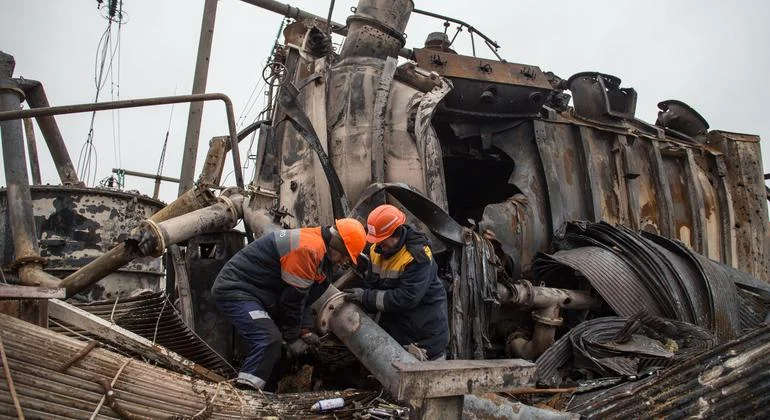
- Recent Weeks: Reports from military personnel stationed at the site indicate that drones are now traversing the airspace above the facility on a daily basis. The UNDP chief’s visit confirmed that these incursions have resulted in physical strikes on protective infrastructure, transforming a site of historical tragedy into a frontline of active military engagement.
Supporting Data: The Scale of Destruction and Resilience
The UNDP’s intervention in Ukraine has evolved into its most ambitious energy project in history. With $1.3 billion mobilized over the past four years, the agency has become the backbone of Ukraine’s efforts to maintain essential services.
Key Statistical Indicators:
- Humanitarian Impact: UNDP-backed energy projects have successfully restored power to 6.6 million Ukrainians.
- Economic Toll: Estimates from the World Bank and various UN bodies place the cost of war-related reconstruction at over $600 billion, a figure that grows daily as infrastructure is targeted.
- Grid Vulnerability: Approximately 50% of Ukraine’s energy generation and distribution capacity has been damaged or destroyed by Russian missile and drone barrages.
- Decentralization: The shift toward decentralized solar and modular power systems is now a strategic necessity rather than a green initiative, aimed at preventing a "single-strike" total collapse of the national grid.
Official Responses and the Quest for Accountability
The UNDP chief’s remarks were unequivocal: "A nuclear installation can never be a target. There can absolutely be no excuse. There can absolutely be no ambiguity."
Addressing the ambiguity surrounding the origin and intent of the drone strikes, the UNDP leadership has called for a formal, transparent investigation. While military observers at the site suggest a pattern of daily surveillance and harassment, the distinction between a deliberate attack and a technical accident is, according to the UN, irrelevant when the consequences involve nuclear containment. "Whether it was a deliberate attack or an accident, this is something which is unacceptable," the chief noted.
In a proactive move to mitigate these risks, the UNDP, in partnership with Lithuania and Japan, inaugurated a new solar power plant within the Exclusion Zone during the visit. This facility is specifically designed to provide redundant power to the cooling systems of Reactor Four, ensuring that even if the main grid is severed by shelling, the most dangerous parts of the site remain stabilized.
Implications: The New Frontline of the War
The reality of life in Ukraine has shifted, and the "frontline" is no longer a geographical line in the Donbas. It is a pervasive, omnipresent threat. During the UNDP delegation’s time in Kyiv, air raid sirens wailed incessantly, marking a rhythm of life defined by the threat of aerial strikes on civilian infrastructure—bus stops, food-processing plants, and residential centers.
The Fragility of Resilience
"We always talk about resilience, but resilience really has its limits," the UNDP chief remarked. This statement highlights the growing concern that the international community has become dangerously accustomed to Ukrainian endurance. While the country continues to function, the psychological and physical strain of five winters under constant bombardment is reaching a breaking point.
The "Build Back Better" Dilemma
The UNDP’s strategy is not to return to the pre-war status quo, which relied on a centralized, vulnerable Soviet-era power grid. Instead, the focus is on building a modern, modular, and sustainable system. This strategy is intrinsically linked to Ukraine’s future integration with European standards. However, the paradox remains: how to build for the future when the present is being systematically dismantled?
Strategic Nuclear Security
The intrusion of drones into the Exclusion Zone has profound implications for global security. If nuclear sites are treated as legitimate or collateral areas of operation, it sets a precedent that could be mirrored in other conflicts worldwide. The international community is now forced to reconcile the necessity of reconstruction with the reality of an adversary that appears to show no regard for the radiological sanctity of the Chernobyl site.
Conclusion: A Call for Global Intervention
As winter approaches, the UNDP is warning of a "bad situation becoming worse." The organization’s efforts to keep 6.6 million people powered are commendable but, by the admission of its own leadership, "never enough."
The situation at Chornobyl serves as a microcosm of the wider conflict: a battle between the creative efforts of a nation trying to sustain its people and the destructive forces aiming to erase its future. The international community faces a choice: to continue providing piecemeal support for emergency repairs, or to recognize that the safety of the world’s nuclear infrastructure is currently in a state of high-stakes gambling.
As the UNDP continues its work, the message from the site of the world’s worst nuclear disaster is clear: the safety of millions is not a variable that can be ignored in the pursuit of military objectives. The world must demand that the airspace over such facilities be rendered inviolable, lest we face a catastrophe that no amount of international aid can mitigate. The frontline is no longer just in the trenches; it is in the air above our most dangerous nuclear legacy, and it demands the immediate attention of the global community.
 Nana Muazin
 Azzam Bilal Chamdy
 Layla Zulfa
