For nearly a decade, A View From the Easel has offered art enthusiasts an intimate, behind-the-scenes look at the physical spaces where contemporary creators bring their visions to life. From cramped urban corners to sprawling rural barns, these profiles map out the ecosystems of artistic production. In this 354th installment of the series, the spotlight turns to Columbia, Missouri, where printmaker and photographer Oswaldo García anchors his multifaceted practice.
First crossing paths with García at Pioneer Works’s bustling Press Play fair in Brooklyn in 2024, the cadence of his workspace is one defined by motion: the rhythmic churning of a risograph machine, the mechanical precision of book-binding, and the infectious energy of cumbias echoing off concrete floors. García’s studio is not merely a room where objects are made; it is an active, breathing organism shaped by migration, academic rigor, and a deep-seated love for community.
Main Facts: The Workspace and the Artist
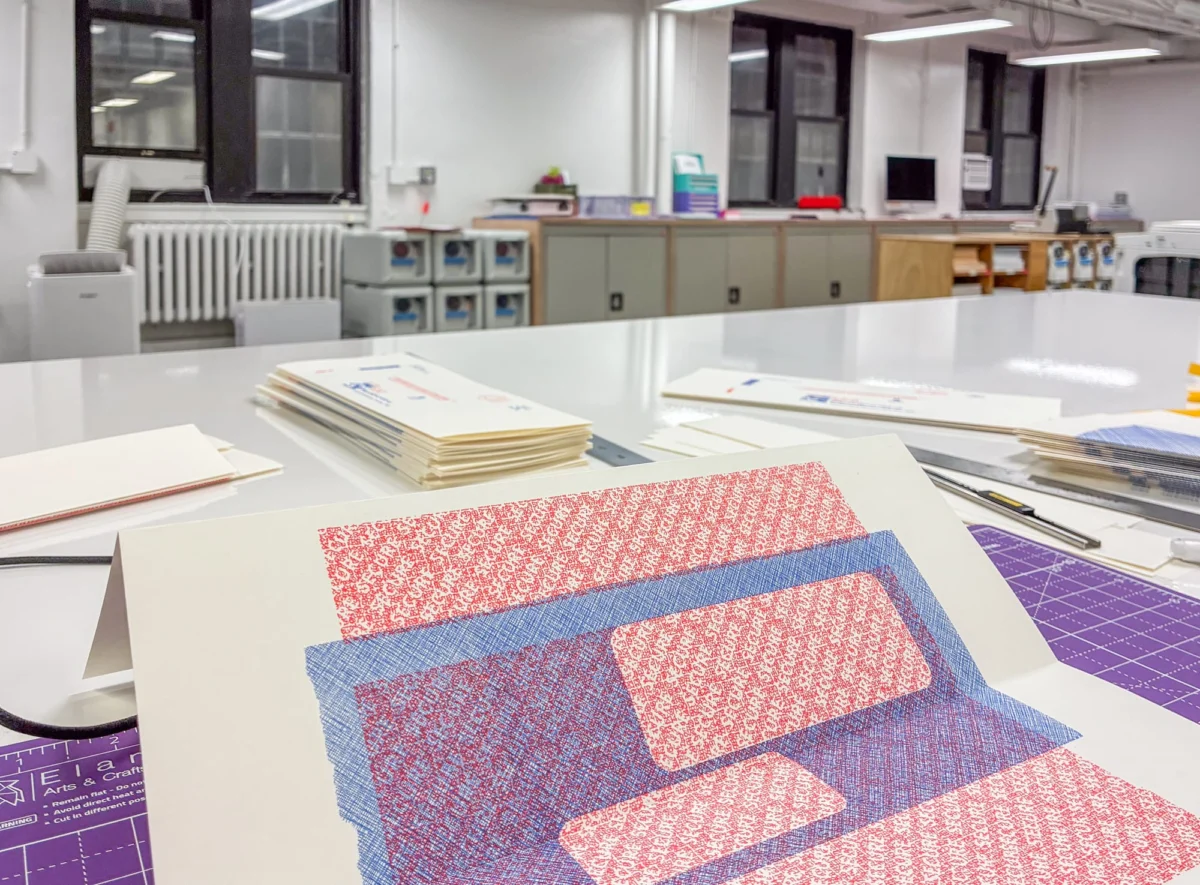
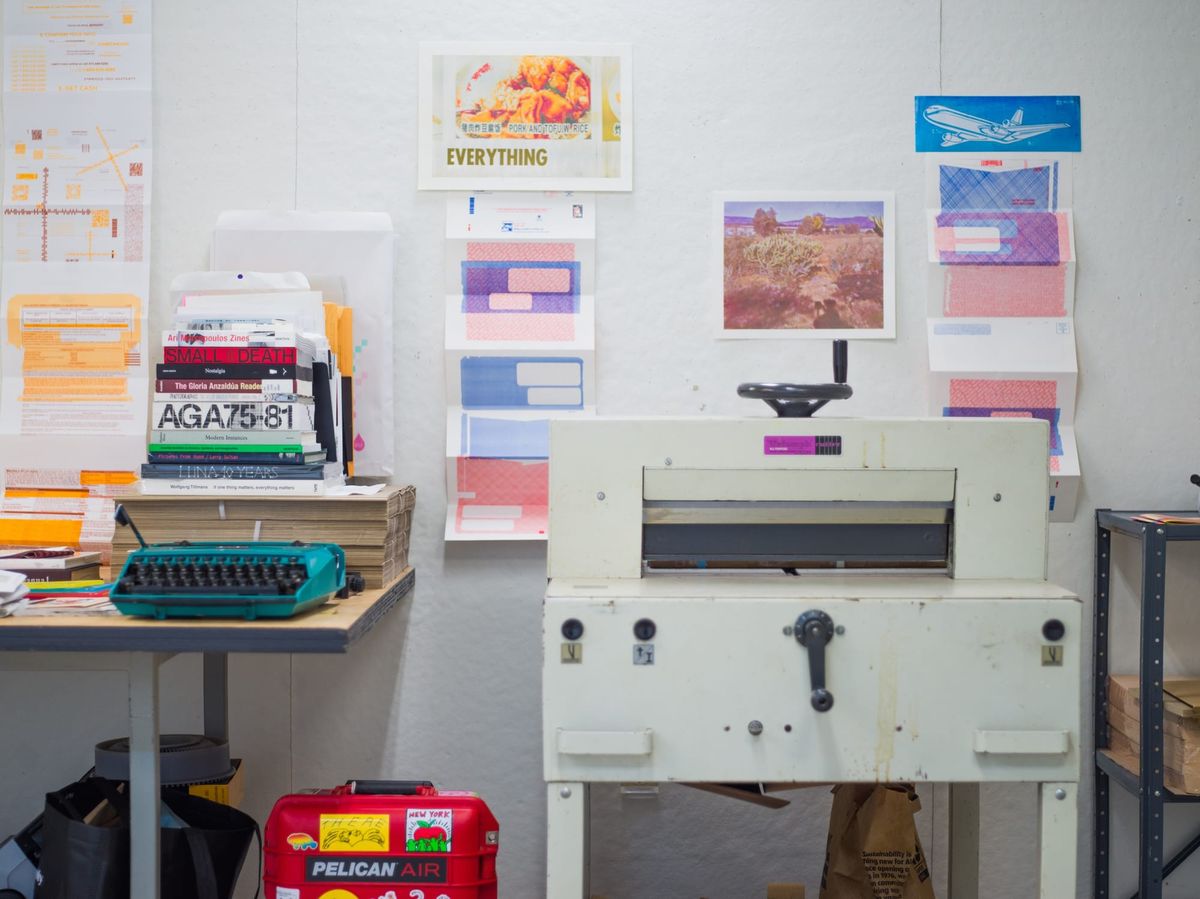
Oswaldo García operates primarily out of the Graduate Studios building at the University of Missouri-Columbia, a space he has inhabited for the past two years after relocating from Mexico to pursue a Master of Fine Arts (MFA). However, defining García’s workspace by a single room would be entirely inaccurate. His artistic footprint extends across multiple specialized zones on campus, reflecting the interdisciplinary nature of contemporary print media. Depending on the phase of production, his daily workflow moves fluidly between his personal grad studio, the campus photolab, and "The Riso Room" (also known locally as Public House), where digital duplication meets tactile fine art printing.
Artist: Oswaldo García
Base Location: Columbia, Missouri (University of Missouri-Columbia)
Primary Mediums: Printmaking, Photography, Book Arts, Risography
Current Academic Status: MFA Candidate (Entered c. 2024, following relocation from Mexico)
Key Influences: Cross-disciplinary studio environments (specifically fiber arts and ceramics), Latin American musical traditions (cumbias, reggaetón, regional Mexican music), and DIY publishing culture.
The physical layout of García’s studio environment underwent a recent transition when he moved from his initial campus workspace to a new, larger room within the same building. While the previous space boasted abundant natural light, the new iteration sacrifices some of that brightness for increased square footage and specialized utility—a trade-off García welcomes, noting that the diffused light is ideal for digital scanning and precise photo-editing tasks.
Chronology: From Mexico to the Midwest
García’s trajectory into the University of Missouri-Columbia’s graduate ecosystem represents a deliberate geographical and professional pivot.
Phase 1: Foundations and Relocation (Pre-2024)
Working initially out of Mexico, García developed a sophisticated visual vocabulary rooted in photography and print. His early investigations laid the groundwork for a multidisciplinary approach that marries traditional darkroom techniques with contemporary zine culture and editioned publishing. The decision to pursue an MFA brought about a major life transition, requiring him to pack up his practice and re-establish his workflow in the heart of Missouri.
Phase 2: Entering the Academic Ecosystem (2024)
Upon arriving in Columbia, García immediately immersed himself in the university’s rigorous graduate program while simultaneously engaging with the broader independent publishing community. A notable milestone during this period was his appearance at Pioneer Works’s Press Play fair in Brooklyn in 2024, an event that highlighted his engagement with independent artist books and alternative distribution networks.
Phase 3: The Expanding Studio Practice (Present Day)
Today, García balances a demanding schedule of teaching undergraduate courses, attending graduate seminars, and producing rigorous bodies of printed matter. His time is partitioned between administrative and pedagogical duties in the mornings and deep, multi-project studio sessions stretching far into the night—particularly when deadlines for regional and national book fairs loom large.
Supporting Data: The Anatomy of a Multitasking Studio
To understand how García produces his intricate editions, one must examine the operational logistics of his daily routine. Unlike artists who focus on a single piece from conception to completion in a linear fashion, García relies on a parallel-processing model.
Sound plays a pivotal operational role in García’s studio methodology. His workflow is sonically stratified:
The Active Phase: When undertaking repetitive, manual tasks—such as the "infinite folding and binding" required for artist books and zines—García fills the room with high-energy Latin rhythms. Cumbias, reggaetón, and regional Mexican pop provide a rhythmic pacemaker for hours of hand-work, turning labor into a dance.
The Contemplative Phase: Conversely, when shifting into the conceptual phase—drafting, researching, or solving compositional dilemmas—he relies on total sensory focus, utilizing headphones to block out external stimuli and embrace silence.
Spatial Dynamics and Cross-Pollination
The physical architecture of the Graduate Studios building fosters an atmosphere of accidental collaboration. Surrounded by peers working in vastly different disciplines, García finds himself regularly influenced by the material explorations of neighboring artists. Exposure to the tactile processes of the ceramics and fiber arts departments has directly bled into his own print practice, encouraging him to experiment with spatial installations, sculptural book forms, and mixed-media assemblages that push beyond the traditional flat plane of the wall or the page.
Official Responses and Reflections: In the Artist’s Words
Reflecting on the realities of his workspace, García highlights both the liberating and restrictive aspects of an institutional studio.
When asked about what makes the space successful, García emphasizes its malleability:
"I love that it’s like a blank canvas or paper that I can use to play and try assembling books, prints, projections, installations. And it is my safe space too, where I can always go and just be there with the work, materials, archive, books."
The transition to a larger footprint has also fundamentally altered how he evaluates his output. The added square footage allows him to step back and let projects "breathe," fostering a more experimental approach to arrangement and composition. Rather than working on a single isolated print, he can lay out multiple proofs simultaneously, cross-pollinating ideas across different bodies of work.
Yet, no workspace is entirely without its limitations. When prompted about what he would change given unlimited resources, García’s answer reveals the boundless ambition characteristic of ambitious printmakers:
"I would love to have taller walls. I think I would go crazy doing bigger things! But I like how it is."
Implications: The Vital Role of Communal Art Spaces
García’s experience inside the University of Missouri-Columbia’s graduate facilities sheds light on a broader conversation within contemporary art education: the necessity of shared, porous studio environments.
In an era where many artists are forced into isolated home studios due to skyrocketing real estate costs, institutional and communal spaces like those utilized by García serve as crucibles for cross-disciplinary innovation. By working alongside ceramicists, fiber artists, photographers, and fellow printmakers under one roof, creators are naturally nudged out of disciplinary echo chambers.
Furthermore, García’s practice underscores the enduring resilience of physical craft in a digital age. Whether he is operating a risograph machine—a technology originally designed for corporate duplication that has found new life in the hands of independent artists—or meticulously hand-binding accordion books to the beat of a cumbia, his work bridges the gap between historical print traditions and contemporary migrant narratives.
As García continues his MFA journey in Columbia, his studio remains a testament to the power of environment. It is a space defined not just by the tools it houses—the presses, the paper, the light tables—but by the kinetic energy of its occupant, transforming raw materials into tactile, resonant cultural artifacts.




 Nana
Nana
 Iffa Jayyana
 Muslim
