

By Channelle Chevelle Russell
Art Review / Special to Hyperallergic
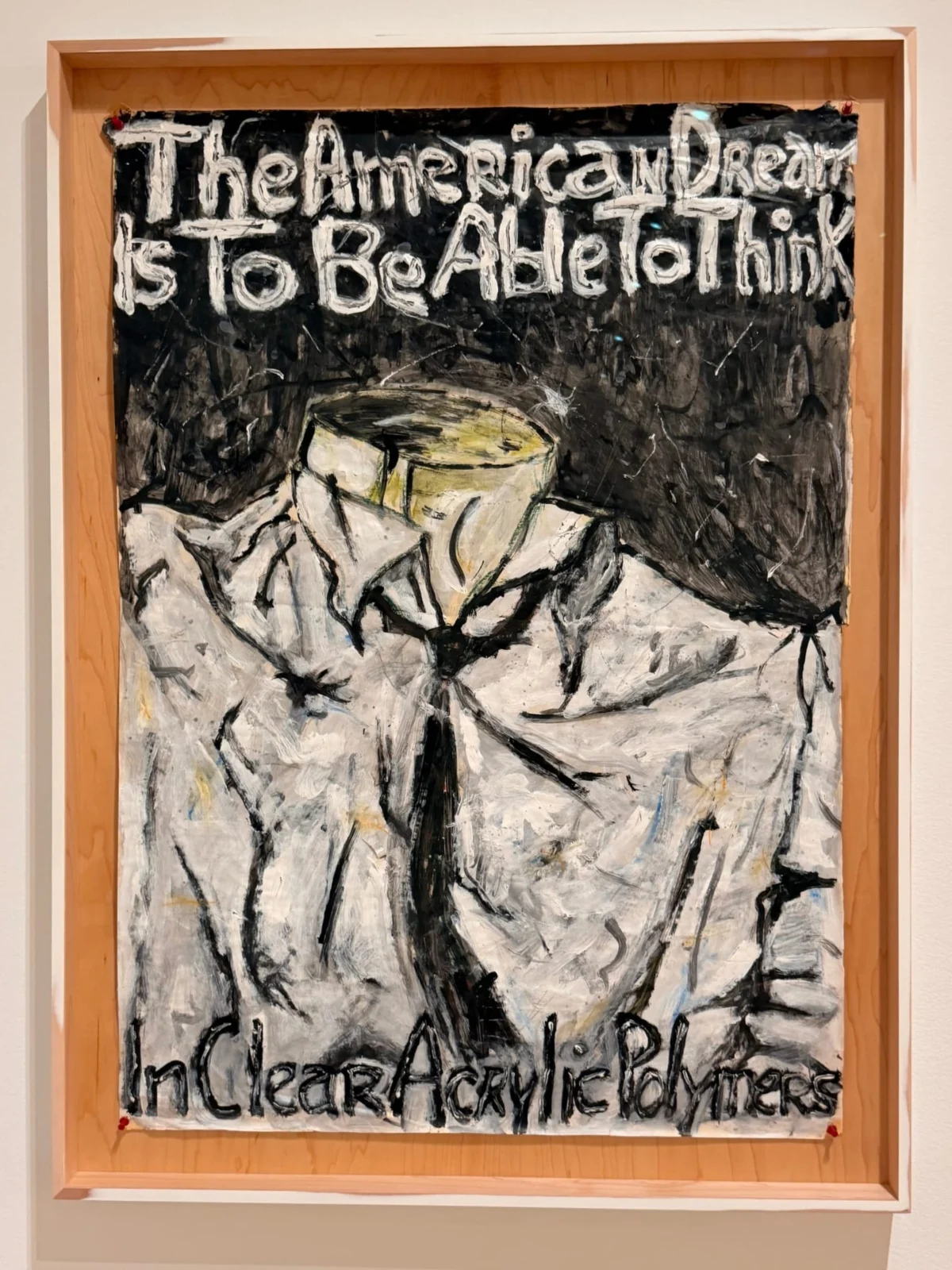
A headless man stares out with no eyes, an absurd study in portraiture both aesthetically and thematically coincident with Ralph Ellison’s seminal 1952 novel Invisible Man. Rendered in a restless cross-contamination of acrylic, oil pastel, marker, pencil, and tape, the late interdisciplinary artist Pope.L’s pivotal painting, “Portrait a.k.a The American Dream Is to Be Able to Think” (1989–90), demands a reckoning. It beckons closer attention to the fraught materiality of race that inaugurated and continues to usher this nation along its tumultuous historical arc.
Unadorned, bereft of a neck for fortitude, lacking a face one might identify, and missing eyes through which to witness the world, this figure—existing as just one powerful anchor in the Drawing Center’s sprawling posthumous exhibition, Certainly an Act: Works on Paper by Pope.L—appears to us already excluded from the very promise of the Dream.
Through stark assemblages of black and white—a crisp white dress shirt paired with a skinny black tie, stark white words set against a grainy black background, an undifferentiated Blackness set against and within an undifferentiated America—Pope.L’s probing of the foundational racial contradictions that birthed the American Dream unspools with even finer, sharper provocations. If the American Dream is indeed the ability to think, then Pope.L’s body of work suggests that entirely newer, more radical approaches to thought are urgently needed.
Main Facts: Certainly an Act at The Drawing Center
The Drawing Center in New York’s SoHo neighborhood has launched one of its most ambitious posthumous surveys of the visionary interdisciplinary artist Pope.L (William Pope.L, 1955–2023). Titled Certainly an Act: Works on Paper by Pope.L, the exhibition shifts the institutional gaze away from his legendary, often physically grueling performance art—such as his famous crawls across New York City—and toward his exhaustive, frantic, and deeply cerebral paper-based practice.

Spanning decades of production, the exhibition highlights drawing not merely as a preparatory medium for larger installations or performances, but as an autonomous, visceral mode of philosophical inquiry. Featuring mixed-media works, text-based pieces, and fragmented portraits, the show positions Pope.L as an uncompromising archivist of American racial anxiety, capitalism, language, and absurdity.
Chronology: Encountering the Archive of Thought
Upon entering the SoHo exhibition space on a breezy August afternoon, thought in all its chaotic, multidisciplinary forms immediately abounds. The visitor is greeted not by art on the walls, but by an arresting spatial installation: two opposing walls densely organized with books.
On one side stands a rigorous institutional archive comprising the 161 previous exhibition catalogues published by the Drawing Center throughout its history. On the opposing side is a vibrant, celebratory display marking the Center’s 162nd exhibition, Certainly an Act, curated in dynamic partnership with the Detroit-based Black Art Library.
For viewers unfamiliar with Pope.L’s broader universe prior to stepping into the gallery, the selected texts populating the Black Art Library serve as an indispensable intellectual compass. Boasting canonical literary names such as Zora Neale Hurston alongside trailblazing visual artists like Faith Ringgold, the library features titles dedicated to Black art, African American mythology, and historical resistance. This curatorial prelude alerts the visitor early on that, throughout this exhibition, Blackness would sit precisely at the center of aesthetic and philosophical consideration.
Inching toward the glass doors that deliver the viewer into the main gallery rooms, the exhibition wall text establishes Pope.L’s core ethos: for the artist, drawing was never merely a medium, but a mode of thinking about the world.

Supporting Data: The Anatomy of Pope.L’s Works on Paper
To understand Pope.L’s works on paper is to understand an artist who treated the page as a battleground of semiotics. His materials—frequently unstable, cheap, or domestic, including masking tape, newsprint, ballpoint pen, and grease crayon—mirror the precarity of the social subjects he dissects.
The Materiality of Exclusion
In “Portrait a.k.a The American Dream Is to Be Able to Think,” the deployment of mixed media underscores the violence of categorization. The absence of a brain or eyes in the central figure is not an oversight by the artist, but a clinical diagnosis of how marginalized bodies are perceived within dominant Eurocentric structures: rendered laboring, hyper-visible yet fundamentally unrecognized as intellectual agents.
Language as Visual Architecture
Throughout the broader exhibition, language functions as both text and texture. Words are crossed out, misspelled, layered over greasy smudges of charcoal, or scrawled with urgent handwriting that mimics the speed of rushing thoughts. Pope.L forces the viewer to read art and decode text simultaneously, creating a cognitive friction that mirrors the psychological double-consciousness articulated by W.E.B. Du Bois.
Official Responses and Curatorial Perspectives
Art historians and critics have long wrestled with how to categorize an artist who defied simple genre boundaries, famously labeling himself a "friend of the people" while staging provocative, disruptive interventions in public spaces.
Curators at the Drawing Center emphasize that Certainly an Act aims to correct a prevailing critical imbalance. While Pope.L’s performances commanded headlines—such as wearing a Superman costume while crawling down Broadway or wearing a skirt made of hot dogs—his studio practice on paper reveals the quiet, relentless intellectual labor that fueled those physical spectacles.

"Pope.L used drawing to process the debris of American culture in real time," notes one gallery statement accompanying the exhibition. "The paper works are where the raw equations of race, class, and bodily autonomy were first balanced, tested, and frequently shattered."
Cultural critics collaborating with the Black Art Library have similarly praised the exhibition’s contextual framing, noting that placing Pope.L’s avant-garde experiments in conversation with Black literary traditions anchors his conceptual absurdity within a deeply grounded lineage of Black radical thought.
Implications: Rethinking the American Project Through Pope.L’s Lens
As the United States approaches major historical milestones—including its 250th anniversary—cultural exhibitions like Certainly an Act carry profound national implications. Pope.L’s work refuses the comforting, sanitized narratives of national progress. Instead, it diagnoses the foundational contradictions upon which the republic was built.
If the Enlightenment ideal of the American Dream rests on rationality, civic participation, and "the ability to think," Pope.L’s frantic and opaque renderings expose how systemic racism systematically forecloses that intellectual agency for Black Americans. Yet, by staging these failures with biting humor, raw vulnerability, and intellectual rigor, Pope.L does not leave the viewer in despair.
Instead, he issues an enduring challenge: if the old definitions of thought and democracy have produced a headless, blinded society, we are morally and intellectually obligated to invent new ones. Through the scarred and layered surfaces of his drawings, Pope.L leaves behind a blueprint for that arduous, necessary reinvention.
 Nana
Nana
 Iffa Jayyana
 Muslim
