

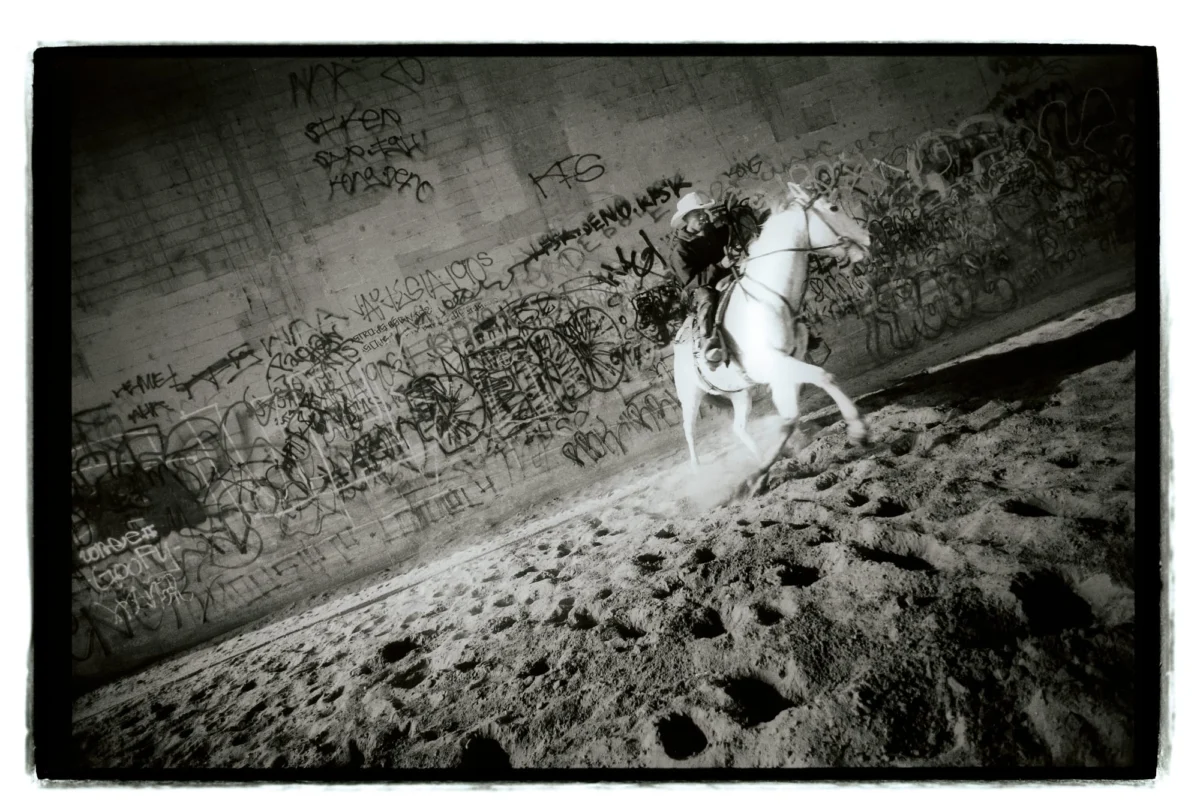
RIVERSIDE, California — For nearly forty years, Southern California-based photographer and conceptual artist Douglas McCulloh operated under a radical premise: to remove personal intention from the act of picture-making. By relying on rigorous systems, maps, mathematical formulas, and the unpredictable forces of pure chance, McCulloh systematically undermined the traditional romantic notion of the photographer as an intuitive author finding beauty in the world. Instead, he treated the camera as a recording device, letting external systems dictate where the lens would point and what stories would unfold.
This fall, the full scope of that four-decade career is receiving its first comprehensive museum survey. Opening September 12 and running through December 20, 2026, UCR ARTS: California Museum of Photography in downtown Riverside presents Dispatches: The Photography of Douglas McCulloh, 1990–2025. The landmark exhibition brings together the major conceptual series that defined McCulloh’s career, tracking a relentless interrogation of American landscape, myth, infrastructure, and human behavior through the lens of systematic methodology.
Main Facts: The Exhibition and Its Premise
Dispatches serves as both a celebration and a critical evaluation of McCulloh’s expansive career, which fundamentally reshaped contemporary understandings of photographic documentation in the American West and beyond.
- Event Dates: September 12 – December 20, 2026
- Location: UCR ARTS: California Museum of Photography, downtown Riverside, California
- Curatorial Focus: The first full-career survey of Douglas McCulloh’s work, spanning 1990 to 2025.
- Core Methodology: The exhibition highlights McCulloh’s reliance on cartography, pre-determined grid systems, and chance operations to strip away conventional artistic subjectivity, allowing the visual world to present itself on its own terms.
- Featured Major Projects: The exhibition includes extensive presentations of foundational series, including Chance Encounters (1992–1999), Lost Among the Stars (2003–2006), Dream Street (1999–2009), and his monumental, final opus, American Cross (2013–2025).
- Special Highlights: Behind-the-scenes documentation of The Great Picture: Revisiting The Legacy Project (2006)—holder of the Guinness World Record for the largest photograph ever made—alongside an innovative virtual reality and screen-based recreation of the massive pinhole project using modern game-engine technology.
The exhibition’s title, Dispatches, underscores McCulloh’s role as an analytical reporter of sorts—one who filed visual updates from the front lines of suburban expansion, cultural mythology, and geographic destiny. Rather than chasing picturesque views or staging emotional narratives, McCulloh permitted structure and luck to co-author his work.
Chronology: A Career Built on Systems and Journeys
Douglas McCulloh’s artistic trajectory was defined by long-term, multi-year projects that required immense physical endurance, logistical planning, and conceptual rigor. His body of work traces a chronological evolution from micro-level human interactions to vast, transcontinental geographical investigations.
1990–1999: The Birth of Systematic Exploration
McCulloh emerged as a distinct voice in contemporary photography during the 1990s, rejecting standard documentary approaches in favor of rule-based frameworks. His breakout project, Chance Encounters (1992–1999), set the tone for his entire career. For this series, McCulloh mapped out 22,000 miles of terrain using random selection methods. As he traversed these arbitrarily chosen routes, he initiated conversations and portraits with virtually everyone he crossed paths with. The resulting body of work challenged the isolation of the lone photographer, turning the camera into a tool for radical, democratic engagement with strangers.
1999–2009: The Rise and Fall of the Suburbs
As the millennium turned, McCulloh trained his analytical gaze on the explosive suburban development transforming the Inland Empire and greater Southern California.
- Lost Among the Stars (2003–2006): In this series, McCulloh constructed an intellectual grid around Hollywood mythology, anchoring his camera to 90 fixed points derived from cinematic history. By systematically photographing these specific locations, he interrogated the gap between manufactured Hollywood illusions and the stark physical reality of the Southern California landscape.
- Dream Street (1999–2009): Perhaps his most poignant sociological study, Dream Street occupied a decade of McCulloh’s life. He chronicled a single, newly constructed Southern California suburban subdivision from its earliest foundation and framing stages all the way through to the devastating financial collapse of the housing market in 2008–2009. The series stands as a definitive visual monument to the fragility of the American Dream, charting the rise of speculative real estate development and its subsequent human and economic toll.
2006: The Guinness World Record and The Great Picture
In 2006, McCulloh collaborated with five other artists (Jerry Burchfield, Mark Chamberlain, Jacques Garnier, Rob Johnson, and Douglas Hill) to execute one of the most ambitious photographic projects in history. Dubbed The Great Picture: Revisiting The Legacy Project, the team transformed a decommissioned Marine Corps air hangar at the El Toro marine base into a massive, functioning pinhole camera.
Using a 31-by-111-foot piece of seamless canvas treated with liquid gelatin silver emulsion, they exposed a panoramic view of the former military base. The resulting physical object—a single gelatin silver print measuring over 31 feet high and 111 feet wide—shattered the Guinness World Record for the largest photograph ever produced. While the physical print itself is too massive to travel for the UCR ARTS exhibition, Dispatches features rare behind-the-scenes documentation of the monumental undertaking, alongside a cutting-edge virtual re-staging built via game-engine technology, allowing visitors to experience the scale of the work through VR goggles or a first-person screen mode.
2013–2025: The Final Journey of American Cross
McCulloh’s final and most monumental undertaking was American Cross (2013–2025), a staggering transcontinental project that consumed the final twelve years of his life.
The conceptual foundation of the project was simple yet daunting: McCulloh drew a giant ‘X’ across a map of the United States, connecting distant corners of the nation in two massive diagonal vectors. He then set out to travel, document, and photograph the exact locations intersected by these imaginary lines.
Beginning in January 2013, McCulloh crisscrossed the country, meticulously recording the diverse communities, forgotten byways, majestic landscapes, and industrial ruins that fell along the geometric path. He continued the grueling endeavor through changing landscapes and personal milestones, ultimately covering more than 5,352 miles of the designated route.

Tragically, the journey was cut short. On January 5, 2025, following a short illness, Douglas McCulloh passed away—leaving American Cross a mere 400 miles short of its physical completion. Despite its unfinished state, the project stands as a monumental capstone to his career, marrying his lifelong obsession with cartographic drawing, physical endurance, and the unpredictable nature of American geography.
Supporting Data and Technical Framework
To fully appreciate Douglas McCulloh’s contribution to photography, one must examine the metrics and mechanisms that governed his art. Unlike traditional street photographers who relied on a "decisive moment" captured by intuition, McCulloh operated like a geographer, a sociologist, and a mathematician combined.
- Geographic Scale: Across his major projects, McCulloh logged tens of thousands of miles, including 22,000 miles for Chance Encounters and over 5,300 miles for the unfinished American Cross.
- Temporal Depth: His projects were explicitly long-form. Dream Street required a 10-year commitment to observing a single neighborhood’s life cycle; American Cross spanned 12 years; and his overall survey at UCR ARTS encapsulates 35 years of active, uninterrupted conceptual output (1990–2025).
- Technological Innovation: The Great Picture utilized a hangar encompassing roughly 3,000 square feet of darkroom space, deploying 60 gallons of black-and-white liquid emulsion and requiring a crew of technicians to expose the massive surface over the course of hours. The 2026 UCR ARTS exhibition modernizes this legacy by deploying real-time game-engine technology to recreate the camera obscura experience digitally for contemporary museum-goers.
- Institutional Legacy: As a cornerstone of the Southern California art scene, McCulloh’s work has been widely exhibited, collected, and studied. UCR ARTS: California Museum of Photography—situated in Riverside—serves as the ideal institutional home for this retrospective, given its deep historical ties to West Coast photography, innovative visual culture, and regional land-use studies.
Official Responses and Curatorial Perspectives
The announcement of Dispatches has drawn widespread acclaim from arts administrators, curators, and photography scholars who view the exhibition as a long-overdue tribute to one of the region’s most rigorous conceptual thinkers.
Museum directors and curatorial teams at UCR ARTS emphasized that McCulloh’s practice was defined by an intellectual generosity that invited viewers to look past the surface of the image and question the invisible systems shaping modern life.
"Douglas McCulloh did not simply take pictures; he built apparatuses of inquiry," noted exhibition organizers. "By letting maps, grids, and random chance dictate his movements, he freed himself—and by extension, his audience—from the tired clichés of traditional landscape and documentary photography. He showed us that if you let go of control, the true, messy, complex reality of the American landscape will reveal itself."
Colleagues and fellow artists who worked alongside McCulloh on monumental collaborative undertakings, such as The Legacy Project, have frequently highlighted his rare ability to merge massive logistical coordination with profound philosophical inquiry. To them, McCulloh was an artist who approached the vastness of the American continent not with romantic bravado, but with the quiet humility of a data collector mapping the human condition.
Art critics have similarly praised the decision to showcase American Cross in its final, poignant state. Even though the artist passed away just 400 miles shy of completing the physical trajectory of the ‘X’, the incomplete nature of the project serves as a powerful metaphor for the open-ended, unending expanse of the American experiment itself.
Implications: The Enduring Legacy of Systematic Photography
The opening of Dispatches: The Photography of Douglas McCulloh, 1990–2025 arrives at a critical juncture in contemporary visual culture. At a time when digital algorithms, automated data collection, and algorithmic curation dictate nearly every aspect of modern daily life, McCulloh’s analog, rule-based interventions feel remarkably prophetic.
Long before social media feeds were governed by randomized algorithms and algorithmic content delivery, McCulloh was voluntarily surrendering his artistic agency to pre-determined mathematical systems. His work anticipated our current anxieties regarding surveillance, mapping, spatial politics, and the ways in which human beings are categorized and processed by systems larger than themselves.
Furthermore, the exhibition cements Southern California’s pivotal role in the history of conceptual photography. While New York often dominated discussions of institutional art markets during the late 20th century, artists like McCulloh proved that the sprawling, rapidly mutating landscapes of the American West—characterized by speculative suburban sprawl, cinematic myth-making, and vast desert expanses—offered an unmatched laboratory for interrogating contemporary culture.
As visitors walk through the galleries at UCR ARTS this fall, they will encounter more than just prints on a wall. They will trace the footsteps of an artist who walked thousands of miles, stared down the housing crisis, mapped Hollywood’s ghosts, and drew a literal ‘X’ across the face of the nation. In doing so, Douglas McCulloh left behind a masterclass in how to look at the world—not as we wish it to be, but as it is constructed, encountered, and lived.
Exhibition Details
- What: Dispatches: The Photography of Douglas McCulloh, 1990–2025
- Where: UCR ARTS: California Museum of Photography, 3824 Main St, Riverside, CA 92501
- When: September 12, 2026 – December 20, 2026
- Admission & Info: For hours, public programming, and digital ticketing information, visit the official museum website at ucrarts.ucr.edu.
 Nana
Nana
 Iffa Jayyana
 Muslim
