

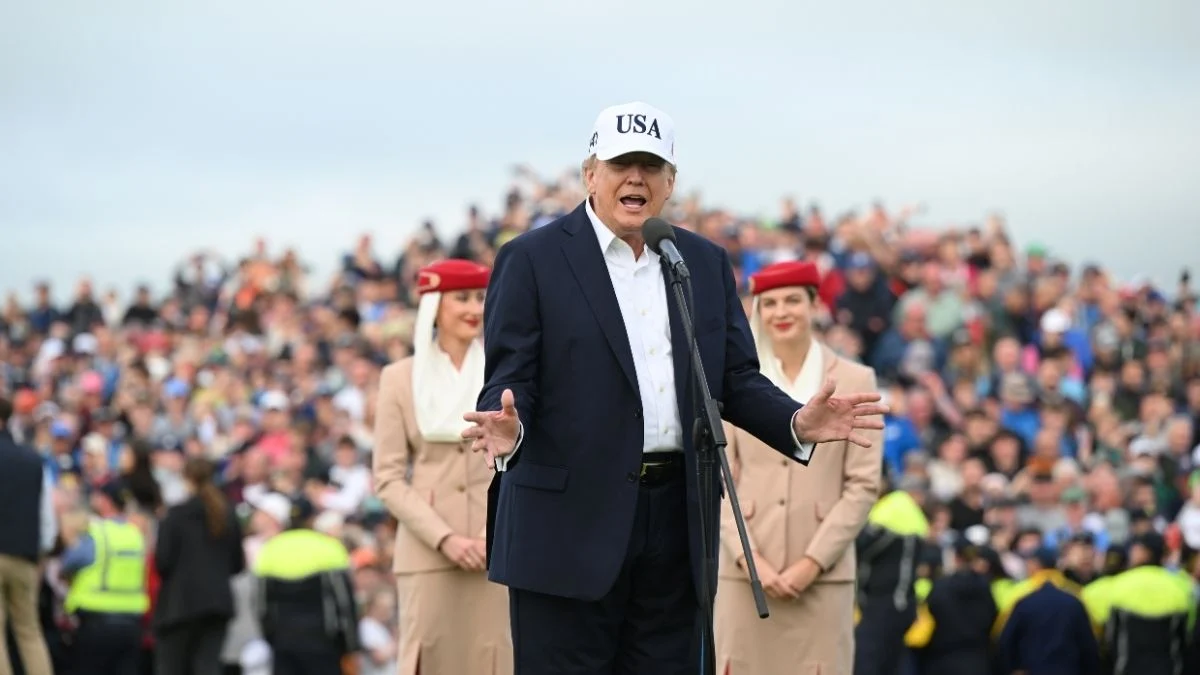
The recent visit of former President Donald Trump to Ireland, intended to be a blend of diplomatic posturing and business interests, has instead become a lightning rod for controversy. While the trip featured significant commentary on the sensitive issue of Irish unification, international attention has been sharply diverted by an unusual and widely criticized interaction between the former president and a member of the press.
During a briefing, when confronted with questions regarding the public backlash to his presence in the country, Trump bypassed the substance of the query entirely, opting instead to comment on the physical appearance of a female reporter—an act that has reignited ongoing debates regarding his relationship with the media and his approach to diplomatic engagements.
The Exchange: A Distraction from Dissent
The incident occurred during an informal media engagement in Dublin, where an unidentified reporter for the Press Association attempted to pivot the conversation toward the palpable tension on the ground. Specifically, the reporter inquired whether Trump had viewed footage of the anti-Trump demonstrations that had broken out across the city and, if so, what his assessment was of the opposition.
"I don’t know," Trump responded initially, his tone dismissive. Rather than addressing the substance of the protest or the grievances of the demonstrators, he shifted the focus to the reporter herself. Pointing toward her, he remarked that she bore a striking resemblance to "a very cute Irish singer who passed away recently."
Without pausing for a reply, he continued, "You know who that is? Sinéad! You look like Sinéad O’Connor." Despite his claim that the comparison was "a compliment"—noting that the late singer "sang beautifully"—the exchange was marked by the president’s mispronunciation of the iconic artist’s name. The interaction, captured on video, quickly circulated across social media platforms, drawing immediate condemnation from critics who viewed the maneuver as a calculated tactic to evade accountability for the unpopularity of his visit.
Chronology of a Contentious Trip
The events of the week have been characterized by a series of volatile moments that highlight the complexities of Trump’s international footprint.
- Arrival and Initial Friction: Upon arriving in Ireland, the former president was met with a divided reception. While he engaged in high-level discussions with Irish Prime Minister Micheál Martin, the public mood remained skeptical.
- The Unification Comments: On Saturday, Trump sparked a diplomatic ripple effect by publicly endorsing the idea of a unified Ireland. During a discussion with Prime Minister Martin, Trump remarked that a unified nation would be "fantastic" and suggested that such an outcome would "happen eventually." The comments, while seemingly casual, were viewed with unease in London, where the status of Northern Ireland remains a delicate constitutional issue.
- The Press Briefing Incident: On Sunday, the interaction regarding the late Sinéad O’Connor occurred, overshadowing the political substance of the trip.
- Escalating Demonstrations: Throughout the weekend, protests intensified. Beyond the demonstrations in Dublin, activists mobilized near Trump’s luxury golf resort in Doonbeg. Concerns were raised not only about the former president’s policies but also about the immense taxpayer-funded security costs associated with his visit, which many locals argued should have been redirected toward pressing domestic issues such as the national housing crisis and healthcare reform.
Supporting Data: The Legacy of Sinéad O’Connor
The reference to Sinéad O’Connor carried a particular irony that appeared to be lost on the former president. O’Connor, a Grammy-winning artist and cultural icon in Ireland, passed away in 2023. Known for her fierce independence and outspoken political activism, she stood in ideological opposition to much of the populism that Trump represents.
In 2024, the estate of the late singer issued a stern rebuke to the Trump campaign, demanding that they cease the use of her 1990 hit, "Nothing Compares 2 U," at political rallies. The estate’s statement was unequivocal: they noted that O’Connor would have been "disgusted" by the association, characterizing her view of the former president as that of a "biblical devil." By invoking her name to deflect from a question about his own unpopularity, Trump unintentionally placed himself in the center of a cultural firestorm, pitting his current political brand against the enduring, defiant legacy of one of Ireland’s most beloved figures.
A Pattern of Media Confrontation
The incident in Dublin is far from an isolated occurrence. It is the latest entry in a long-standing ledger of contentious, often gendered, exchanges between Donald Trump and the media. His approach to female reporters, in particular, has been a recurring subject of scrutiny.
Only days prior to the Dublin trip, Trump engaged in a heated confrontation with ABC reporter Rachel Scott. When Scott questioned the feasibility and political intent behind a campaign promise to grant American citizens $5,000 in the event of a Republican midterm victory, Trump reacted with hostility, dismissing the line of questioning. Similarly, on August 29, Trump took to his social media platform, Truth Social, to launch a personal attack against New York Times reporter Maggie Haberman, targeting both her physical appearance and her professional character.
These incidents, when viewed as a collective, suggest a consistent strategy: when faced with rigorous journalistic scrutiny, the former president often retreats into ad hominem attacks or bizarre, unrelated diversions—such as the O’Connor comparison—to undermine the credibility of the questioner rather than answering the question itself.
The Broader Implications
The Dublin visit serves as a microcosm of the challenges inherent in Trump’s international diplomacy. By weighing in on the issue of Irish unification, he demonstrated a willingness to disrupt long-standing international norms for the sake of a headline. However, by failing to manage the local optics—and by treating the press with open derision—he highlighted the reasons why his international popularity remains consistently low.
The Diplomatic Fallout
The UK government’s reaction to his unification comments, while muted in public, indicates a deep-seated anxiety among European allies regarding Trump’s unpredictability. When a former president comments on the internal political structure of neighboring sovereign states, it creates a diplomatic headache that the current administration must then spend weeks repairing.
Domestic Dissent and the Cost of Hosting
The protests in Dublin and Doonbeg were not merely about the individual; they were about the cost of maintaining the security apparatus required for a high-profile, polarizing figure. For a country struggling with its own budgetary constraints, the financial burden of the Trump visit became a rallying cry for activists. The demonstration of public dissent serves as a reminder that for many in the international community, the "Trump brand" is seen as a liability rather than an asset.
The Future of Media Relations
The incident also underscores the shifting landscape of modern journalism. Reporters are increasingly finding themselves as the subjects of the stories they cover, as high-profile political figures use the spotlight to "work the refs" and distract from policy failures. This tactic, while effective at energizing a specific segment of the base, creates a hostile environment that threatens the core function of the press: to hold power accountable.
Conclusion
As Donald Trump moves forward with his ongoing political endeavors, the Dublin incident will likely be remembered as a quintessential example of his style: a mix of grand, headline-grabbing policy declarations and dismissive, performative behavior toward the press. While he may have intended for his trip to Ireland to signal strength and global influence, the reality of the visit was a chaotic sequence of events that highlighted the persistent friction between his methods and the expectations of traditional statecraft.
Whether these tactics will continue to serve his political interests or eventually erode his standing further remains a point of intense speculation. However, one thing is clear: as long as the former president continues to conflate diplomacy with theater, he will remain a figure who commands attention, even as he loses the confidence of those who value stability and professional decorum in the international arena.
 Dwi Wanna
 Iffa Jayyana
