

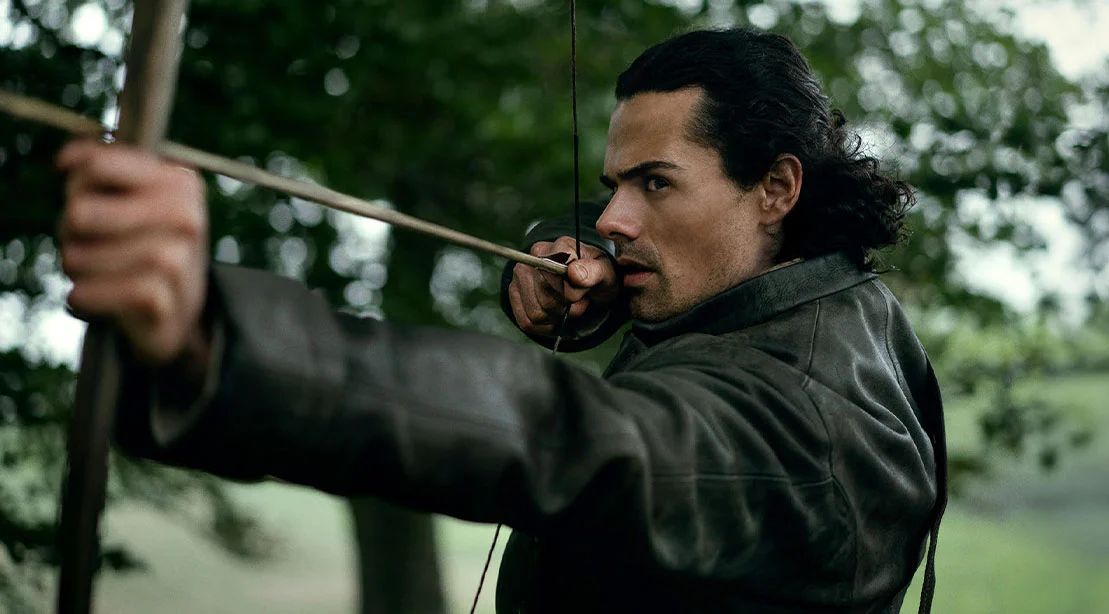
The television landscape is rarely gifted with a phenomenon as enduring as the Outlander saga. Spanning eight seasons and 101 episodes between 2014 and 2026, the historical epic—which follows the time-traveling journey of Claire Randall from 1946 to the treacherous Jacobite risings of 1743—has become a cultural touchstone. As the franchise evolves, its prequel, Blood of My Blood, has emerged as a cornerstone of modern period drama. At the center of this new chapter is Scottish actor Jamie Roy, a 6’1” force of nature who has not only captured the essence of Brian Fraser—the father of the iconic Jamie Fraser—but has also utilized the role as a canvas for a profound physical and artistic transformation.
The Stars Align: A Career-Defining Casting
The trajectory of Jamie Roy’s career is a testament to the adage that timing is everything. Years prior to his current fame, a then-unknown Roy auditioned for a minor role in the original Outlander series. Despite his best efforts, he was unsuccessful in securing a part in the sprawling epic. However, fate had other plans. When producers began the rigorous process of casting Blood of My Blood, they were struck by an uncanny visual resonance between Roy and Sam Heughan, the actor who defined the role of Jamie Fraser for over a decade.
For Roy, the casting process was a surreal full-circle moment. "It just turned out that all the stars had aligned for me," he tells M&F. Being cast as Brian Fraser, the patriarch of the clan, was not merely a career milestone; it was an opportunity to anchor a prequel that carries the heavy weight of fan expectation. As the show progressed into its featured status, Roy recognized that to truly embody Brian Fraser—a man defined by the rugged landscapes of 18th-century Scotland—he would need to undergo a physical evolution that mirrored the character’s growth.
Chronology of Transformation: From Lean Youth to Rugged Maturity
The journey to the screen began five days before Roy’s 30th birthday. Faced with the daunting task of portraying a character whose physical presence would need to shift as the seasons progressed, Roy set his sights on a dual-phase transformation.
Season One: The Lean Foundation
In the inaugural season, Roy’s goal was to present Brian as a youthful, agile man in his 20s. This required a strict caloric deficit to achieve a lean, almost gaunt aesthetic suitable for the grueling conditions of the era. The visual payoff was immediate, particularly in the series’ most intense sequences, including the harrowing scenes of his character’s flogging and the vulnerable, intimate moments shared with his love interest, Ellen MacKenzie, portrayed by Harriet Slater.
Season Two: The Shift Toward Power
As production for season two loomed, Roy’s creative vision shifted. "I wanted the look for the first season to be quite lean because he’s a young boy, essentially, in his 20s," Roy explains. "But as the seasons go on, I want to fill Brian out a little bit more, because we know what he looks like as a man, and he’s larger."
This transition from lean to muscular required a pivot in his training methodology. Working closely with his coach at Ultimate Performance, Giulio Palau, Roy moved away from the extreme deficits of his early filming days and into a high-volume hypertrophy program designed to build functional mass while maintaining the aesthetic lean needed for the camera.
Overcoming Adversity: The Road to the Iron
The path to this transformation was far from linear. During the peak of his training, Roy suffered a series of setbacks—a broken wrist followed by a fractured thumb. For many actors, such injuries might have signaled the end of a fitness-focused training block. For Roy, it was merely an adjustment of strategy.
"The leg press became my favorite friend during that time," Roy admits. By shifting his focus to his lower body, core, and back, he ensured that he did not lose momentum during his recovery. Once he regained full mobility, his intensity skyrocketed. Under the remote guidance of Palau, Roy utilized a structured block-periodization model. "He was fantastic," Roy says of his coach. "He would make my workouts for me, training blocks essentially, and he would always explain what the goal of the training block was."
The Science of Strength: Hypertrophy and Performance
Roy’s training regime for the second season was defined by three to four sessions per week, split between upper and lower body movements. The philosophy was simple: prioritize performance to build a foundation that would not only look authentic on screen but serve the functional demands of the role.
High-Volume Superset Methodology
Roy’s workouts were centered on "super-heavy" exercises, paired together as supersets to maximize time under tension and metabolic demand.
- The Superset Approach: One staple of his routine involved weighted pull-ups—six sets of 3 to 6 reps—immediately supersetted with dumbbell incline presses for the same rep range.
- Mechanical Load: In another session, he utilized single-arm dumbbell rows paired with barbell bench presses, typically 5 to 6 sets of 6 to 8 reps.
This high-volume, low-rep approach allowed Roy to push maximum weight while keeping intensity high. Even when rep ranges increased to the 8-to-12 bracket, he maintained strict control, leaving only a "small number of reps in reserve" to ensure that every set was pushed to near-failure.
Nutritional Discipline and the 80/20 Rule
Dietary control was the backbone of his aesthetic. To stay accountable, Roy submitted weekly progress photos to Palau. As the filming schedule approached, he tapered his caloric intake, dropping from a 3,000-calorie surplus to the 2,000-calorie range. Despite the discipline, Roy remains a self-proclaimed "food lover." He utilized the 80/20 rule—consuming nutrient-dense whole foods 80% of the time, while allowing for flexibility in the remaining 20%—to ensure he stayed mentally sharp and physically fueled without succumbing to the burnout often associated with strict "dieting."
Official Insights: The Intersection of Fitness and Narrative
The physical gains Roy has made are not merely vanity; they are a narrative necessity. Season two requires a more physically capable version of Brian Fraser, one who can engage in complex, close-quarters combat and wield a sword with historical accuracy.
Coach Palau’s emphasis on "full range of motion" and "holding the stretch" has paid dividends. Roy notes that this focus on technique has made him more mobile and more prepared for the taxing choreography of the show’s battle sequences. By building muscle that is both aesthetically imposing and functionally agile, Roy has ensured that Brian Fraser feels like a man capable of surviving the turbulent 18th century.
The Legacy of Outlander and the Future of the Prequel
Born in Greenock, Scotland, Roy carries a deep sense of pride in representing his heritage on a global stage. He views the Outlander universe as a unique storytelling vessel that balances the visceral realities of war with the tender complexities of romance.
"I think it’s because there’s something for everybody in there," Roy reflects. "Between Outlander and Blood of My Blood, there’s love, romance, war, sex, passion, betrayal." He remains optimistic about the longevity of the project. With the original series having enjoyed an eight-season run, the cast and crew are hopeful for a multi-season arc for Blood of My Blood. "We’re lucky enough to have two, hopefully three [seasons]. We’re still waiting for the green light on that!"
Implications: A New Standard for Period Drama
The transformation of Jamie Roy underscores a broader trend in television: the rise of the "performance-ready" actor. No longer content with merely "looking the part," actors are increasingly expected to possess the functional strength to perform their own stunts and the discipline to maintain physical continuity over years of production.
By documenting his journey—from the lean, vulnerable youth of the first season to the formidable, battle-hardened man of the second—Roy has provided fans with a blueprint for dedication. His story serves as a reminder that behind the cinematic splendor of Outlander: Blood of My Blood lies a grueling, meticulous commitment to craft.
As viewers prepare to return to the Highlands on September 18, 2026, they will not just be watching a character; they will be witnessing the culmination of years of labor, a physical embodiment of the Fraser legacy, and the rise of a leading man who understands that in both life and art, the struggle is the source of the strength.
Season two of Outlander: Blood of My Blood premieres on Friday, Sept 18, 2026, exclusively on Starz.
 Nana
Nana
 Iffa Jayyana
 Reynand Wu
