

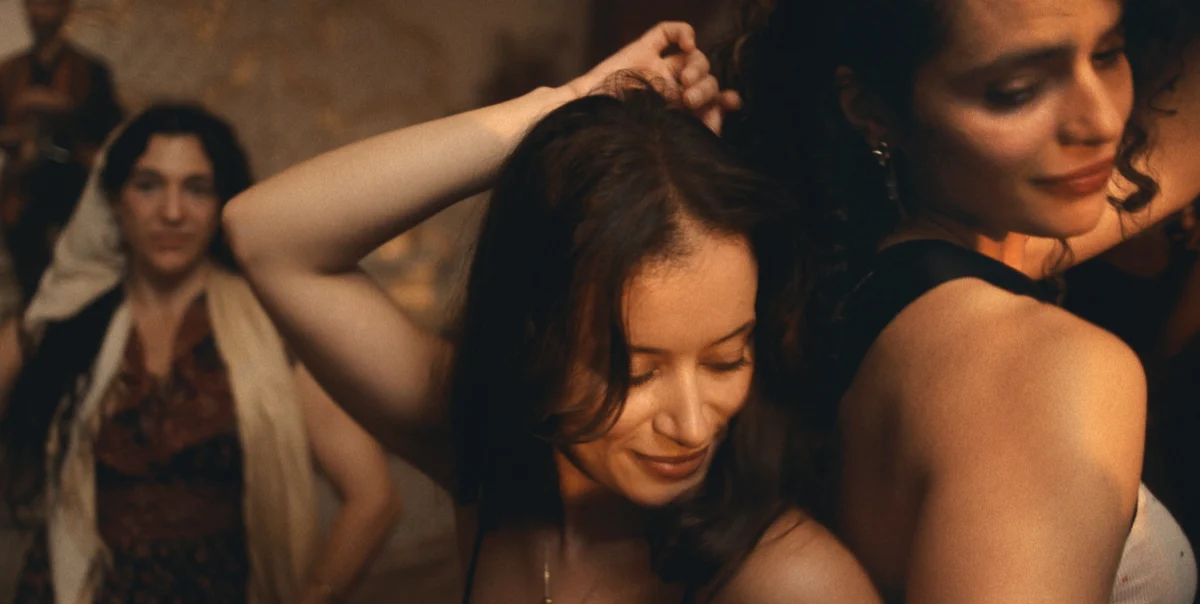
The opening frames of The Daughters of Abraham serve as a sensory invitation. We are dropped into the pulsing, neon-drenched heart of a Marrakech nightclub, where the night feels infinite and the constraints of the daylight world are blissfully suspended. Myriam (played with magnetic vulnerability by Melissa Guers) and Eva (portrayed by Ava Baya) move through this space with the effortless grace of youth, their laughter cutting through the rhythmic, bass-heavy atmosphere.
It is a sequence of pure cinematic allure, expertly lensed to make even the most dedicated homebody yearn for the freedom of the dance floor. Yet, director Hanaël El Yousfi is too savvy a filmmaker to allow this euphoria to persist unchallenged. As the camera lingers on the amber glow of the club, it captures the encroaching reality of the outside world: the crass, entitled behavior of men who view these women as public property. It is a sharp, necessary reminder that for women, "carefree" is a state of mind that must be rigorously defended. This duality—the desire for unfettered joy versus the suffocating weight of societal expectation—forms the emotional bedrock of El Yousfi’s feature debut.
A Chronology of Conflict and Connection
To understand the trajectory of The Daughters of Abraham, one must look at the structural choices El Yousfi makes. The film is not a linear coming-of-age story; it is a portrait of a fractured timeline. By utilizing a significant time jump, the narrative forces us to witness the erosion of a bond that once felt unbreakable.
When the audience first meets Myriam and Eva, they are at the precipice of adulthood—that volatile period at 25 where the world feels both wide open and strangely closing in. They are European hedonists in spirit, navigating their identities with a mix of defiance and curiosity. However, the film jumps five years later, reuniting the two women at a wedding. The air is thick with the sediment of time, unspoken grievances, and the palpable pressure of familial duty.
This reunion serves as the catalyst for the film’s second act. The vibrant energy of their youth has been replaced by the quiet, grinding exhaustion of trying to satisfy their families. The wedding is not merely a social obligation; it is a cage. For Myriam and Eva, the transition from 25 to 30 has transformed them from protagonists of their own lives into supporting characters in the grand, suffocating dramas of their respective clans.
Supporting Data: The Cultural Tension of Interfaith Bonds
At the heart of the narrative is the friendship between a Muslim woman and a Jewish woman. The film is astute in its portrayal of how these identities are treated in their shared social circles. The characters are constantly reminded—by family, friends, and passersby—that their friendship is "not a problem." In the lexicon of family politics, this constant insistence that there is no tension is, in itself, the primary indicator that the tension is all-consuming.

Myriam and Eva exist in a liminal space. Their families are modern enough to allow them education and cultural exploration but traditional enough to demand total capitulation when the clock strikes a certain age. The film highlights the "Jane Austen-esque" nature of their predicament: the relentless, polite maneuvering of mothers and aunts to facilitate marriages that protect the family’s social standing.
The interfaith element is handled with a commendable lack of heavy-handedness. Rather than focusing on grand geopolitical declarations, El Yousfi focuses on the "petty" clashes that actually define the friction between these communities: the scheduling of a bachelor party during a High Holy Day, the subtle microaggressions masked as religious tolerance, and the performative politeness that hides a deep-seated, generational resentment. It is in these granular, domestic details that the film finds its most biting truths.
Official Responses and Critical Reception
Since its premiere at the 2026 Toronto International Film Festival, The Daughters of Abraham has been hailed by critics as a poignant exploration of the universal struggle between individual liberation and the comfort of community.
"The title itself is a stroke of brilliance," says lead critic Marcus Thorne. "By invoking the shared lineage of Abraham, El Yousfi is not just highlighting the differences between Judaism and Islam, but pointing to the terrifying similarities in the patriarchal structures that govern them. It is a film about the ‘religious DNA’ that binds these two women, even as they are pulled apart by the strictures of their faiths."
While the film is currently seeking U.S. distribution, early screenings have generated significant buzz regarding its portrayal of modern femininity in traditional societies. The film does not offer easy answers, nor does it villainize the families involved. Instead, it presents a nuanced look at how love, duty, and tradition often operate in direct, heartbreaking contradiction.
Implications: The High Cost of Autonomy
What are the implications for a generation caught between the promise of modern independence and the reality of ancient social contracts? The Daughters of Abraham suggests that the cost is significantly higher than we are often willing to admit.

The film’s third act, which takes a notably tragic turn, forces the audience to confront the limitations of choice. In its strongest moments, the film illustrates that the desire for a strong, supportive community and the desire for radical self-expression are often mutually exclusive in the contexts the characters inhabit. When a character attempts to break the mold—as Myriam does with her lingering, forbidden feelings for Eva’s brother—the social cost is near-total alienation.
El Yousfi shows us that the "tradition" being protected is often a hollowed-out shell, maintained only because the alternative—the uncertainty of being truly, individualistically free—is too frightening for the older generation to contemplate. The film does not just ask if the girls can escape; it asks if the culture itself can survive if they do.
Strengths and Shortcomings: A Final Assessment
It must be noted that The Daughters of Abraham is not a flawless piece of work. At 93 minutes, the film feels both rushed and overstuffed. There is an ambitious sprawl of side characters and subplots—extended family members, potential suitors, and work colleagues—that occasionally muddies the narrative waters. Certain arcs feel truncated, leaving the viewer to wonder about the fuller stories of the secondary players who drift in and out of the girls’ orbit.
However, these structural imbalances are largely mitigated by the powerhouse performances of Guers and Baya. Their chemistry is the anchor that prevents the film from drifting into melodrama. Their ability to convey volumes with a single, averted gaze or a tight, forced smile is a testament to their skill. They inhabit the middle ground of their characters with such precision that the viewer feels the psychic toll of their double lives.
El Yousfi’s direction demonstrates a sophisticated eye for visual storytelling, using the contrast between the saturated, chaotic nightlife and the sterile, muted interiors of the family home to mirror the characters’ internal dissonance. While the film may suffer from the "first-feature" tendency to include too much, the specificity of its observation is a rarity in modern cinema.
Final Grade: B
The Daughters of Abraham is an essential watch for those interested in the collision of identity and culture. It is a work of sensitive, humanistic inquiry that marks Hanaël El Yousfi as a filmmaker to watch. As the film moves through the distribution phase, it serves as a timely reminder that while the rules of society may be man-made, the struggle to rewrite them is one of the most difficult, and most necessary, human endeavors.
 Lina Hope
 Azzam Bilal Chamdy
 Pevita Pearce
