

By Noah Fischer
Published in partnership with Hyperallergic
Main Facts: A Graphic Reckoning with the Ultimate Atrocity
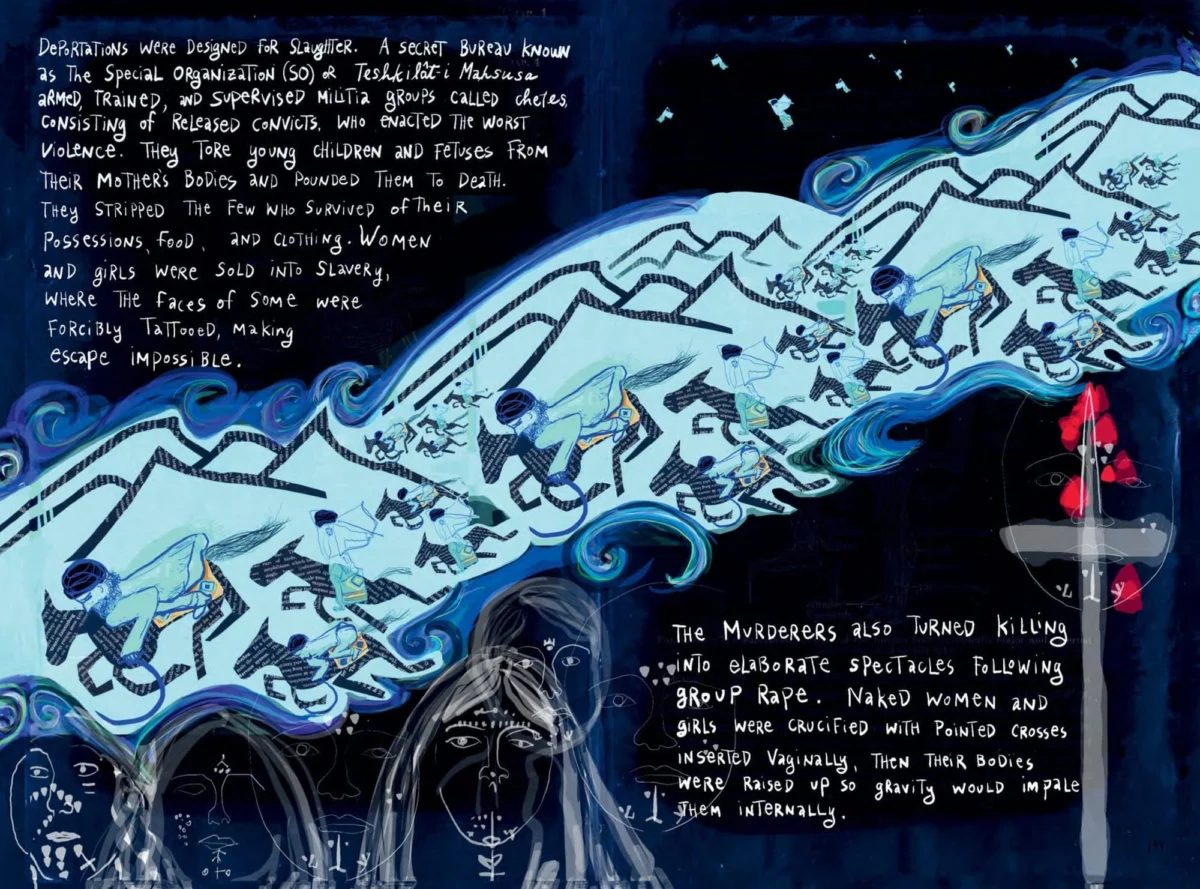
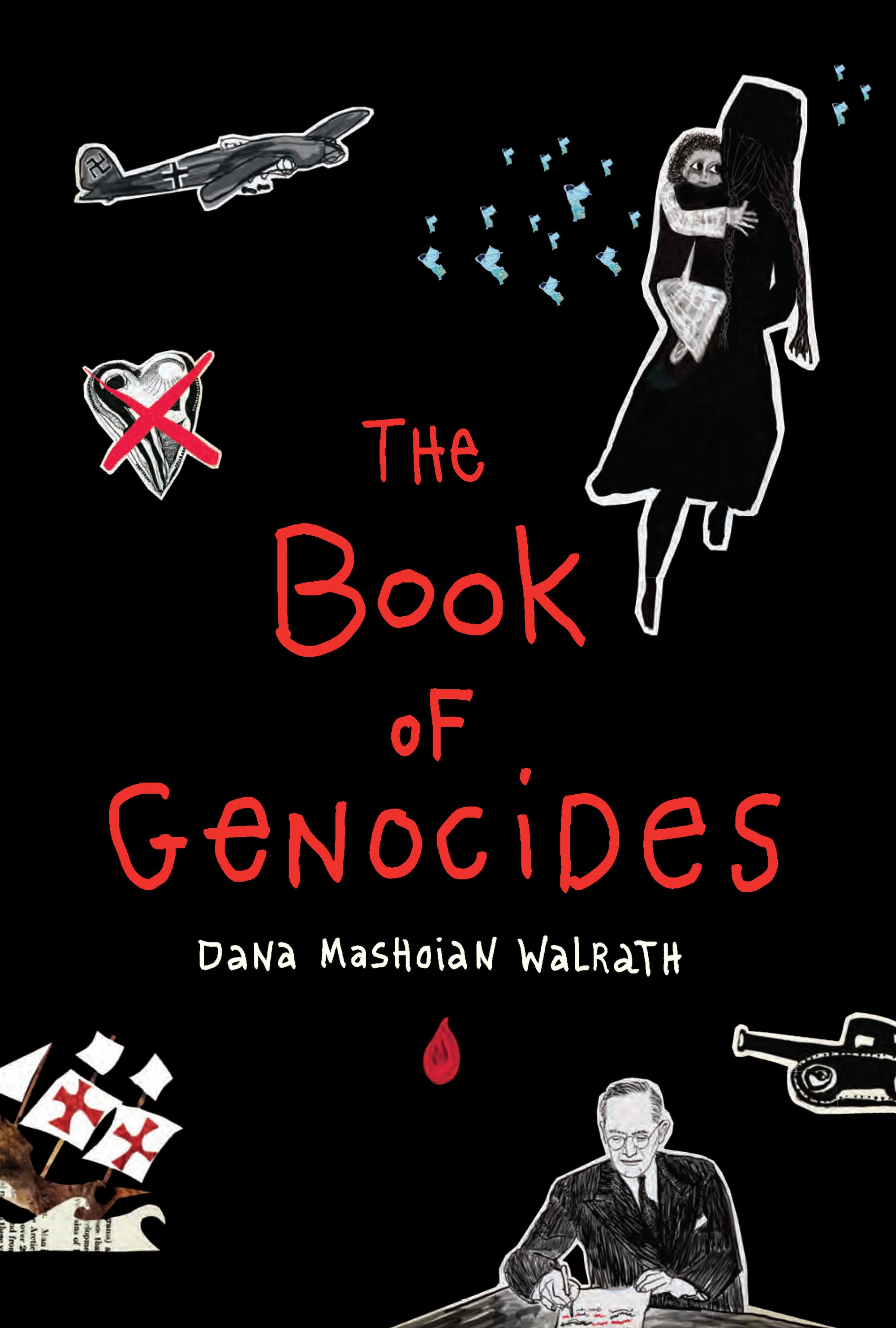
Dana Mashoian Walrath’s The Book of Genocides (Harvard University Press, 2026) is not a conventional work of history. Operating within the visceral, boundary-pushing medium of graphic nonfiction, the book confronts one of humanity’s darkest and most heavily contested concepts. Through an unrelenting sequence of ten historical atrocities, Walrath maps out the mechanical architecture of systemic mass violence, guiding the reader from the colonization of the Americas to the modern devastation of Gaza.
At its core, the book opens with a terrifyingly intimate glimpse into Walrath’s own familial trauma. Rendered in a scratchy, digital charcoal style that mimics an X-ray, the opening pages depict her grandmother hiding inside an ornamental urn while Ottoman Turkish soldiers publicly dismember her great-grandfather during the Armenian Genocide. This personal point of entry strips away the safe distance often provided by standard historical texts, immediately immersing the reader in a moral abyss.
Rather than focusing primarily on legal indictments or tracking the perpetrators of these war crimes, Walrath’s work attempts something vastly more ambitious: an exercise in epic empathy. Across its heavily stylized pages, the book tackles a profound socio-legal paradox. "Genocide" functions simultaneously as a universal moral imperative and as a heavily gatekept, weaponized tool manipulated by nation-states, international human rights bureaucracies, and media conglomerates. By placing ten distinct mass atrocities into direct visual and narrative conversation, The Book of Genocides exposes the chilling historical patterns that link state-sponsored violence across centuries and continents.
Chronology of Catastrophe: Ten Atrocities in Unrelenting Sequence
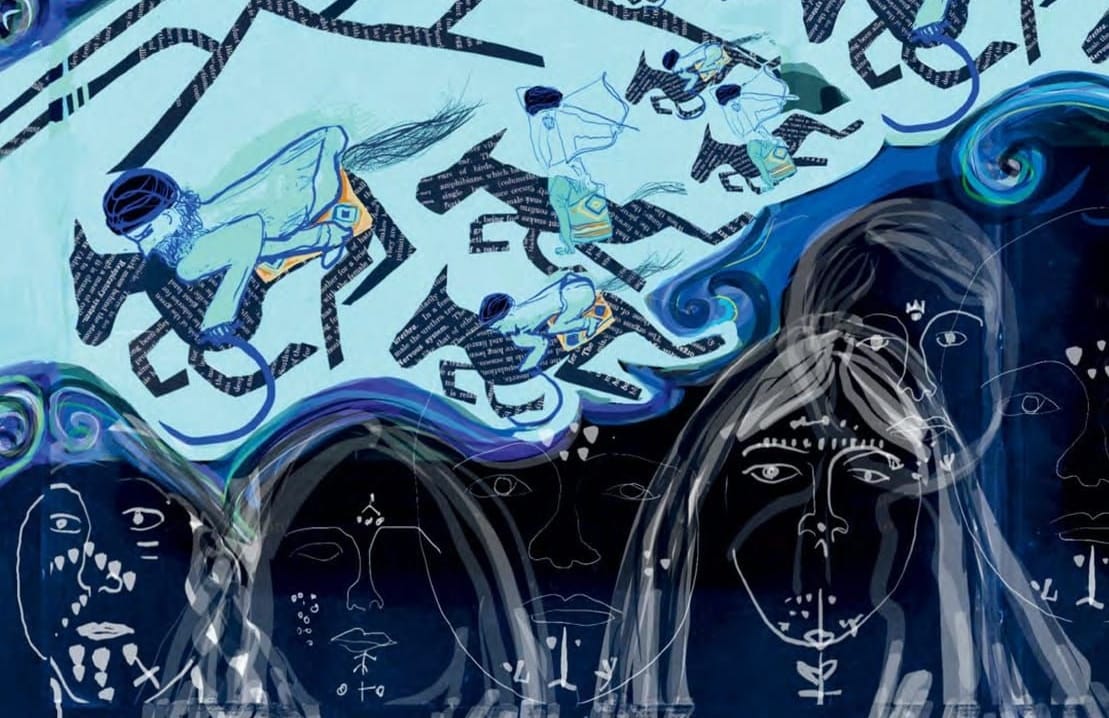
The structural core of The Book of Genocides relies on a relentless, rhythmic drumbeat of historical chapters. Each section opens with a striking, patterned red page, functioning almost like a warning flare. This preamble transitions into an illustrated historical overview of the targeted population, followed by full-body pencil drawings of human victims and impacted animals, paired opposite striking blackout poems.
Walrath’s sweeping historical scope spans centuries of systemic violence:
- The First Peoples of the Americas: The foundational campaigns of displacement, biological warfare, and extermination launched against Indigenous populations following European contact.
- The Enslavement and Systematic Oppression of Black Americans: The legal, social, and physical violence of chattel slavery, institutionalized terror, and Jim Crow-era lynchings.
- The Aboriginal and Torres Strait Islander Peoples: The forced separations, cultural erasures, and frontier massacres directed by Australian state policies.
- The Armenian Genocide: The systematic extermination and deportation of over one million Armenians by the Ottoman Empire, drawing directly from the author’s ancestral lineage.
- The Holocaust: The Nazi regime’s industrialized, continental slaughter of six million European Jews and millions of others deemed "subhuman."
- The Cambodian Genocide: The radical agrarian-communist transformation under the Khmer Rouge, resulting in the death of a quarter of Cambodia’s population through executions, forced labor, and famine.
- The Rwandan Genocide: The 1994 mass slaughter of Tutsis by Hutu nationalist militias, catalyzed by colonial divisions and accelerated by state media.
- The Bosnian Genocide: The systematic ethnic cleansing and mass killings of Bosniaks by Bosnian Serb forces during the breakup of Yugoslavia.
- The Rohingya Genocide: The military-led campaigns of mass rape, arson, and slaughter in Myanmar that drove hundreds of thousands of Rohingya Muslims into Bangladesh.
- The Ongoing Destruction in Gaza: The contemporary campaign of bombardment, starvation, and systemic displacement unfolding in the Palestinian enclave.
Supporting Data: The Anatomy of the Word
To truly understand the weight of Walrath’s work, one must examine the origins of the word itself. The term "genocide" was coined in 1944 by Raphael Lemkin, a Polish-Jewish legal scholar who fled the Holocaust after losing 49 members of his extended family. Lemkin fought tirelessly to codify the crime into international law, resulting in the 1948 United Nations Genocide Convention.
However, Walrath does not hagiographize Lemkin; instead, she critically interrogates his blind spots, using them to illustrate the broader hypocrisy surrounding the term. In one of the book’s most striking visual sequences, Walrath depicts Lemkin’s face spattered with blood as he refuses to support a landmark 1951 petition titled "We Charge Genocide." Submitted to the United Nations by the Civil Rights Congress—featuring prominent figures like Paul Robeson and William L. Patterson—the petition explicitly classified lynchings, police brutality, and institutionalized racism in the United States as acts of genocide.

Lemkin’s refusal to back the petition highlighted a fatal flaw in the institutionalization of the term: the architects of international human rights law were often unwilling to apply their own definitions to the domestic atrocities of powerful Western nation-states. Walrath’s illustration of this historical moment frames Lemkin’s hesitation not as an isolated administrative error, but as an early manifestation of the political self-preservation that continues to plague international law today.
Official Responses and Linguistic Gatekeeping
The weaponization of the term "genocide" is a central thesis of Walrath’s investigation. Rather than serving as an objective legal threshold that triggers immediate international protection, the label is constantly filtered through geopolitical alliances, economic interests, and media self-censorship.
This dynamic was laid bare during the escalation of violence in Gaza. As international legal bodies, human rights experts, and global civil society increasingly utilized the term "genocide" to describe the unfolding humanitarian catastrophe, major Western institutions engaged in aggressive linguistic gatekeeping. Most notably, internal memos leaked from the New York Times in 2024 revealed that editorial leadership instructed journalists to deliberately avoid using terms like "genocide," "ethnic cleansing," and "occupied territory" when covering Israel’s military operations in Gaza.
Similarly, political leaders across the globe routinely dismiss or embrace the label based on strategic convenience. When geopolitical allies commit or support mass violence, state departments scramble to redefine the parameters of international law, demanding impossibly high legal burdens of "specific intent" while populations starve under blockades. Conversely, when adversaries engage in atrocities, the label is weaponized immediately to justify diplomatic isolation or military intervention. By placing the genocide in Gaza alongside the Holocaust and the Armenian Genocide, Walrath cuts through this institutional double-speak, insisting that human suffering must be evaluated by its material reality rather than the political permissions granted by state actors.
Implications: Reimaining Universalism in an Age of Polarization
The Book of Genocides ultimately asks an urgent, destabilizing question: Where is our collective historical memory taking us?
In her introduction, Walrath writes: "I know the anger, fear, and violence that makes people lose their ground and meet violence with violence, but our dreams can be different." By sidestepping the courtroom drama of prosecuting individual perpetrators, Walrath shifts the book’s objective from retributive justice to preventive empathy.
In an era defined by resurgent nationalism, rising authoritarianism, and global polarization, the book serves as a vital warning against tribalist morality. Throughout history, dominant groups have consistently weaponized the definition of mass violence, carving out exceptions for their own crimes while demanding strict accountability from their enemies. Walrath’s graphic nonfiction demonstrates that this hypocrisy is not a bug in the system of international human rights, but a feature that has enabled atrocity after atrocity to repeat unchecked.
By forcing readers to sit with the raw visual and emotional parallels between ten distinct historical traumas, The Book of Genocides challenges us to abandon selective empathy. It demands a radical restructuring of our moral vocabulary—one where human life is valued universally, independent of the geopolitical utility granted by the very nation-states that so often orchestrate our destruction.
 Nana
Nana
 Iffa Jayyana
 Muslim
