

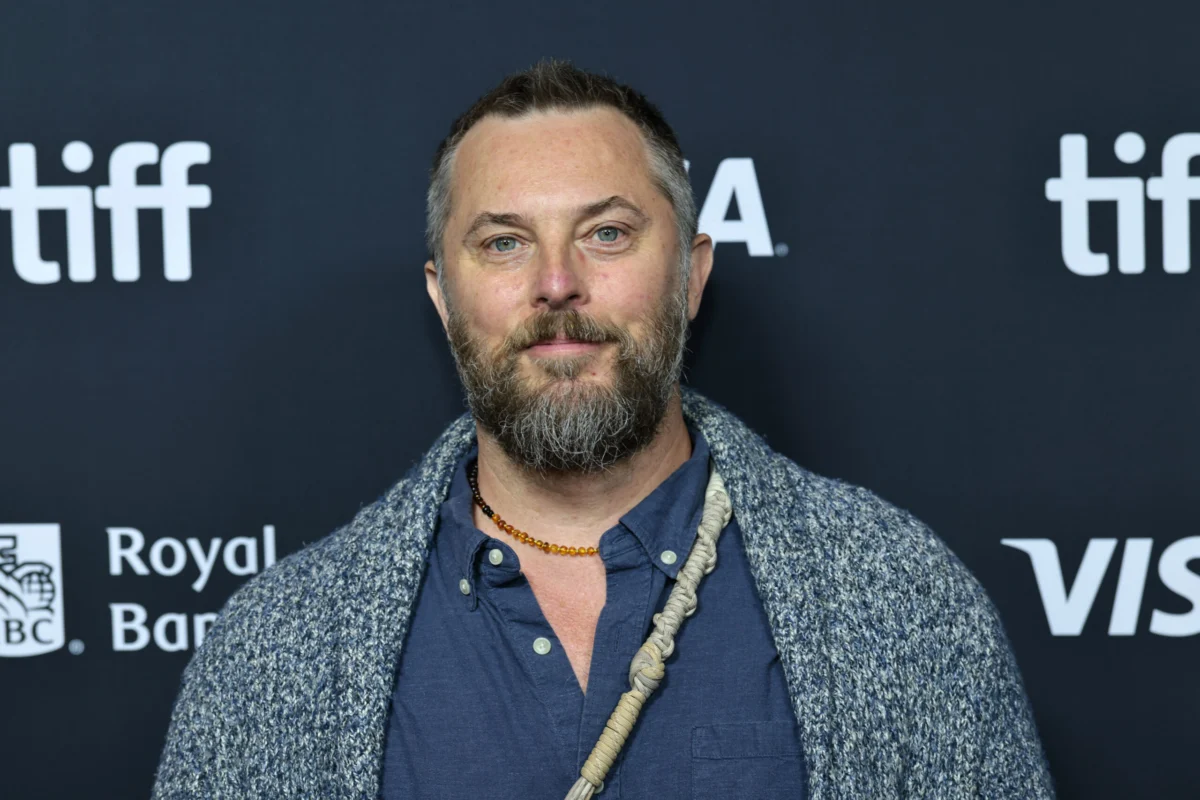
For the past eight years, the cinematic landscape has felt noticeably emptier for fans of high-concept, cerebral science fiction. Since the release of his divisive 2018 Netflix feature Mute, director Duncan Jones—the visionary behind Moon and Source Code—has been conspicuously absent from the director’s chair. While he has remained a vocal presence on social media platforms like Bluesky, the silence regarding his creative output led many to wonder if the filmmaker had stepped away from the medium entirely.
The answer, as it turns out, was not a departure, but an arduous, multi-year odyssey to bring a passion project to the screen. At the 2026 Toronto International Film Festival, Jones finally unveiled his latest feature: the animated adaptation of the legendary British comic book series Rogue Trooper. For Jones, the film is not just a career milestone; it is a defiant declaration of independence in an era increasingly dominated by algorithmic filmmaking and the creeping encroachment of artificial intelligence.
A Legacy of Sci-Fi Precision
To understand the weight of Rogue Trooper, one must look at the trajectory of Jones’s career. In his first nine years as a filmmaker, Jones established himself as a master of tight, high-stakes storytelling. Moon (2009) remains a touchstone for low-budget, high-concept brilliance, while Source Code (2011) proved his ability to handle mainstream thriller mechanics with intellectual rigor. Even his ambitious, if sprawling, Warcraft (2016) and the noir-drenched Mute (2018) highlighted a filmmaker committed to building worlds that felt lived-in and distinct.
Then, the momentum stalled. The industry shifted, the "middle-budget" theatrical film began its slow decline, and the path to funding personal, auteur-driven projects became increasingly treacherous. Yet, Jones had a target in his sights: Rogue Trooper, a gritty sci-fi property owned by 2000 AD—the same storied publisher behind Judge Dredd.

The Ghost of Dredd and the Eight-Year Hustle
The journey to Rogue Trooper was anything but linear. Jones reveals that he first engaged with the owners of 2000 AD, Jason and Chris Kingsley, a staggering 25 years ago. However, the formal development of the film began in 2018, immediately following the release of Mute.
The project faced an uphill battle from the start, largely due to the "curse" of previous Judge Dredd adaptations. While the 2012 cult classic Dredd, starring Karl Urban, was critically lauded, its lackluster box office performance cast a long shadow over the entire 2000 AD catalog. "It hurt everything," Jones admits. "2000 AD has so many amazing, fun characters, and I know a lot of directors who really want to do 2000 AD movies. But there’s the track record with those films. It’s been a hard road for them."
Rather than courting traditional studios—who were spooked by the perceived failure of previous comic adaptations—Jones and his team took the independent route. They leveraged a patriotic appeal, positioning the film as a quintessentially British production. By utilizing local talent, British stars, and emphasizing the pedigree of the source material, they successfully courted independent investors, bypassing the traditional studio gatekeepers who might have demanded the very compromises Jones refused to make.
The Anatomy of ‘Rogue Trooper’
The film itself is a faithful, visceral translation of the comic. It follows 19 (voiced by Aneurin Barnard), a "Genetic Infantryman" who finds himself the sole survivor of a massacre. To continue his mission, 19 carries the consciousness of his three fallen comrades—downloaded onto computer chips integrated into his equipment.

It is a classic, high-octane Duncan Jones premise: intimate, strange, and deeply character-driven, even amidst the chaos of a futuristic battlefield. Visually, the film carves out its own aesthetic identity. While the production initially experimented with Unreal Engine, the team eventually pivoted to a hybrid approach, incorporating traditional animation techniques to avoid the "video game" aesthetic that often plagues fully digital productions.
The AI Controversy: A Line in the Sand
Perhaps the most significant aspect of the Rogue Trooper discourse is Jones’s unwavering stance on artificial intelligence. In an industry currently obsessed with generative AI as a cost-cutting measure, Jones is staunchly opposed to its use in his work.
"AI to me is a troubling one because it’s difficult to explain the use of AI in film as anything other than theft or being developed through the use of other people’s material, which was not paid for," Jones says. When asked if he feels frustrated by others in the industry embracing the technology, his response is nuanced but firm: "I know people who are using AI. It’s not something that I choose to do. It’s hard because if you’re a jobbing, working person in the arts, it’s already really hard to get work. I understand why you feel like you have to do that. But I’m not down with this."
Jones draws a sharp distinction between technological progress—such as the motion-capture advancements used in films like Gladiator—and generative AI. For him, the latter is a fundamental violation of the creative process, a shortcut that threatens the livelihoods of the very artists whose work was used to train the models.

The State of the Industry: A "Curmudgeon’s" Perspective
Beyond the technical hurdles of Rogue Trooper, the interview underscores a broader existential crisis within Hollywood. Jones notes that the current ecosystem is increasingly hostile to the kind of films he built his reputation on.
"I’m kind of a curmudgeon," Jones jokes. "I have an agent and they come to me with projects from studios and I’m like, ‘No, I don’t want to do that.’"
He points to his experience with Mute as a "sweet spot" that has since evaporated. "Netflix at that time was like, ‘We just want directors to come here and do what they want to do.’ That was a moment in time because that doesn’t happen anymore."
Jones worries that the reliance on algorithms—which prioritize existing trends and narrow demographics—is creating a feedback loop that will eventually "eat itself." As studios consolidate and the middle-budget theatrical space continues to shrink, he sees a future where the diversity of cinematic voices is stifled.

"I worry that maybe audiences don’t know what they’re missing out on," Jones reflects. "The studios are collapsing in on themselves. I’m not really sure where the streamers are going. If their algorithm is only saying, ‘This is popular, this is popular,’ it’s just going to get smaller and smaller until you’re only making one kind of movie with two or three actors in it."
Implications: Where Does Auteurism Go From Here?
The premiere of Rogue Trooper serves as a litmus test for the viability of independent, high-concept animation. If the film succeeds, it may provide a roadmap for other filmmakers to bypass the studio system and prove that there is a hungry, global audience for stories that don’t fit neatly into an algorithmic box.
For Duncan Jones, the last eight years have been a test of patience and principle. He has spent nearly a decade fighting to maintain control over his vision in a climate that demands conformity. Whether Rogue Trooper becomes a hit or remains a cult curiosity, it stands as a testament to the idea that some stories are worth the wait—and that true art, in the age of automation, is defined by the human hands that craft it.
As Rogue Trooper seeks U.S. distribution following its TIFF debut, the industry will be watching. In a world of safe bets and digital shortcuts, Jones has placed a very human wager on a very strange, very British soldier. And for now, that is exactly where he wants to be.
 Lina Hope
 Azzam Bilal Chamdy
