

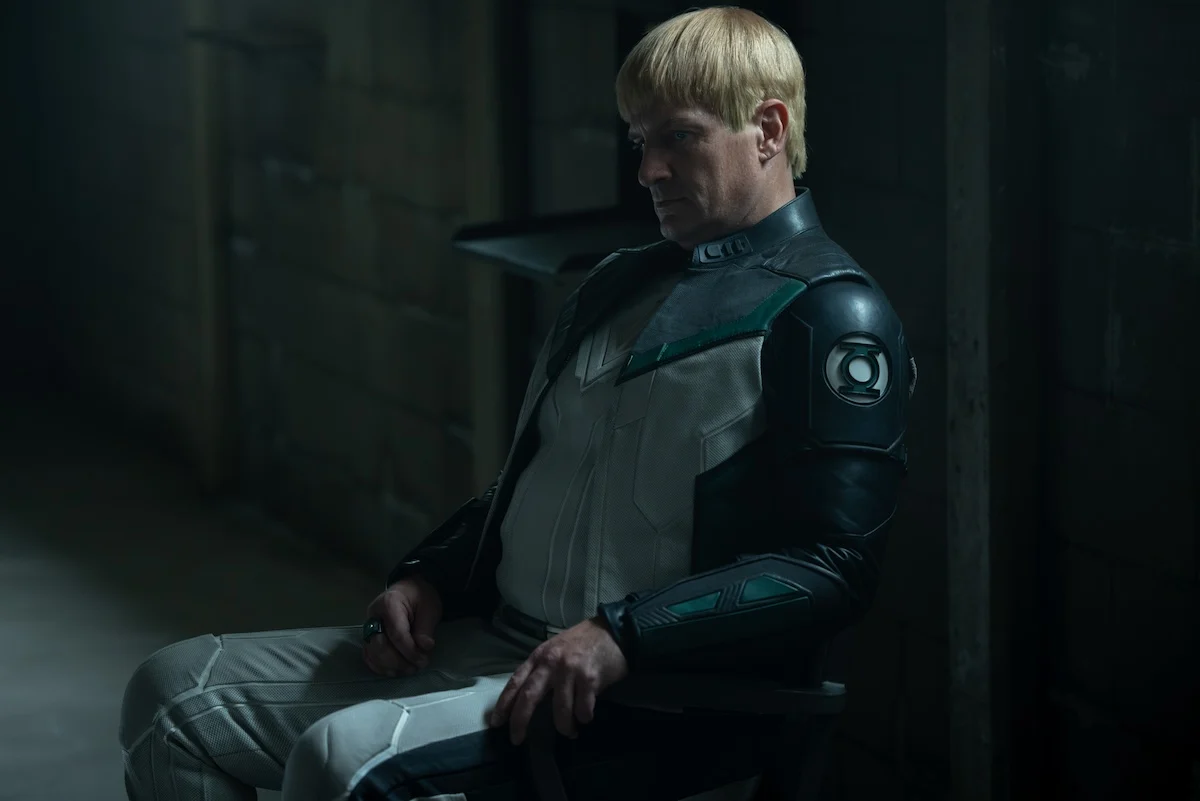
[Editor’s note: The following review contains significant spoilers for “Lanterns” Episode 6, “Bad Optics,” including details regarding the series’ central mystery and the fate of its lead characters. For a spoiler-free analysis, please consult our full season review.]
“Shit, am I dead?”
When the “Hal-o-gram”—a digital, consciousness-based echo of Hal Jordan—first uttered these words in the series premiere, it served as a dark, meta-textual wink at the audience. It was a cheeky bit of foreshadowing for the revelation that followed: the discovery of Hal’s literal, lifeless body. Now, six episodes into the inaugural season of HBO’s Lanterns, that same digital backup consciousness finds itself looking down at Hal’s freshly exhumed corpse. His response? A weary, resigned, “Goddamnit.”
The irony is palpable. While the physical Hal Jordan may be long gone, the show has refused to abandon the magnetic, acerbic energy brought to the screen by Kyle Chandler. By reviving Hal’s backup consciousness, Lanterns has successfully transformed the show’s dynamic. John Stewart (Aaron Pierre) is no longer investigating the murder of his mentor alone; he is now accompanied by a digitized version of the very man he was meant to replace. In a twist of fate, Hal’s backup has become his successor’s backup, ensuring that the friction—and the chemistry—between the two Green Lanterns remains the beating heart of the narrative.

The Chronology of a Cold Case
To understand the weight of the current investigation, one must look back at the night of the murder. Episode 6, titled “Bad Optics,” finally pulls back the veil on the final encounter between Hal and John.
For weeks, the audience has speculated about the circumstances surrounding Hal’s death. The truth is far more intimate and tragic than a simple act of violence. On the night he died, John Stewart traveled to Rushville, expecting an apology from his mentor—an apology promised to him by his mother, Bernadette. However, the meeting was a disaster. Hal had made no such promise, and the two quickly devolved into a heated argument regarding the destruction of the town and the subsequent loss of life that occurred years prior.
“I took the fall,” Hal insisted, pointing to his decade-long prison sentence as proof of his penance. John, ever the moral compass, countered with a devastating observation: “No, you didn’t take the fall. You fell.”
The tension escalated when Hal brought up the current Green Lantern, former athletic director Guy Gardner (Nathan Fillion), before delivering a chilling, prophetic warning: “There’s more than one killer at this table. You know that, right?” The scene ended with a desperate, frantic plea from Hal, urging John to keep his presence in Rushville a secret. Whether Hal was attempting to shield John from the town’s lingering resentment or possessed foreknowledge of his own impending assassination, the moment solidifies John’s path. He is now compelled not just to clear his own name—given that his DNA may be linked to the crime scene—but to solve the mystery that cost his mentor his life.

Supporting Data: The Suspects and the Scars of Rushville
As the series shifts its focus from the “how” to the “who,” the suspect pool has widened. With the help of the Hal-o-gram, John is systematically picking apart the threads of the investigation.
The Primary Suspects
- Sinestro: The former mentor looms large over the series, even in his absence. With rumors circulating that he has been broken out of space prison, Sinestro remains the most logical antagonist. He has the motive, the skill, and the deep-seated grudge against Hal to orchestrate such a high-profile killing.
- Noah: The son of Sheriff Kane (Kelly Macdonald) has been framed by the narrative as a potential sleeper agent. The Manhunter’s final command to him—to “remember everything it taught him”—suggests a long-term plan. As a football star with political ambitions, he perfectly embodies the “path to power” that the Manhunters historically seek.
- Sheriff Kane: Despite her grief, her involvement cannot be ruled out. While her tears appear genuine, the possibility remains that she killed Hal to protect the town or a loved one. The series forces us to ask: is she a tragic figure, or a calculated protector of a dark secret?
- John Stewart: While ranked as the least likely culprit, the show purposefully keeps the door ajar. The cryptic nature of Hal’s “more than one killer” comment leaves enough ambiguity for the series to pull a truly subversive twist in the finale.
Official Context and Narrative Implications
The production design of “Bad Optics” reflects the internal state of its characters. Rushville remains a ghost town, its infrastructure propped up by temporary beams that have become permanent scars. This setting is not merely a backdrop; it is a mirror for John Stewart’s own psychological state.
As writers Justin Britt-Gibson and Damon Lindelof emphasize through the parallel structure of John’s two visits to the town, he is trapped. He arrived in the pilot as an outsider, and he remains stuck there now, unable to move forward until the ghost of Hal Jordan is put to rest.
The emotional core of the episode is arguably the reveal that Hal had spent his final months attempting to humble himself. He was not the arrogant pilot of his youth; he was a man going door-to-door, mowing lawns and offering apologies to those he had wronged. Carol Ferris’s (Amie MacKenzie) confirmation that “he liked you, John” serves as the final, stinging reminder of the connection that neither man was capable of vocalizing while Hal was alive.

The Future of the Force
The introduction of the Hal-o-gram raises significant questions regarding the show’s long-term vision. Does Lanterns function better as a buddy-cop procedural featuring a living legend and a green recruit? Or is this a temporary crutch that prevents John from truly stepping into the light as the sole hero?
The “bad optics” of the show’s title take on a double meaning. On one hand, it refers to the literal investigation of a crime scene where the evidence is skewed. On the other, it questions the optics of continuing to center the narrative on a white hero, even in death, while the Black lead struggles to forge his own identity.
However, the chemistry between Chandler and Pierre is undeniable. As the series moves toward its conclusion, the show must decide if it will lean into the legacy of the Green Lantern Corps or prioritize the singular rise of John Stewart. For now, the audience is treated to a high-stakes, character-driven mystery that manages to balance sci-fi spectacle with the intimate, often uncomfortable, process of grief.
As John’s brother, Marcus, poignantly notes: “You’ve been stuck in Rushville for 10 years, and you ain’t leaving until you finish whatever it is you and Hal motherfucking Jordan started out there.”

With the Hal-o-gram now active and the investigation heating up, the path forward is as perilous as it is clear. John Stewart is no longer just holding the ring; he is holding the truth, and in the dark corners of Rushville, that is the most dangerous weapon of all.
Grade: B+
“Lanterns” airs new episodes on Sundays at 9 p.m. ET on HBO and is available for streaming on Max.
 Lina Hope
 Azzam Bilal Chamdy
 Pevita Pearce
