

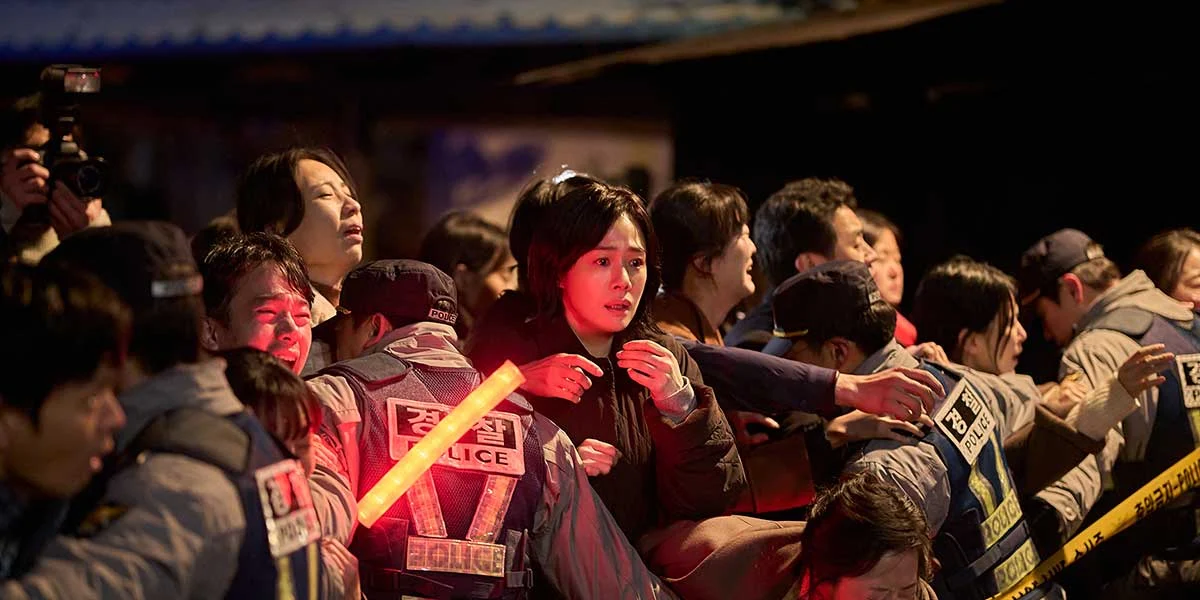
In the landscape of contemporary South Korean cinema, few directors possess the visceral, genre-bending command of Yeon Sang-ho. From the claustrophobic, high-octane terror of Train to Busan to the existential, super-powered grappling of Psychokinesis, Yeon has consistently proven his ability to weave complex social critiques into the fabric of blockbuster entertainment. However, his latest venture, Paradise Lost—which recently held its world premiere at the 2026 Toronto International Film Festival—marks a puzzling departure. It is a film of grand, ambitious ideas that ultimately collapses under its own weight, offering a dispiritingly flat exploration of grief, technology, and morality.
The Core Premise: A Tri-Pronged Narrative
At its heart, Paradise Lost attempts to juggle three disparate thematic balls: the use of Virtual Reality (VR) as a coping mechanism for profound grief; the narrative trope of a long-lost child returning home after a decade; and a dark, cautionary tale regarding sociopathy and the cycle of learned violence.
While each of these threads contains enough dramatic potential to anchor a feature-length film, the screenplay forces them into a collision course that leaves no room for character development or emotional resonance. The result is a film that feels less like a cohesive narrative and more like an intellectual exercise in "what-if" scenarios, where the characters function as mere chess pieces in a predictable game of genre tropes.
A Chronology of Disillusionment
The film begins with a promising, albeit ominous, first act. We are introduced to So-young (played with a desperate, wasted intensity by Kim Hyun-joo), a single mother whose life is shattered when her young son, Sun-woo, disappears while on a school trip. The inciting incident is handled with the director’s signature efficiency: a bus goes missing, a crash site is discovered near an unstable mine, and the grim reality of death settles over the surviving families.
In the wake of this tragedy, the tech conglomerate "Transhuman" enters the fray, offering a digital panacea. Their "Children of Paradise" project utilizes high-fidelity VR technology to create digital avatars of the deceased children, allowing parents to continue their parental bonds in a synthetic, ageless afterlife.
For the next nine years, the narrative follows So-young’s descent into this dream state. She lives in a perpetual loop, interacting with a version of Sun-woo that remains trapped at the age he was when he vanished. However, the equilibrium of her existence is shattered when the police reach out with a startling discovery: a young drifter, played by Bae Hyun-sung, has been identified via DNA testing as the real Sun-woo.

The stage is set for a profound psychological exploration: how does a parent reconcile a sanitized, perfect digital memory with a flesh-and-blood human being who has been hardened by a decade of trauma? Unfortunately, this is where the film begins to lose its way.
Supporting Data: The Comparison to "Sheep in the Box"
The thematic overlap between Paradise Lost and Hirokazu Kore-eda’s Cannes entry Sheep in the Box is striking. Both films pivot around the concept of an artificial copy of a lost child. Yet, where Kore-eda’s film uses the android child as a mirror to reflect the nuances of human connection, Yeon’s film treats the VR ghost-child as a plot device.
In Paradise Lost, the VR glasses are merely a gateway to a conflict that the script is unwilling to truly explore. The film lacks a genuine interest in the ethical implications of its own central conceit. While the audience is invited to ponder the nature of grief and the danger of living in the past, the screenplay constantly pivots to a more lurid, procedural-style investigation into the teenage Sun-woo’s alleged sociopathic tendencies. By prioritizing thriller elements over character-driven drama, the film dilutes the impact of its most poignant questions.
Official Responses and Industry Context
While the film is currently seeking U.S. distribution, early industry reactions out of Toronto have been mixed, leaning toward disappointment. Critics have noted that while the production design—particularly the rendering of the VR world—is technically proficient, the script fails to provide the "whizbang" action that usually balances Yeon’s more heavy-handed philosophical musings.
Compared to Jung_E, Yeon’s previous foray into the intersection of technology and humanity, Paradise Lost feels strangely muted. Jung_E successfully masked its existential inquiries behind the spectacle of gun-toting androids; Paradise Lost, however, has no such mask. It forces the audience to sit in the stillness of So-young’s living room, and because the dialogue is so heavily focused on exposition rather than visceral emotion, the experience becomes tedious.
Implications: The Failure of the Emotional Catch-22
The most significant failing of Paradise Lost is its refusal to engage with the emotional Catch-22s it creates. A compelling drama about a mother choosing between a digital fantasy and a broken, violent reality requires a deep dive into the messiness of the human heart. Instead, Yeon provides an audience-friendly, albeit predictable, path.

Bae Hyun-sung’s portrayal of the teenage Sun-woo is particularly illustrative of the film’s missed opportunities. Rather than allowing the character to embody the tragedy of a lost decade, the script uses him as a mouthpiece to verbalize the film’s themes. He is a plot point rather than a person, a device used to escalate the tension when the drama begins to sag.
The conversations between So-young and the executives at Transhuman are perhaps the most egregious offenders. These scenes serve as mere window dressing, gesturing at ethical quandaries—such as the commodification of grief—without ever committing to a stance or challenging the viewer. The film essentially tells us what to think about its themes, rather than showing us the human cost of those themes in action.
Final Verdict
As the credits roll, the viewer is left with a sense of emptiness that has nothing to do with the film’s tragic subject matter and everything to do with its lack of narrative depth. Paradise Lost wraps itself up with a neatness that feels unearned, leaving no room for the audience to grapple with the complexities of loss, mortality, or our increasingly digital existence.
It is a rare misstep for a director of Yeon’s caliber. By opting for a procedural structure that barely gels with the emotional core of the story, the film squanders its potential. It is a cautionary tale of a different sort: that no amount of technical skill can compensate for a story that fails to breathe.
Grade: C+
Paradise Lost is currently seeking U.S. distribution following its premiere at the 2026 Toronto International Film Festival.
 Lina Irawan
 Iffa Jayyana
