

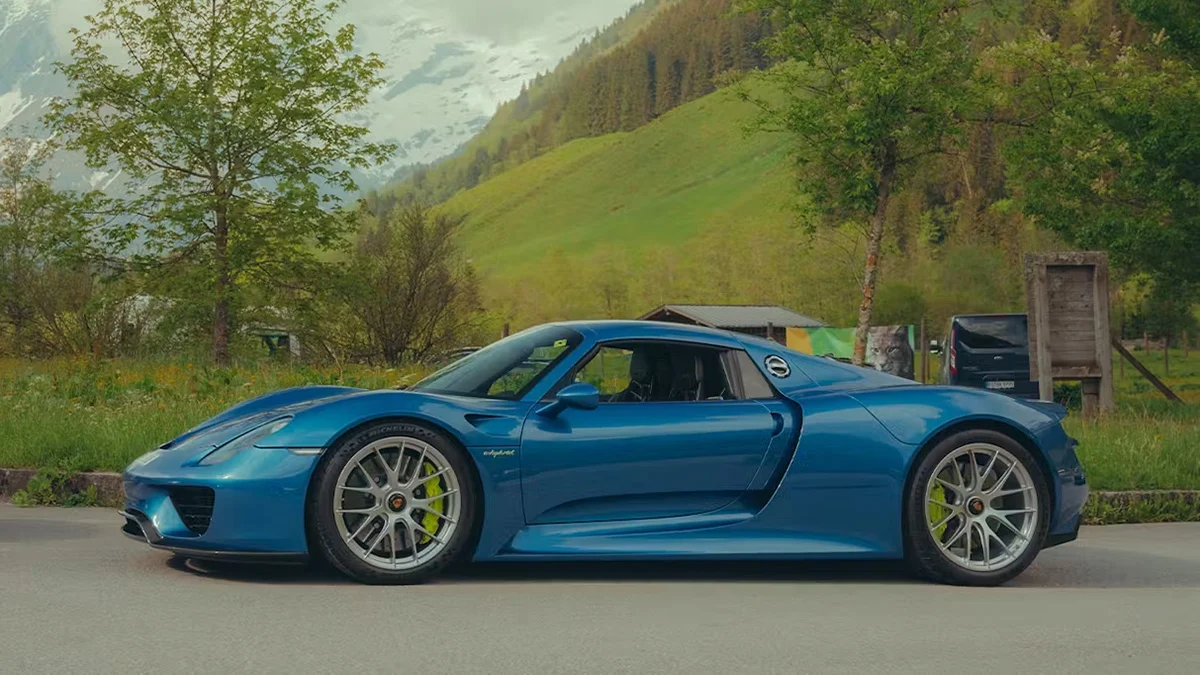
The automotive world is once again buzzing with anticipation as rumors swirl out of Stuttgart. According to recent reports from the prominent German business newspaper Handelsblatt, Porsche is deep in development on a revolutionary new flagship supercar—tentatively dubbed the S1—that threatens to usurp the venerable 911 from its long-held position at the pinnacle of the marque’s lineup.
While the 911 remains the undisputed heartbeat of Porsche and one of the most celebrated sports cars in automotive history, the introduction of this new halo vehicle promises to push engineering boundaries previously thought unattainable for a series-production road car. Most thrilling of all for purists and technophiles alike is the persistent rumor that the S1 will be powered by an industry-shaking, production-ready flat-eight engine—a configuration the company has tinkered with historically, but never before commercialized for public roadways.
As details trickle in from European outlets, the global automotive community is bracing for what could be the most significant Porsche hyper-machine since the legendary 918 Spyder bowed out of production a decade ago.
Main Facts: What We Know About the Porsche S1
At the center of this developing story is a vehicle currently known in insider circles as the S1. While official confirmation remains guarded, the core details emerging from German automotive reporting paint a vivid picture of a machine engineered to redefine performance:
- The Powerplant: The S1 is heavily rumored to feature a flat-eight (boxer-8) engine. If true, this marks a monumental milestone for Porsche, as the brand has never installed a flat-eight engine into a regular production road car, despite decades of experimental development.
- The Heritage Gap: It has been more than ten years since Porsche last offered a true flagship supercar. The S1 would fill the void left vacant since the termination of the 918 Spyder production run.
- The Price Tag: According to Handelsblatt, the projected base price for the S1 will hover around €500,000 (roughly $572,000 USD). This places it squarely in hypercar territory—significantly more expensive than a range-topping 911 Turbo S, yet notably more accessible than the million-dollar-plus hypercars dominating today’s market.
- The Timeline: Whispers suggest that prospective investors and select stakeholders may get their very first private glimpse of the vehicle as early as October 7, hinting that a public concept or prototype reveal could be closer than previously imagined.
Chronology of Kings: Porsche’s Lineup Hierarchy and Supercar History
To understand the magnitude of the S1, one must look back at Porsche’s historical approach to its internal hierarchy. While the 911 is the emotional and commercial anchor of the brand, Porsche has a storied tradition of periodically introducing ultra-exclusive halo supercars that sit comfortably—and perform radically—above the 911 range.
1985: The Porsche 959
Long before hypercars were a common industry segment, the Porsche 959 arrived as a technological tour de force. Originally developed to conquer Group B rallying, the all-wheel-drive, twin-turbocharged marvel showcased innovations like adjustable ride height, tire-pressure monitoring, and sequential turbocharging. It briefly claimed the title of the world’s fastest street-legal production car and established a blueprint for future technological flagships.
1998: The 911 GT1 Strassenversion
Born out of homologation requirements for top-tier endurance racing, the road-going 911 GT1 was essentially a Le Mans race car wrapped in bare-minimum street legalities. Powered by a twin-turbocharged flat-six engine mounted in the middle of a tubular chassis, only a tiny handful of these street versions were ever built, cementing their place as unicorn status collectibles.
2004–2006: The Carrera GT
Fifteen years after the 959, Porsche pivoted toward pure, unadulterated analog engagement with the Carrera GT. Featuring a carbon-fiber monocoque chassis and a shrieking, race-derived 5.7-liter V-10 engine generating 605 horsepower, it paired a traditional six-speed manual transmission with a revolutionary ceramic clutch. Today, it is universally regarded as one of the greatest-sounding and most challenging driver’s cars ever assembled.

2013–2015: The 918 Spyder
The most recent addition to Porsche’s elite hypercar pantheon was the 918 Spyder. Arriving in the mid-2010s alongside contemporaries like the Ferrari LaFerrari and McLaren P1, the 918 pioneered the "Holy Trinity" era of hybrid hypercars. It combined a naturally aspirated 4.5-liter V-8 engine with dual electric motors to churn out a combined 875 horsepower, routing power through a lightning-fast dual-clutch transmission to all four wheels.
Now, a decade after the final 918 rolled off the production line in Stuttgart, the S1 is poised to become the fifth pillar in this legendary dynasty of displacement and design.
Supporting Data: The Mechanics of the Flat-Eight
The most compelling technical rumor surrounding the S1 involves its rumored engine configuration. Why is a flat-eight such a monumental talking point in the automotive industry?
Boxer engines—characterized by horizontally opposed cylinders that move inward and outward simultaneously—offer inherent engineering advantages. Their low center of gravity improves vehicle handling dynamics, while their primary balance reduces engine vibrations. While Porsche is universally famous for its flat-six engines (most notably found hanging over the rear axle of the 911), scaling that architecture up to eight cylinders for a production road car has historically been deemed too complex, bulky, or expensive for mass implementation.
However, recent developments within Porsche’s research and development divisions suggest breakthroughs in powertrain design. For instance, reports have surfaced regarding internal testing of advanced internal combustion concepts tied to Porsche’s eFuel initiatives. One notable test bed featured a 5.0-liter twin-turbocharged flat-eight engine engineered to produce:
- 750 horsepower
- 728 lb-ft of torque
- A screaming 9,000 RPM redline
Whether this specific experimental eFuel-compatible mill will find its way into the engine bay of the S1 remains unconfirmed, but the technical capability to build a high-revving, massively powerful flat-eight is clearly present within Porsche’s engineering arsenal.
From a financial standpoint, the projected €500,000 ($572,000 USD) price point occupies a very specific strategic niche:
- Porsche 911 Turbo S: Starts at approximately $270,300 USD.
- The Projected S1 Supercar: Estimated at ~$572,000 USD (nearly double the Turbo S).
- Porsche 918 Spyder (Original MSRP): Launched around $845,000 USD.
By pricing the S1 well above the 911 hierarchy yet below the rarefied air of the multi-million-dollar collector hypercar market, Porsche is carving out a sustainable, highly lucrative niche for high-net-worth enthusiasts seeking ultra-exclusive performance.

Official Responses and Industry Reactions
As is customary for major automotive manufacturers guarding proprietary pipeline updates, Porsche’s corporate communications team has maintained a tight-lipped stance. When reached for formal comment regarding the Handelsblatt report and the existence of the S1, a Porsche representative offered a standard industry disclaimer to Robb Report:
"We can’t speculate or comment on potential future product."
Despite the official corporate reticence, industry analysts and insider leaks suggest that internal momentum behind the project is exceptionally strong. The rumored October 7 stakeholder preview indicates that Porsche may be preparing to socialize the concept with key investors, a classic precursor to official design sign-offs and public teaser campaigns.
Automotive journalists and financial markets alike are watching closely to see how the S1 aligns with Porsche’s broader electrification strategy. While the brand has heavily invested in battery-electric vehicles (EVs) like the Taycan and the upcoming electric Macan and Boxster/Cayman replacements, the S1 indicates that Stuttgart remains fiercely committed to pushing the absolute limits of internal combustion—especially when paired with synthetic eFuels that could secure the future of high-performance engines in a tightening regulatory landscape.
Implications: What the S1 Means for the Future of Porsche
The introduction of a flat-eight supercar carrying a badge above the 911 carries profound symbolic and practical implications for the brand:
- Redefining the Halo Effect: For decades, the 911 GT2 RS and Turbo S have served as the functional ceilings for Porsche’s lineup. Introducing a dedicated, mid-engine supercar re-establishes a clear tier above the 911, giving elite buyers a fresh object of desire that doesn’t share architecture with a mass-production sports car.
- The Preservation of Combustion: By exploring cutting-edge multi-cylinder configurations—potentially paired with carbon-neutral eFuels—Porsche is signaling that the internal combustion engine still has a vibrant, evolutionary future ahead of it, even as the global automotive sector races toward electrification.
- Market Positioning: At a half-million dollars, the S1 bridges the gap between ultra-high-end sports cars and unobtainable, ultra-limited hypercars. This sweet spot allows Porsche to capture capital from collectors who missed out on the 918 Spyder or are priced out of the hyper-exclusive secondary market.
As autumn unfolds and whispers from Stuttgart grow louder, enthusiasts around the world wait with bated breath. If the rumors prove true, the Porsche 911 may soon have to share the spotlight—and perhaps even surrender its crown—to a flat-eight titan destined to write a brand-new chapter in automotive history.
 Sagoh
Sagoh
 Reynand Wu
 Siti Muinah
