

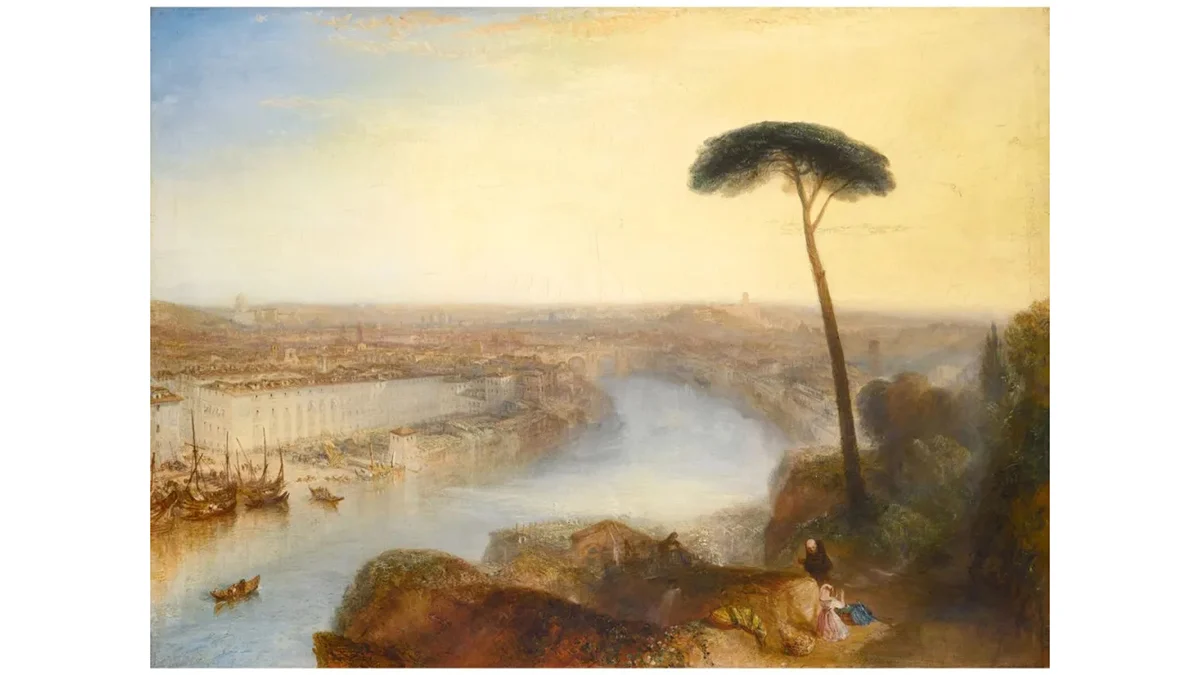
LONDON — In what is already being heralded as one of the most significant art market events of the decade, a breathtaking and exceptionally rare masterpiece by Joseph Mallord William Turner is set to hit the auction block. Rome, from Mount Aventine (1836), a luminous and defining work from the zenith of the British artist’s career, has been consigned to Sotheby’s with an eye-watering pre-sale estimate of £50 million ($66.2 million).
The painting is scheduled to anchor Sotheby’s prestigious Old Master Evening Sale in London on December 9. Before it crosses the podium in the British capital, however, the canvas is enjoying a triumphant homecoming. It is currently being exhibited to the public at the Palazzo Rondinini, a magnificent 18th-century Baroque palace in the heart of Rome, where it will remain on view through October 1, offering Italian audiences a rare glimpse of their city as envisioned by Britain’s greatest landscape painter nearly two centuries ago.
The impending sale not only underscores the enduring resilience and stratospheric ceiling of the high-end art market for blue-chip masterpieces, but it also shines a spotlight on a canvas that has spent nearly its entire existence sheltered from the public eye. Remaining one of the very few major Turner paintings still held in private hands, its return to the open market is a momentous occasion for curators, historians, and international collectors alike.
Main Facts: The Sale, The Estimate, and The Canvas
The headline figure of £50 million ($66.2 million) places Rome, from Mount Aventine squarely in the upper echelon of historic art sales. While contemporary and modern art frequently command nine-figure sums, Old Masters and 19th-century British works of this caliber rarely achieve such astronomical valuations, signaling that premier, museum-quality historical canvases remain intensely coveted by global ultra-high-net-worth collectors.
Measuring an impressive scale that allows for sweeping topographical detail blended with Turner’s signature atmospheric dissolution, the 1836 painting depicts the Eternal City bathed in the warm, honeyed glow of an Italian sun. From the elevated vantage point of Mount Aventine, Turner captures a panoramic vista that sweeps across the Tiber River, taking in architectural landmarks like the dome of St. Peter’s Basilica while dissolving the boundaries between earth, air, and light.
Crucially, the physical integrity of the painting adds immeasurably to its value. In its 191-year history, Rome, from Mount Aventine has never been relined, nor has it undergone any structural restoration. It remains remarkably preserved on its original canvas and housed in its original frame—a miraculous survival for a 19th-century oil painting. This pristine, untouched state provides a direct, unmediated window into Turner’s working methods and creative intent, sparing the surface from the interventions of later conservators that so often alter the texture and luminosity of historic works.
Chronology: The Journey of a Masterpiece
To understand the extraordinary provenance of Rome, from Mount Aventine, one must trace a timeline spanning nearly two centuries, marked by visionary patronage, aristocratic unions, and rare appearances in the public sphere.
1835–1836: Conception and Creation
The genesis of the painting lies in Turner’s extended travels through Italy, where he absorbed the searing light and classical topography of the Mediterranean. According to historical records and scholarship provided by Sotheby’s, the painting was conceived and initially mapped out during Turner’s time in Italy. However, true to his customary studio practice, Turner brought his preliminary sketches and color studies back to London, where the composition was fully realized and completed on the canvas in 1836.
The painting was directly commissioned by Hugh Andrew Johnstone Munro of Novar, a prominent Scottish art collector, landowner, and amateur painter. Munro was not merely a wealthy patron; he was one of Turner’s closest friends and most trusted confidants, frequently traveling with the artist and offering crucial support during a period when Turner’s increasingly radical, atmospheric style was beginning to baffle more conservative critics.
1876: An Aristocratic Wedding Gift
For four decades, the painting remained in Munro’s collection. Following Munro’s death and subsequent estate dispersions, the canvas reached a watershed moment in its provenance. In 1876, the painting was acquired by Archibald Primrose, the 5th Earl of Rosebery—who would later serve as the Prime Minister of the United Kingdom.
Lord Rosebery purchased the painting for the princely sum of £6,142. Adjusted for inflation, that figure equates to roughly £636,165 in today’s currency. Rosebery bought the magnificent Turner as a wedding gift for his bride, Hannah de Rothschild. Hannah was the daughter of Baron Mayer de Rothschild and was recognized at the time as the wealthiest woman in Great Britain. For the young couple, the acquisition of a major Turner was a statement of cultural sophistication, immense wealth, and political ambition.
2014: The Landmark Auction
For more than 130 years, Rome, from Mount Aventine remained tightly held within the Rosebery family estate, hidden away from public exhibitions and art market scrutiny. That changed dramatically in July 2014, when the family decided to part with the heirloom, sending it to Sotheby’s London saleroom.
The 2014 auction created a sensation. Bidding was fierce, reflecting the extreme scarcity of major Turners on the market. When the hammer finally fell, the painting realized a stellar £30.3 million (approximately $51.7 million at the time), shattering previous records for the artist and setting a high-water mark for 19th-century British painting.
2025: The Return to Rome and the Upcoming Sale
Following its 2014 acquisition by an anonymous private collector, the painting once again receded into private view. Now, a little over a decade later, it is cycling back through the market. The journey begins with its current public exhibition at the Palazzo Rondinini in Rome—a poignant geographic homecoming—before heading to London for the December 9 Old Master Evening Sale, where it aims to eclipse its previous auction record.
Supporting Data: Contextualizing the Turner Market
To fully appreciate the significance of the £50 million estimate, it is necessary to examine the broader economic and art-historical landscape surrounding J.M.W. Turner.
- The Turner Bequest: The vast majority of Turner’s lifetime artistic output—consisting of hundreds of oil paintings and tens of thousands of sketches and watercolors—was bequeathed by the artist to the British nation upon his death in 1851. Today, the bulk of this treasure trove resides permanently in the Clore Gallery at Tate Britain. Consequently, the number of finished, major oil paintings remaining in private hands can be counted on two hands, turning every appearance of a private Turner into a historic event.
- Auction Records: Turner’s previous auction record was firmly established by Rome, from Mount Aventine itself when it sold for £30.3 million in 2014. Prior to that, Turner works rarely crossed the eight-figure threshold at auction. If the painting achieves its current £50 million estimate, it will represent a staggering value growth of roughly 65% over its 2014 price in just over a decade, far outpacing general inflation and demonstrating the robust appetite for undisputed masterworks.
- Condition Metrics: The fact that the painting has never been relined places it in an elite tier of historical survivals. In the 19th and early 20th centuries, standard conservation practice often involved "relining"—attaching a new canvas to the back of the original using heat and adhesive to stabilize degrading fabric. That Rome, from Mount Aventine has survived untouched means that its original canvas weave, impasto texture, and delicate glaze layers remain entirely uncompromised, commanding a significant premium among museum curators and sophisticated collectors who prioritize absolute authenticity.
Official Responses: What the Experts Say
The announcement of the consignment has drawn enthusiastic commentary from the upper echelons of the international art trade, emphasizing both the aesthetic brilliance of the work and its pivotal role in the history of art.
Julian Gascoigne, Senior Specialist of British Paintings at Sotheby’s London, issued a glowing assessment of the canvas in an official statement released by the auction house:
"Few paintings capture Turner’s genius as vividly and completely as this extraordinary vision of Rome’s timeless beauty. Created at the height of his powers, it is a work of extraordinary ambition, beauty, and innovation, one that has come to define not only Turner’s achievement but the very course of modern painting."
Gascoigne’s emphasis on "modern painting" touches upon a critical art-historical consensus. Long before the birth of Impressionism or Abstract Expressionism, Turner was dissolving forms, prioritizing light and color over rigid draughtsmanship, and painting atmospheric conditions rather than physical objects. Rome, from Mount Aventine is frequently cited by scholars as a direct precursor to modernism, demonstrating an avant-garde fearlessness that anticipated the radical experiments of Claude Monet and the French Impressionists by decades.
Italian cultural commentators and representatives at the Palazzo Rondinini have similarly expressed profound pride in hosting the exhibition. Allowing the painting to hang in Rome prior to its sale provides a bridge between British patronage, Scottish collection history, and the Italian landscape that inspired it all.
Implications: What This Sale Means for the Art World
As the December 9 auction approaches, art market analysts are looking beyond the headlines to gauge what the sale of Rome, from Mount Aventine signifies for the broader cultural economy.
1. The Flight to Quality in an Uncertain Market
Against a backdrop of global economic fluctuations and geopolitical uncertainty, wealth managers note that ultra-high-net-worth individuals increasingly view blue-chip art as a secure, tangible store of value. However, this "flight to quality" is highly selective. While the mid-tier art market often experiences sluggishness, museum-quality masterpieces with impeccable provenance—such as a pristine, un-restored Turner with a storied aristocratic history—remain virtually immune to market downturns. The £50 million estimate reflects deep confidence that ultimate-tier assets will always find aggressive, competitive bidding.
2. The Scarcity Premium of Private Turners
Because the National Gallery, Tate Britain, and international institutions hold institutional monopolies over the vast majority of Turner’s oeuvre, private collectors face a near-insurmountable barrier to entry if they wish to own a premier oil painting by the artist. When a masterpiece like Rome, from Mount Aventine comes to market, it represents a once-in-a-generation opportunity. This acute scarcity artificially inflates valuations, turning the auction into a high-stakes proxy war among global billionaires and private foundations.
3. Public Accessibility vs. Private Wealth
The impending sale also reignites ongoing debates within the cultural sector regarding the privatization of art history. While the exhibition in Rome temporarily restores the painting to public view, its ultimate destination following the December auction will almost certainly be another private collection, hidden away behind secure gates and climate-controlled residential galleries. Museum directors and cultural heritage advocates frequently lament the cyclical disappearance of such pivotal works, raising questions about whether governments or public institutions should intervene—or whether the private market remains the only viable mechanism for preserving and circulating works of this magnitude.
Conclusion
For now, all eyes are turned toward Rome and London. As Rome, from Mount Aventine glows under the lights of the Palazzo Rondinini and prepares for its monumental evening at Sotheby’s, it carries with it the weight of 191 years of history. Whether it shatters expectations and surpasses its £50 million estimate remains to be seen, but one thing is certain: J.M.W. Turner’s visionary embrace of light and air continues to captivate the world, proving that true genius only appreciates with time.
 Evan Lee Salim
 Asep Darmawan
 Laily UPN
