

Published on September 25, 2026
The automotive world has long held a fascination with the Mercedes-Benz G-Class. Originally conceived as a utilitarian military workhorse, it has evolved over the decades into the ultimate status symbol—a boxy, uncompromising titan of the tarmac. Yet, for the German master tuner Brabus, the standard factory output of an AMG G 63 is merely a blank canvas. Today, the Bottrop-based powerhouse has shattered expectations once again, unveiling the 900 Rocket Edition Cabrio: an open-top, high-performance masterclass that effectively redefines what a luxury off-roader can be.
Main Facts: Engineering the Impossible
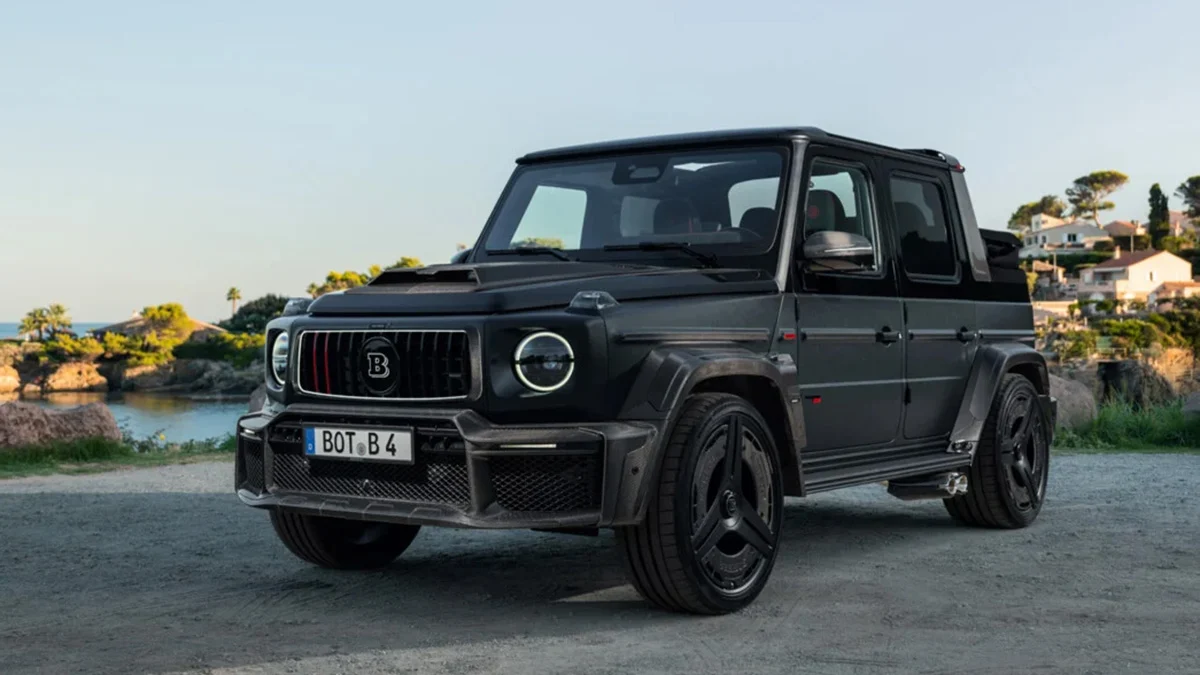
The Brabus 900 Rocket Edition Cabrio is not simply a G-Wagen with its roof removed; it is a fundamental reconstruction of the vehicle’s structural and mechanical identity. By surgically removing the roof and everything above the beltline beyond the C-pillar, Brabus has created an open-air experience that remains faithful to the G-Wagen’s aggressive aesthetic while introducing a level of bespoke craftsmanship rarely seen in the automotive industry.

At the heart of this beast lies a 4.5-liter twin-turbocharged V-8 engine, a significant departure from the 4.0-liter displacement found in the stock Mercedes-AMG G 63. Through the implementation of forged pistons, high-performance connecting rods, and a custom-milled billet crankshaft, Brabus has coaxed a staggering 888 horsepower and 922 ft-lbs of torque from the powertrain. This power is funneled through a nine-speed automatic transmission, propelling the massive SUV from a standstill to 62 mph in a supercar-rivaling 3.2 seconds.
A Chronology of Excess: From XL to Rocket
Brabus has never been a company to shy away from the extreme, and the trajectory toward the 900 Rocket Edition Cabrio is a storied one.
- The Foundation: For decades, Brabus has dominated the G-Class tuning market, establishing the "Rocket" moniker as their ultimate performance tier.
- The Precursor: The company previously experimented with the open-top format via the XL 800 Cabrio. While that vehicle proved the viability of a topless G-Wagen, it lacked the refined engineering and the sheer horsepower output of the new 900 series.
- The Development Phase (2024–2026): Over the past two years, Brabus engineers focused on structural rigidity. Removing a fixed roof from a vehicle as tall as the G-Wagen usually compromises handling; to mitigate this, Brabus integrated 500 newly developed components, including a specialized carbon-fiber bow designed to maintain the soft-top’s shape at high velocities.
- The Unveiling (September 2026): The culmination of this research is the 900 Rocket Edition, a limited-run masterpiece that bridges the gap between a rugged 4×4 and a high-speed convertible.
Supporting Data: Performance and Precision
To understand the 900 Rocket Edition, one must look at the data points that differentiate it from the standard G-Wagen.

Performance Specifications
| Feature | Specification |
|---|---|
| Engine | 4.5L Twin-Turbo V-8 |
| Horsepower | 888 hp |
| Torque | 922 ft-lbs |
| 0-62 mph | 3.2 seconds |
| Top Speed | 149 mph (electronically limited) |
| Production | 10 examples worldwide |
The vehicle’s suspension is equally impressive. It features a fully adjustable setup that allows the driver to lower the ride height by 1.8 inches, shifting the center of gravity to enhance cornering stability—a necessary adjustment given the vehicle’s massive footprint and high-performance capabilities.
Aesthetic Appointments
The visual language of the 900 Rocket Edition is defined by "Rocket Red" accents and an aggressive body kit. The front fascia has been redesigned to feed more air into the enlarged turbochargers, while the fender flares have been widened to accommodate bespoke "Platinum Edition" monoblock wheels. These rims are a nostalgic nod to the iconic three-spoke designs that graced Brabus builds in the 1980s, providing a heritage-inspired touch to a modern technical marvel.
Inside, the cabin is a symphony of luxury. The four-seat configuration features center consoles for both rows, ensuring that rear passengers enjoy the same level of opulence as those in the front. The interior is drenched in black leather and Alcantara, highlighted by high-gloss carbon-fiber trim and the signature Brabus shell-patterned quilting on the seats.

Official Perspectives: The Brabus Philosophy
In a statement accompanying the release, Brabus representatives emphasized that the 900 Rocket Edition Cabrio is not meant to be a mass-produced vehicle. "Our objective was to strip away the limitations of the factory G-Wagen while preserving its soul," a spokesperson noted. "By integrating the motorized soft-top with a high-performance engine typically reserved for our sedans, we have created an open-top experience that is as exhilarating on a mountain pass as it is on the coast."
The decision to limit production to just 10 units is a strategic move to ensure exclusivity. At a price point of 890,740 euros—surpassing the $1 million mark—the vehicle is positioned not merely as a car, but as a collectible piece of art. For the prospective buyer, the value lies in the personalization and the assurance that no other vehicle on the road will match the engineering intensity of the Rocket Edition.
Implications for the Luxury Automotive Market
The arrival of the 900 Rocket Edition Cabrio has significant implications for the future of luxury vehicle customization.

- The Resurgence of the Cabriolet: While the automotive industry has largely pivoted toward SUVs and crossovers, the demand for open-top experiences remains strong among ultra-high-net-worth individuals. Brabus is proving that "open-air" does not have to mean "impractical."
- The Limits of Tuning: The 900 Rocket Edition pushes the G-Class platform to its physical limits. By moving from a 4.0L to a 4.5L engine, Brabus is signaling that they are no longer satisfied with software mapping; they are now performing deep-level mechanical engineering that rivals major OEMs.
- Investment Grade Collectibles: With only 10 units being produced, the 900 Rocket Edition is essentially "pre-sold" to a list of existing collectors. This reinforces the trend of top-tier tuning houses transitioning into limited-run boutique manufacturers, effectively bypassing the traditional dealership model.
Conclusion: A New Zenith
The Brabus 900 Rocket Edition Cabrio is a testament to the brand’s refusal to conform. In a market where electrification and homogenization are becoming the norm, this vehicle stands as a loud, unapologetic celebration of the internal combustion engine and the art of coachbuilding. It is a vehicle designed for a very specific type of owner: one who views the world from the top, expects the best in performance, and demands a level of exclusivity that money—at least for those who can afford the million-dollar price tag—can indeed buy.
For those interested in the engineering details, the aesthetic choices, or the sheer spectacle of the build, the 900 Rocket Edition is a landmark achievement. It confirms that as long as there is an iconic chassis and an insatiable desire for power, Brabus will continue to redefine the boundaries of what is possible on four wheels. Those fortunate enough to secure one of the 10 build slots will find themselves in possession of more than just a car; they will own a piece of automotive history that stands as the absolute zenith of the G-Wagen evolution.
 Pevita Pearce
 Suro Senen
 Sagoh
Sagoh
