

If you have spent the last decade ignoring the seismic shift occurring in the world of global spirits, you have likely missed the rise of Indian single malt. Long relegated to the periphery of the whisky world, Indian producers have spent the last fifteen years proving that terroir—even in the tropical heat of Goa—is a formidable force. Now, as high-quality releases from the subcontinent become increasingly accessible to American collectors, a new, ultra-limited collaboration serves as a masterclass in cross-continental maturation.
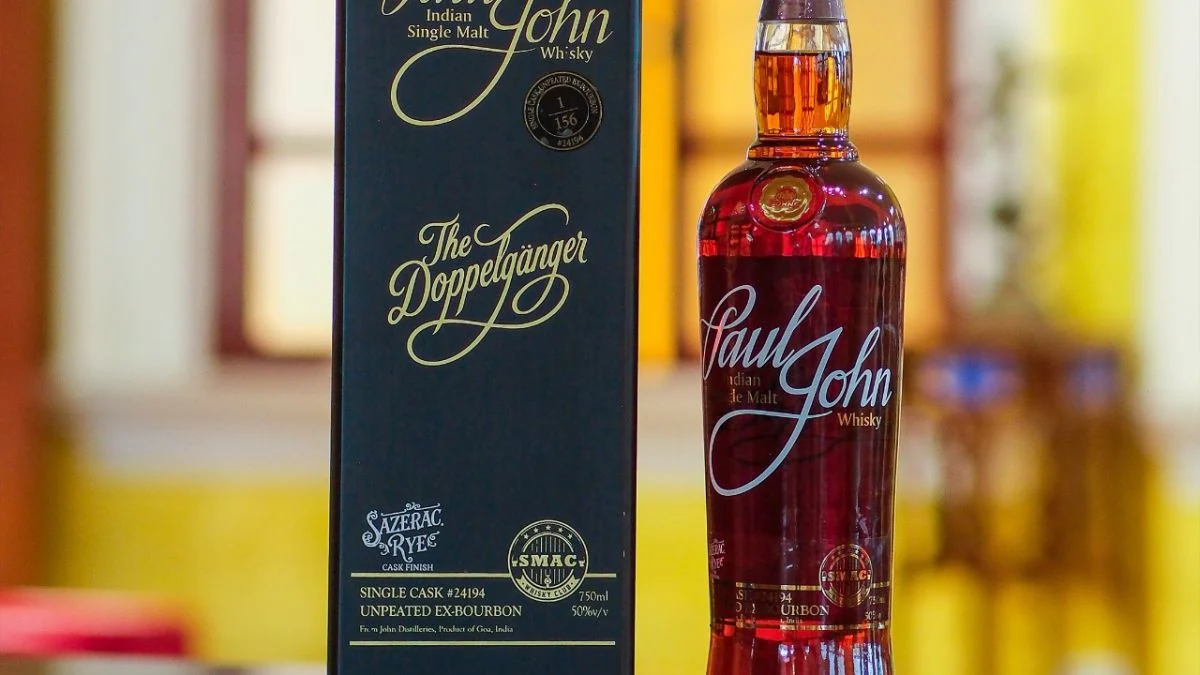
The latest release from the celebrated John Distilleries in Goa, titled "Doppelgänger," is not merely a new bottle on the shelf. It represents a rare, high-stakes experiment: an Indian single malt aged in a barrel that once held the legendary Sazerac Rye from Buffalo Trace. For enthusiasts of both American bourbon/rye culture and the emerging Indian category, this release is a unicorn worth hunting.
Main Facts: A Convergence of Two Distilling Titans
The "Doppelgänger" is a single-cask expression (cask #24194) that bridges the gap between the humid, high-velocity maturation climate of India and the storied, spice-forward traditions of Kentucky’s Sazerac Rye.
Produced by the award-winning Paul John distillery, this single malt spent nearly nine years in its barrel. In the context of Indian whisky, where the tropical climate accelerates wood extraction by as much as three times that of Scotland or Kentucky, nine years is an eternity. It suggests a spirit that has reached a profound level of maturity, complexity, and structural integrity.
The collaboration was orchestrated through the Single Malt Amateur Club (SMAC) of India. Having formed a partnership with the distillery in 2020, this marks the fourth single-cask collaboration between the two entities. However, it is the first time the partnership has utilized a Sazerac Rye cask, setting a new benchmark for what can be achieved when American oak and Indian spirit collide. With only 156 bottles produced, the release is as ephemeral as it is significant.
The Chronology of a Distilling Powerhouse
To understand why this collaboration matters, one must look at the meteoric rise of Paul John. While the brand officially entered the market in 2012, its parent company, John Distilleries, was founded in 1992 by Paul P. John. The distillery is situated in Goa, a coastal region that provides a unique microclimate for spirit aging.
- 2008: John Distilleries begins its journey into the production of high-end single malts.
- 2012: The official launch of the Paul John single malt range, which quickly garners international acclaim at prestigious competitions like the World Whiskies Awards.
- 2017: Sazerac Company, the parent entity of Buffalo Trace, acquires a majority stake in John Distilleries, creating a formal bridge between the American powerhouse and the Indian innovator.
- 2020: The inception of the partnership with SMAC (Single Malt Amateur Club), aimed at pushing the boundaries of what consumers expect from Indian whisky.
- 2024: The release of "Doppelgänger," the first collaboration featuring a Sazerac Rye cask, cementing the synergy between the two companies.
Supporting Data: Why Climate and Cask Matter
The "Doppelgänger" is a case study in scientific maturation. For the uninitiated, the "Angel’s Share"—the amount of whisky lost to evaporation—is significantly higher in Goa than in the cooler climates of the Northern Hemisphere. This creates a dense, concentrated flavor profile that allows younger whiskies to exhibit characteristics that would take decades to develop in a traditional climate.
However, the Doppelgänger defies this rule by aging for nearly nine years. By selecting a cask previously used to age Sazerac Rye, the blenders have introduced a specific set of chemical compounds into the spirit. Sazerac Rye is known for its high rye content, which imparts notes of black pepper, baking spices, and a specific "dry" crispness. When this is transferred into an Indian single malt, which typically leans toward tropical fruits, honey, and salted caramel, the result is a hybrid profile that is rarely seen in standard commercial releases.
The technical specifications of the release include:

- Cask Number: #24194
- Maturation: Nearly nine years (an outlier in the Indian climate).
- Cask Provenance: Ex-Sazerac Rye from Buffalo Trace, Kentucky.
- Limited Edition Run: 156 bottles.
- Price Point: Rs. 8,200 (approximately $85).
Official Responses: The Philosophy of the Blind Selection
The naming of the "Doppelgänger" was not a marketing decision made in a boardroom; it was the result of a blind tasting conducted by members of the SMAC. According to Hemanth A. Rao, the founder of SMAC, the process was intentionally devoid of bias.
"For us, the most exciting part is that members chose the whisky before they knew anything about it," Rao stated. "There was no age, cask, or identity to influence the room—only the liquid. What came afterwards made that choice even more fascinating."
Rao noted that the SMAC panel was initially convinced the spirit had been aged in a sherry cask due to its deep, rich profile and dark fruit notes. The revelation that it was, in fact, an American white oak Sazerac Rye cask was a surprise that defied their collective assumptions, hence the name "Doppelgänger." The spirit mimicked the characteristics of a sherry-matured malt so effectively that it played a trick on the experts’ palates.
Regarding the flavor profile, Rao suggests a complex dance on the tongue. While the rye spice is present, it acts as a base layer for more nuanced notes: dried fruit, licorice, cinnamon, rich chocolate, vanilla, and a lingering caramel finish. It is a spirit that demands time and attention, unfolding differently as it opens up in the glass.
Implications for the Future of Indian Whisky
The release of the Doppelgänger is a bellwether for the future of the Indian whisky industry. For years, the category was dismissed by some traditionalists as "immature." The success of this collaboration proves that Indian distillers are no longer just participating in the market—they are leading it by experimenting with global cask sourcing and long-term aging that few other tropical distilleries have dared to attempt.
Furthermore, the influence of the Sazerac ownership is undeniable. By leveraging the vast inventory of barrels at Buffalo Trace, Paul John is effectively conducting a massive, high-level research project. If this release is any indication, the future will likely see more cross-pollination between the Kentucky bourbon industry and the Goan single malt scene.
For the American consumer, the availability of such releases in the States signifies that the barrier to entry for international whisky is falling. As global supply chains become more sophisticated and international partnerships more commonplace, the "Doppelgänger" serves as a reminder that the most exciting developments in the spirit world are no longer confined to the glens of Scotland or the hills of Kentucky.
Whether this release remains a niche collector’s item or signals a shift toward a new era of "globalized" whisky production, one thing is certain: the industry is paying attention. The Doppelgänger is not just a whisky; it is a declaration that the rules of maturation are meant to be tested, challenged, and ultimately, rewritten by those willing to experiment with the liquid in the glass. As more of these high-quality, rare-cask Indian malts make their way to our shores, the "Doppelgänger" will undoubtedly be remembered as the moment the category truly found its own, distinct voice.
 Ali Ikhwan
 Laily UPN
 Raul Delapena Setiawan
