

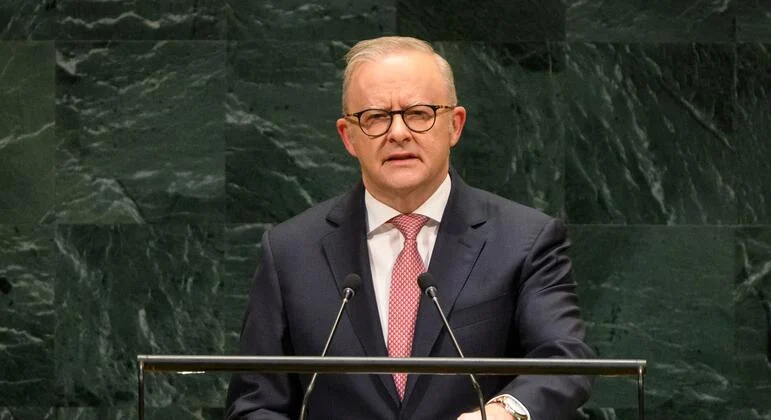
UNITED NATIONS, New York – Amidst a backdrop of escalating geopolitical tension and rapid technological transformation, Australian Prime Minister Anthony Albanese took to the podium at the United Nations General Assembly (UNGA) on Thursday to deliver a clarion call for renewed global cooperation. In a wide-ranging address, the Prime Minister argued that the survival of the rules-based international order depends on the collective will of nations to confront climate change, regulate artificial intelligence, and restore the sanctity of international law.
The Core Mandate: A Test of Our Time
Prime Minister Albanese opened his address by invoking the historical impetus behind the United Nations, reminding delegates that the institution was forged eight decades ago "from the ruins of war." He underscored that the original vow to prevent global conflict remains the central, albeit increasingly difficult, objective of the 21st century.
"Cooperating on the urgent challenges that confront every country, creating solutions that work for our citizens, and staying true to the UN’s founding purpose remains the test of our time," Albanese stated. "It is a test we can and must pass."
The Prime Minister’s rhetoric was aimed at countering the rising tide of isolationism and the fracturing of global trust. He insisted that the mission of the UN cannot be the exclusive domain of "great powers," nor should it be "subcontracted" to the world’s most powerful technology corporations. By placing the onus on the collective, Albanese signaled Australia’s intent to play a pivotal role as a middle power, advocating for a multilateral system that is inclusive, transparent, and resilient.
Chronology of the 2026 UNGA Address
The appearance of the Australian Prime Minister on September 25, 2026, marked a significant moment in the General Assembly’s high-level week. The day’s events followed a specific progression:
- Morning Session: General debate focused on the "Summit of the Future" follow-ups, with particular emphasis on the Global Digital Compact.
- Midday Address: Prime Minister Albanese delivered his keynote, shifting the focus from abstract policy to the tangible threats of social media influence and state sovereignty.
- Afternoon Bilaterals: Following his address, the Prime Minister engaged in a series of closed-door meetings with Pacific Island leaders and G20 counterparts to discuss climate adaptation funding and regional security.
- Evening Reception: Discussions continued regarding the formalization of Australia’s bid for a non-permanent seat on the UN Security Council for the 2029-2030 term.
Security Council Ambitions and the Sovereignty Agenda
A primary pillar of the Australian diplomatic strategy outlined by Mr. Albanese is the nation’s campaign for a non-permanent seat on the UN Security Council for the 2029-2030 term. This ambition is not merely symbolic; it is presented as a commitment to upholding the UN Charter in an era where sovereignty is frequently challenged by both coercion and technological overreach.
"Australia will safeguard the rules that protect us all by upholding international law, including the UN Charter and the sovereignty of all States," the Prime Minister affirmed. He highlighted that if Australia secures the seat, the government aims to serve as a bridge between the interests of small states—particularly in the Pacific—and the broader international community. By "amplifying the voices of small states and middle powers," Australia hopes to ensure that the Council’s decision-making process is not dictated solely by the world’s loudest or most powerful nations.
Addressing the Technological Frontier: The Social Media Precedent
One of the most notable segments of the Prime Minister’s address focused on the regulation of emerging technologies. Drawing on Australia’s recent legislative success—a nationwide ban on social media for individuals under the age of 16—Albanese positioned his country as a pioneer in protecting digital well-being.
The policy, which was spurred by the advocacy of grieving parents, has garnered significant international interest. Mr. Albanese reported that over 20 nations are now in the process of implementing similar age-verification and social media restrictions. "We are seeing a global shift," he noted. "With the European community also taking action, it is clear that the era of unregulated digital influence on our youth is coming to an end."
This stance serves as a microcosm for his broader philosophy on AI: that technology must be harnessed in the interest of citizens, rather than allowing the pace of innovation to outstrip the ability of governments to provide safety and social cohesion.
Official Responses and International Reaction
The address has been met with a mix of cautious optimism and diplomatic acknowledgement.
- The Pacific Bloc: Regional neighbors have largely welcomed the Prime Minister’s emphasis on "cooperation over coercion." For many Pacific Island nations, Australia’s promise to champion the voices of smaller states within the Security Council provides a vital safety net against the pressures of regional hegemony.
- European Union Delegates: EU representatives expressed support for the Australian position on AI regulation, noting that the alignment between Canberra and Brussels on digital safety creates a stronger front for future global AI governance frameworks.
- The "Great Power" Perspective: While larger nations have acknowledged the speech, the response has been predictably measured. The call for a more inclusive Security Council often meets resistance from permanent members who prefer the status quo, creating an underlying friction that observers note will define the coming years of diplomatic maneuvering.
Implications: The Shift Toward "Sovereign Choice"
The Prime Minister’s speech articulated a clear strategic vision: the concept of "sovereign choice." In a world where economic and energy security are increasingly used as levers of influence, Australia is positioning itself as a partner that supports regional stability without demanding subservience.
"We are elevating relationships that help to build sovereign capability and offer nations sovereign choice free from coercion," Albanese said. This policy is intended to address transnational crime, economic instability, and energy security—issues that, if left unaddressed, leave smaller nations vulnerable to external manipulation.
Supporting Data and Contextual Realities
The urgency of Mr. Albanese’s message is supported by several ongoing global trends:
- Climate Instability: With 2026 seeing record-breaking temperature anomalies, the "climate crisis" remains the most pressing existential threat, particularly for the nations in the Indo-Pacific region.
- AI Proliferation: The rapid integration of Generative AI into critical infrastructure and information ecosystems has created a "trust deficit" that the UN is currently ill-equipped to police.
- Breakdown of Social Cohesion: The rise of digital echo chambers and disinformation campaigns has been identified by various UN reports as a major factor in the degradation of democratic processes globally.
Looking Ahead: The Road to 2029
The address solidifies Australia’s role as an active participant in the reform of multilateralism. By explicitly calling for the "embrace" of reform, the Prime Minister has signaled that the current UN structures are insufficient for the challenges of the 21st century.
As Australia prepares for its Security Council bid, the international community will be watching to see if Canberra can deliver on its promise to bridge the gap between regional concerns and global security mandates. The Prime Minister’s speech was not merely a diplomatic exercise; it was a roadmap for a middle-power strategy that seeks to balance technological progress with human protection, and national interest with global responsibility.
"Shaping a secure, peaceful, and prosperous world is a task for all of us," Albanese concluded. Whether this message translates into tangible policy shifts within the halls of the UN remains to be seen, but the path forward—one defined by collective action rather than isolated competition—has been firmly staked.
 Nana Muazin
 Azzam Bilal Chamdy
 Layla Zulfa
