

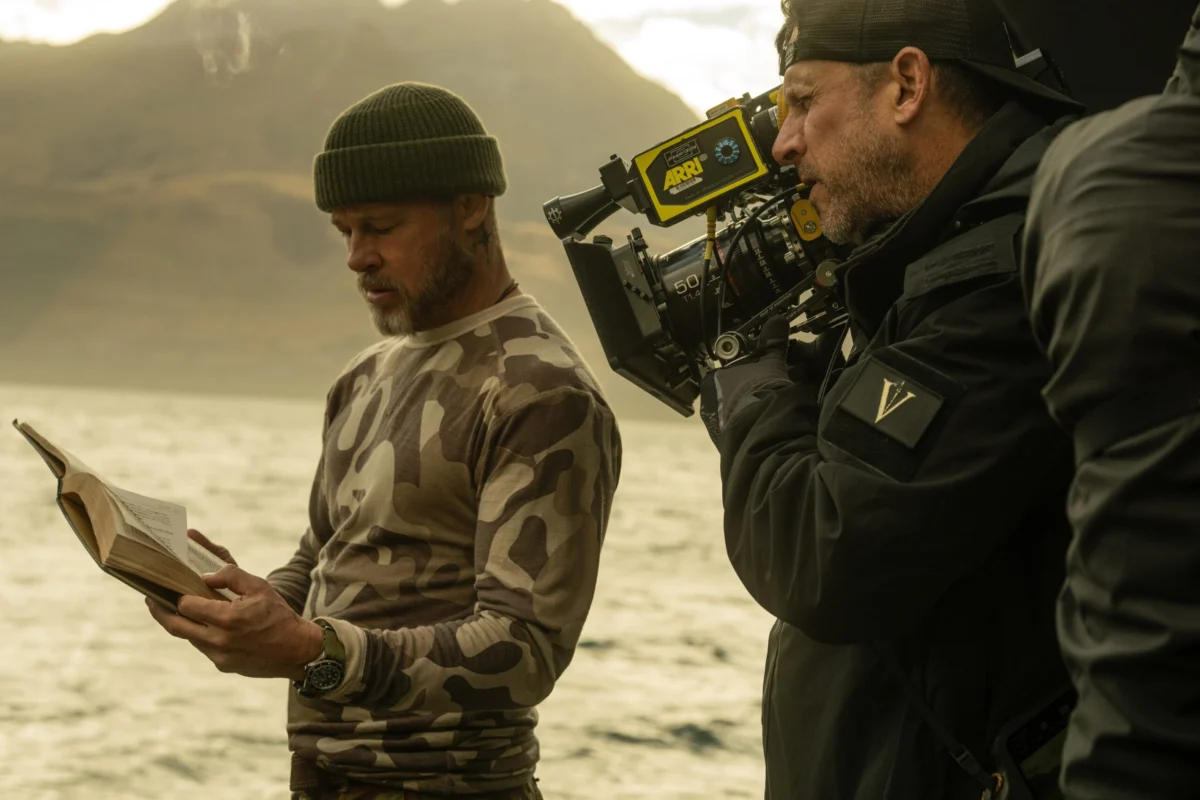
Jean-Luc Godard famously posited that all one truly needs to make a compelling film is a girl and a gun. In the high-stakes, hyper-kinetic landscape of modern Hollywood, director David Ayer and superstar Brad Pitt have decided to test a new theorem: all you really need is a man, a dog, and the unrelenting, indifferent expanse of the Alaskan wilderness.
Their new adventure film, Heart of the Beast, serves as a minimalist masterclass in storytelling. The narrative is deceptively simple: Brad Pitt stars as James, a seasoned special forces veteran, who finds himself stranded in the frozen, unforgiving tundra following a catastrophic plane crash. His only ally in the struggle for survival is his loyal canine companion, Odin. With the exception of a few fleeting interactions with peripheral characters, the film is an intimate, claustrophobic character study that pits human resilience against the absolute silence of nature.
While the premise sounds straightforward, the execution proved to be one of the most grueling undertakings of both men’s careers. It was a project that forced them to dismantle their own cinematic toolkits, stripping away the pyrotechnics and ensemble dynamics that usually define their work in favor of a raw, exposed, and deeply emotional performance.
The Challenge of Minimalism: Nowhere to Hide
For David Ayer, who earned his reputation staging the chaotic, multi-layered warfare of the World War II epic Fury, the shift toward the singular focus of Heart of the Beast was both daunting and enlightening.
"It was a bigger challenge than I understood going into it," Ayer admitted during a recent appearance on the Filmmaker Toolkit podcast. "I really didn’t know what I was in for. In Fury, you have massive battle sequences, a cast of soldiers, and a mechanical environment. But stripping the action down to one actor and a dog created its own set of terrifying difficulties. The simplicity of it exposes the filmmaking in ways I never imagined. Your decisions regarding tone, mood, and performance count more than ever in that situation. There was simply nowhere to hide."
In traditional action cinema, directors often rely on the interplay between characters to drive the narrative or provide exposition. In Heart of the Beast, the lack of dialogue forces the audience to engage with the environment as a character itself. Every glance, every labored breath, and every interaction between James and Odin becomes a critical piece of the plot.

A Chronology of Collaboration: From Concept to Tundra
The journey of Heart of the Beast began with a screenplay by Cameron Alexander, which landed on Ayer’s desk and immediately demanded his attention. According to the director, the script resonated with him on a deeply personal level, touching upon themes of grief and the universal, often unmet, human need for companionship.
"I think the script triggered part of my own grief over the loss of my father when I was young," Ayer revealed. "It tapped into an aspirational desire in me. I wish I had someone who looked after me the way James looked after Odin. I wish I had that kind of unconditional love and support in the darkest moments."
Following his decision to helm the project, the production timeline was remarkably condensed. The team was forced into a whirlwind pre-production schedule that required an almost telepathic level of coordination between the director, his department heads, and his lead actor.
Production design played a pivotal role in maintaining the film’s narrative integrity. Ayer worked closely with production designer Greg Berry to map out a "visual journey" that mirrored the protagonist’s internal psychological arc. Because the shoot was so rapid, there was no room for error; the team had to establish the tone, the visual language, and the emotional stakes before the cameras ever rolled in the remote locations.
Deconstructing Masculinity: The Pitt-Ayer Dynamic
The thematic focus of Heart of the Beast—a rugged, military-trained man forced into a state of total vulnerability—is the perfect vehicle for David Ayer’s long-standing preoccupation with the architecture of masculinity. Throughout his career, from the gritty screenplay of Dark Blue to the visceral intensity of Harsh Times and End of Watch, Ayer has consistently prodded at the assumptions society makes about heroism, violence, and the male psyche.
In Brad Pitt, Ayer found a willing collaborator—a star who has spent decades curating a persona that balances effortless cool with a hidden, simmering depth. In their previous work together, they explored the rigid, externalized codes of the soldier. Here, they look inward.

"I think it has to do with his willingness to jump into material that isn’t so traditionally engineered as a movie star role," Ayer noted. "He’s open to the deconstruction. And he has a lot of range; I feel like he doesn’t always have the opportunity to find those dichotomies in himself. There’s a kinship there in our understanding of traditional masculinity—the masks men are given in life to wear—and the fact that there’s often a confused, beating heart beneath them."
Critics have already begun to draw parallels between this collaboration and the legendary partnerships of the past—John Ford and John Wayne, or Don Siegel and Clint Eastwood. Like those pairings, Ayer and Pitt seem to be refining a specific cinematic language, one that uses the "action star" icon to explore the fragility of the human spirit.
The Physical and Emotional Toll
The production of Heart of the Beast was not merely a logistical challenge; it was a physical one. Unlike standard studio shoots, where actors retreat to comfortable trailers or socialize in directors’ chairs between takes, the filming conditions for Heart of the Beast were intentionally harsh to mirror the reality of the characters.
"Normally on a set, you have the director’s chairs lined up, and the actors sit in them and socialize," Ayer explained. "Brad had nowhere to go other than to be cold and tired and emotionally exhausted by himself. He didn’t have a big cast to react to and pass that energy back and forth; he had to react to the circumstances. It was like a jet pilot flying a solo mission."
This isolation was essential to Pitt’s performance. Deprived of the typical comforts of a high-budget production, Pitt was forced to lean into his exhaustion. The result is an internal, understated performance that relies on presence rather than dialogue. By removing the safety net of a large ensemble, the film captures a rare, authentic sense of human endurance.
Implications for the Future of Action Cinema
The success of Heart of the Beast signals a potential shift in the blockbuster landscape. In an era dominated by CGI-heavy franchises and sprawling cinematic universes, there remains a persistent, hungry audience for "human-scale" stories that leverage the power of a single, committed performance.

The film suggests that the "action movie" genre can be a profound vessel for exploring themes of trauma, isolation, and the restorative power of nature. By focusing on the bond between man and dog, Ayer has created a film that is as much a psychological thriller as it is a survival epic.
For Ayer, the process has been transformative. "I’ve done a few movies and feel like I’m just beginning to come into my own," he reflected. "I was open to really challenge myself both emotionally and as a filmmaker. Everything came together."
As the film moves into its wider release, it stands as a testament to the idea that sometimes, less really is more. By stripping away the spectacle and the ensemble, David Ayer and Brad Pitt have reached a place of striking clarity. They have proven that when you take away the masks men wear and the noise of the modern world, you are left with something far more compelling: a beating, fragile heart, and the sheer, desperate will to survive.
To hear the full, in-depth conversation with director David Ayer regarding the making of "Heart of the Beast," be sure to subscribe to the Filmmaker Toolkit podcast on Apple, Spotify, or your preferred streaming platform.
 Lina Hope
 Azzam Bilal Chamdy
 Pevita Pearce
