Main Facts: Redefining an Icon Without the Timepiece
Against the electric, media-frenzied backdrop of Paris Fashion Week, Swiss haute horlogerie powerhouse Audemars Piguet has executed one of the most unexpected and calculated luxury maneuvers of the year. The venerable manufacturer has introduced the Royal Oak Joaillerie collection—an 18-piece suite comprising necklaces, earrings, cuffs, and chokers.
For watch enthusiasts, the name alone triggers immediate recognition, evoking the legendary 1970s luxury sports watch designed by Gerald Genta. However, this launch breaks a fundamental mold: the collection does not feature a single watch.
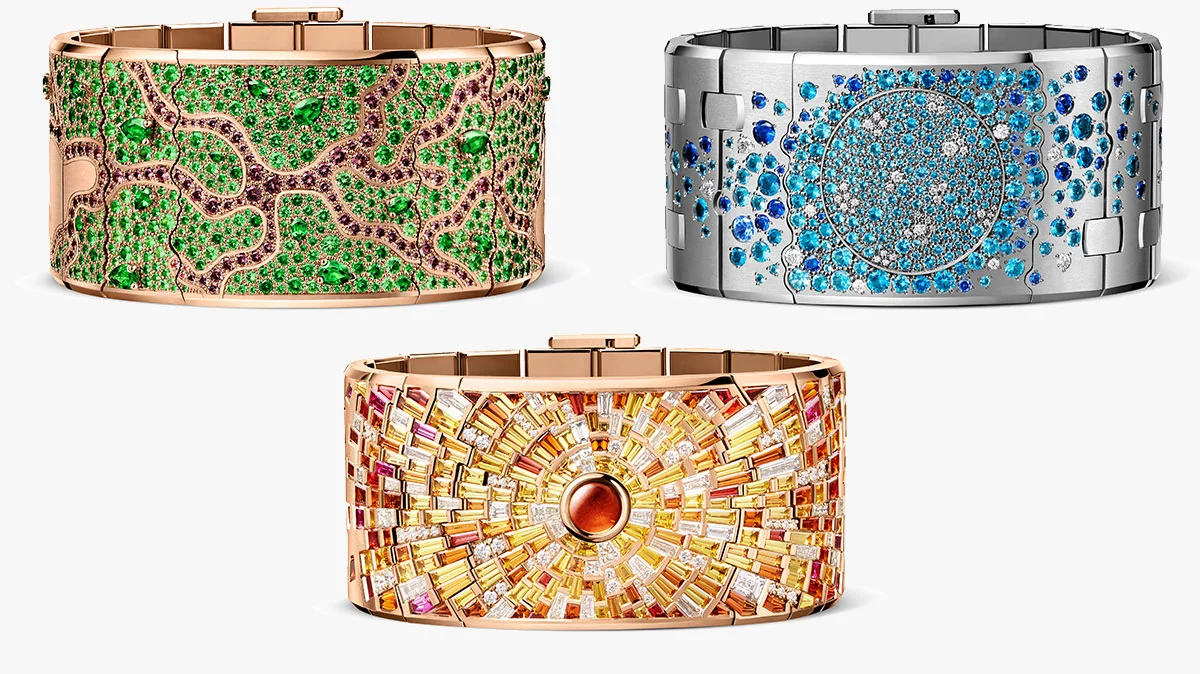
Instead, Audemars Piguet has taken the unmistakable geometry, interlocking link bracelets, and light-capturing brushed-and-polished finishes of its signature timepiece and translated them entirely into high jewelry. Set with precious and non-precious stones across white gold, yellow gold, and titanium, the suite draws inspiration from the natural landscape surrounding the watchmaker’s home in the Vallée de Joux—from frosted alpine lakes to local flora.
Key pieces include:
The "Dream of Joux" Necklace and Earrings: A tie-style statement piece crafted in white gold and anodized blue titanium, illuminated by 42 pear-shaped diamonds (totaling roughly 63 carats) and 1,670 blue sapphires (exceeding five carats).
The "Risoud Eclipse" Line: Named after a local forest, this blackened titanium and white gold set features striking emeralds, including five sugarloaf stones totaling 16.5 carats on the necklace and three emeralds totaling 12 carats on the matching cuff.
The Nature-Inspired Cuffs: Ranging from the vibrant, sun-drenched "Sunburst Royal Oak cuff" (loaded with orange and yellow sapphires and spessartites) to the literal botanical artistry of the "Blueberries Royal Oak cuff" (crafted with 506 diamonds, 19 amethyst cabochons, and 16 black spinel cabochons).
Frosted Gold Chokers and Cuffs: Everyday-wearable iterations utilizing the signature shimmering hammered gold finish pioneered by Audemars Piguet and jeweler Carolina Bucci in 2016.
Chronology: A Historical Evolution Into High Jewelry
While a dedicated, purist high jewelry collection may strike some purists as a radical pivot, Audemars Piguet’s relationship with precious stones and decorative arts spans well over a century.
The 19th Century and Early Collaborations: Since the 1800s, the Vallée de Joux manufacturer has periodically stepped outside traditional timekeeping to create stylized pendant and ring watches, often in close collaboration with premier jewelry houses like Tiffany & Co., Cartier, and Bulgari.
The 1980s Workshop Establishment: Seeking greater creative autonomy, the house established its own dedicated internal jewelry workshop during the 1980s, enabling them to handle complex gemstone setting and bespoke decorative arts in-house.
The 1999 Anniversary Milestone: For its 125th anniversary, the maison stunned collectors by unveiling the jaw-dropping Baroque cuff watch, an architectural masterwork heavily encrusted with diamonds alongside yellow and pink sapphires.
The 2015–2017 Era: The house further flexed its avant-garde design muscles with the punk-inspired Diamond Trilogy secret watch collection, proving that high jewelry and high complications could seamlessly coexist.
The 2026 Paris Fashion Week Debut: Culminating years of material exploration and responding to shifting consumer behaviors, Audemars Piguet formally launches the Royal Oak Joaillerie collection during Paris Fashion Week, marking its first-ever standalone jewelry line anchored by watch codes.
Supporting Data: The Macroeconomics of the Luxury Shift
The timing of Audemars Piguet’s dive into pure high jewelry is far from accidental; it is a strategic alignment with current macroeconomic realities and shifting luxury consumer habits.
Slowing Luxury Sector Growth: In May, financial services firm Morgan Stanley adjusted its growth projections for the broader luxury goods sector downward to a modest 2.5 percent for 2026. Ongoing geopolitical instability, macroeconomic uncertainty, and conflicts in the Middle East continue to weigh heavily on consumer confidence.
The "Flight to Quality": Amid a cooling market for fast-moving fashion items, affluent consumers are increasingly channeling disposable income into hard assets. High jewelry has emerged as a premier investment vehicle, benefiting from a robust "flight to quality" mentality and historically strong gold prices.
Divergent Performance Metrics: The resilience of the jewelry sector is underscored by financial reports from major conglomerates. For instance, Richemont reported a staggering 24 percent year-over-year revenue growth in its jewelry maisons division for the third quarter ending June 30, vastly outperforming its traditional watchmaking divisions, which posted a more moderate 8 percent growth.
By diversifying out of timepieces and into pure high-end adornments, Audemars Piguet is positioning itself precisely where consumer capital is currently congregating.
Official Responses: Capturing the Voice of Leadership
For a brand historically tethered to its horological identity, explaining the rationale behind a watch-free jewelry collection requires a clear vision from the top.
Audemars Piguet CEO Ilaria Resta noted that the inspiration for the collection sprang organically from observant interactions with the brand’s existing clientele—specifically the runaway success of the compact 23 mm Royal Oak Mini.
"We saw clients stacking and wearing them almost as jewelry, which showed us that there was a very contemporary way of living with the Royal Oak beyond the watch itself," Resta explained during the launch.
Expanding on the design philosophy behind translating mechanical watch components into sculptural jewelry, Resta emphasized a desire to push boundaries rather than rely on literal interpretations:
"We wanted to explore that design language in a new form. Rather than reproducing familiar Royal Oak codes, we looked at the bracelet almost as an object in its own right and asked how its geometry, rhythm, and movement could translate into jewelry. That opens up a different creative space for us."
Implications: What Royal Oak Joaillerie Means for the Future of AP
The launch of the Royal Oak Joaillerie collection carries profound implications for Audemars Piguet’s brand trajectory, market positioning, and product diversification strategy.
1. Diversification Beyond the Icon
For decades, industry analysts have cautioned Audemars Piguet about its heavy reliance on the Royal Oak family. While the introduction of the round Code 11.59 watch collection was a step toward diversifying its horological portfolio, the watch market remains volatile. By expanding the Royal Oak design vocabulary into high jewelry, AP is effectively hedging its bets. It allows the brand to capitalize on its most valuable intellectual property—the Royal Oak aesthetic—while entering an entirely separate retail category.
2. Capturing the Self-Purchasing Female Demographic
Historically, high-end timepieces were marketed predominantly to male collectors, while jewelry lines were often viewed through the lens of gifting. However, modern luxury consumption is increasingly driven by self-purchasing women who view jewelry as an expression of personal style, power, and financial independence. The Royal Oak Joaillerie collection—featuring bold colored gemstones like emeralds and sapphires alongside contemporary titanium settings—speaks directly to this empowered, style-conscious demographic.
3. A New Canvas for Hype-Led Creativity
Audemars Piguet has long thrived on a modus operandi defined by rule-breaking, bold materials, and cultural cachet. By treating the iconic Royal Oak bracelet geometry as a sculptural canvas rather than a mechanical strap, the maison has unlocked an endless horizon of future iterations. If the initial 18-piece suite is any indication, the luxury world can expect the Royal Oak Joaillerie franchise to expand with the same ferocious momentum that turned the original 1972 sports watch into a global cultural phenomenon.




 Nana Muazin
 Jia Lissa
