

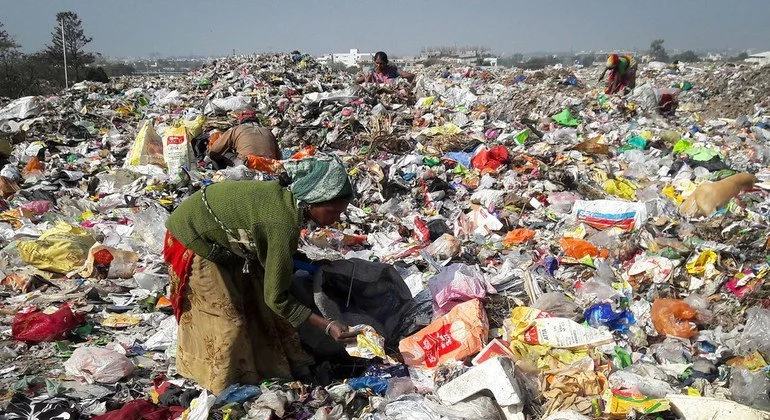
The global climate crisis is frequently framed through the lenses of industrial manufacturing, fossil-fuel-reliant transportation, and the energy-intensive grid. However, a silent, decomposing culprit is hiding in plain sight: our kitchen bins. According to recent findings by the United Nations Environment Programme (UNEP), rotting food waste is not merely an environmental nuisance—it is a climate catastrophe, emitting five times more greenhouse gases than the entire global aviation industry.
As the world scrambles to meet the ambitious targets set by the Paris Agreement, addressing food waste has emerged as one of the most immediate, cost-effective, and neglected levers for climate mitigation.
The Anatomy of the Crisis: From Harvest to Landfill
The journey of food waste begins long before it reaches the dinner table. It encompasses a vast spectrum of loss, categorized into "food loss" (products spoiled during harvest, processing, or transit) and "food waste" (finished meals and items discarded by retailers or households).
When this organic matter reaches the landfill, it undergoes a chemical transformation that is devastating for the atmosphere. Buried under layers of trash and deprived of oxygen, food waste enters an anaerobic state. In this environment, specific micro-organisms break down the matter, releasing methane—a potent greenhouse gas that is significantly more destructive than carbon dioxide in the short term.
The Methane Multiplier
While carbon dioxide (CO2) is the primary target of most climate policy, methane is a far more aggressive heat-trapper. UNEP data indicates that methane is responsible for nearly one-third of global warming. Over a 20-year period, methane traps approximately 86 times more heat than CO2. Because of this, the methane emitted from landfills acts as a turbocharger for the greenhouse effect, accelerating global temperature rises at a rate that is currently outpacing the warming caused by aviation emissions.
Chronology of a Growing Problem
To understand how we reached this "mountain of discarded food," it is necessary to examine the trajectory of global consumption patterns over the last two decades.
- 2015: The Global Commitment: The United Nations established the Sustainable Development Goals (SDGs), including Target 12.3, which aims to halve per-capita global food waste at the retail and consumer levels by 2030.
- 2015–2020: The Stagnation Period: Despite the high-level commitments, the Food and Agriculture Organization (FAO) reports that there has been no tangible progress in reducing food losses globally. Consumption patterns in developing and developed nations alike have continued to favor high-waste, high-disposal lifestyles.
- 2021–2023: Emerging Awareness: UNEP began aggregating data that highlighted the link between methane emissions and municipal solid waste. During this period, the United States identified municipal landfills as the third-largest source of human-related methane emissions, sparking a shift in how waste is viewed at the policy level.
- 2024: The Call to Action: The UNEP Food Waste Index Report 2024 served as a stark wake-up call, confirming that more than one billion meals are discarded every single day, with 60% of that waste originating from private households.
Supporting Data: The Hidden Costs of Discarded Resources
The environmental footprint of food waste extends far beyond the methane gas released in landfills. It represents a massive misallocation of the planet’s finite resources.
Agricultural Footprint
The FAO estimates that approximately 1.4 billion hectares of land—roughly 28% of the world’s total agricultural area—is dedicated to producing food that is never consumed. This land usage is intrinsically linked to the biodiversity crisis. As demand for agricultural land grows, forests are cleared to make room for crops and livestock. These forests serve as vital carbon sinks; when they are removed, the earth loses its natural ability to pull CO2 out of the atmosphere.
The Water Paradox
Water security is another critical dimension. The vast quantities of water required for irrigation, processing, and transportation of food are effectively "flushed away" when that food is discarded. By wasting food, we are essentially depleting our freshwater aquifers and river systems for no return, worsening the impact of droughts in food-insecure regions.
Official Responses and Strategic Policy Shifts
The international community is beginning to acknowledge that we cannot reach our climate goals without addressing the "methane problem" within our waste streams.
The "Short-Lived" Opportunity
One of the most compelling arguments for tackling food waste is the atmospheric lifespan of methane. Unlike CO2, which lingers in the atmosphere for centuries, methane is relatively short-lived. This creates a unique opportunity: by drastically reducing methane emissions today, the world could see tangible climate benefits within decades rather than centuries.
UNEP’s Stance
Martin Krause, a UNEP official, has been vocal about the urgency of this transition. "At a time when the world is searching for practical ways to slow warming quickly, tackling food waste may be one of the most immediate and cost-effective climate solutions available," Krause noted. He emphasizes that the lack of progress since 2015 is unacceptable and that the world must accelerate its efforts if it is to meet the 2030 target.
Implications: Practical Innovations and Future Solutions
If the problem is global, the solutions must be localized. Governments and innovators are beginning to deploy creative strategies to divert organic waste from landfills.
1. Empowering the Informal Sector: Waste Pickers
In many African nations, waste pickers are the backbone of the recycling economy. Eleven governments have recently committed to integrating these workers into formal waste management systems. Supported by the Climate and Clean Air Coalition, these initiatives provide training on sorting and composting organic matter. This not only diverts methane-producing waste from landfills but also formalizes employment, improves livelihoods, and fosters community-level climate resilience.
2. The Rise of Black Soldier Flies
Innovation is also taking a biological turn. In countries ranging from Malawi to Uganda, specialized facilities are utilizing black soldier flies to recycle organic material. These insects are highly efficient at consuming food waste, turning it into valuable biomass that can be used as high-protein animal feed or fertilizer. By scaling these insect-based waste management systems, cities are creating a circular economy that prevents waste from ever reaching a landfill.
3. Policy and Consumer Behavior
The broader implication is that climate policy must shift from a "supply-side" focus—primarily targeting energy and transportation—to a "demand-side" focus. This includes:
- Retail Reform: Changing "best before" labeling practices to reduce consumer confusion.
- Infrastructure: Investing in localized composting and anaerobic digestion facilities.
- Education: Cultivating a global culture that views food as a precious resource rather than an expendable commodity.
Conclusion: The Urgency of Now
The "mountain of discarded food" is a monument to our inefficiency, but it is also a reservoir of potential. As the climate crisis intensifies, the choice is clear: we either continue to allow our food waste to drive methane-induced warming, or we transform our waste systems into engines of sustainability.
The technology and the labor force exist. The question remains whether the political will can match the urgency of the science. As Mr. Krause stressed, "We have to move faster." The clock is ticking, not just for the climate, but for the one billion meals wasted every day that could instead be feeding the future of our planet.
 Suro Senen
 Nana Muazin
 Reynand Wu
