

September 9, 2026
By Olivia Tauber, Deputy Digital Culture Editor
Apple’s high-stakes "Surprise and shine" keynote event delivered the expected wave of hardware updates, but the crown jewel of the presentation was undisputedly the company’s long-rumored entry into the foldable market: the iPhone Duo. Coming in with a hefty $1,999 price tag, Apple positioned its premier folding device as a marvel of engineering—sleek, seamless, and poised to redefine the high-end smartphone landscape.
However, corporate presentations are carefully choreographed affairs. Now that the keynote has concluded and early testers, journalists, and internet personalities have gotten their hands on actual hardware inside Apple Park, a clearer, more nuanced picture has emerged. From rapid-fire folding sessions by streamers like IShowSpeed to technical teardowns by veteran tech journalists, the tech community finally knows what the iPhone Duo looks, feels, and acts like in the wild.

Main Facts: What Is the iPhone Duo?
Priced starting at $1,999, the iPhone Duo represents Apple’s official dive into foldable technology. For years, competitors like Samsung, Google, and OnePlus have iterated through generations of folding phones, carving out a dedicated, albeit niche, market for dual-screen mobile devices. Apple’s entrance instantly validates the form factor, bringing the Cupertino giant’s design philosophy and ecosystem integration to a flexible display.
Key physical and functional attributes observed during the initial hands-on period include:
- The Form Factor: A remarkably thin profile when folded and unfolded, challenging the traditional bulkiness associated with early-generation foldables.
- The Display: A sprawling inner screen (measured around 7.6 inches) that transitions fluidly into a compact outer cover screen.
- The Hinge and Crease: An advanced mechanical hinge that supports multiple viewing perspectives, paired with an inner display that nearly achieves invisibility at certain angles, though a subtle vertical crease remains visible under direct overhead lighting.
- Software Optimization: Fluid, low-latency animations that adapt instantly as the device shifts from its closed state to its fully opened tablet-like layout.
Chronology: From Keynote Reveal to Hands-On Floor Chaos
The journey of the iPhone Duo transitioned from corporate secrecy to public spectacle in a matter of hours on September 9, 2026.

Morning: The Keynote Reveal
During the "Surprise and shine" keynote, Apple executives showcased the iPhone Duo as a paradigm shift. The device was demonstrated handling complex multitasking—such as composing an email on one half of the screen while referencing the original thread on the other—with zero perceived friction. Apple’s promotional footage framed the device as virtually seamless, setting towering expectations for the hands-on demo area.
Afternoon: The Hands-On Experience at Apple Park
Immediately following the keynote, doors opened to the hands-on area at Apple Park, where tech creators, reviewers, and journalists put the hardware through its paces.
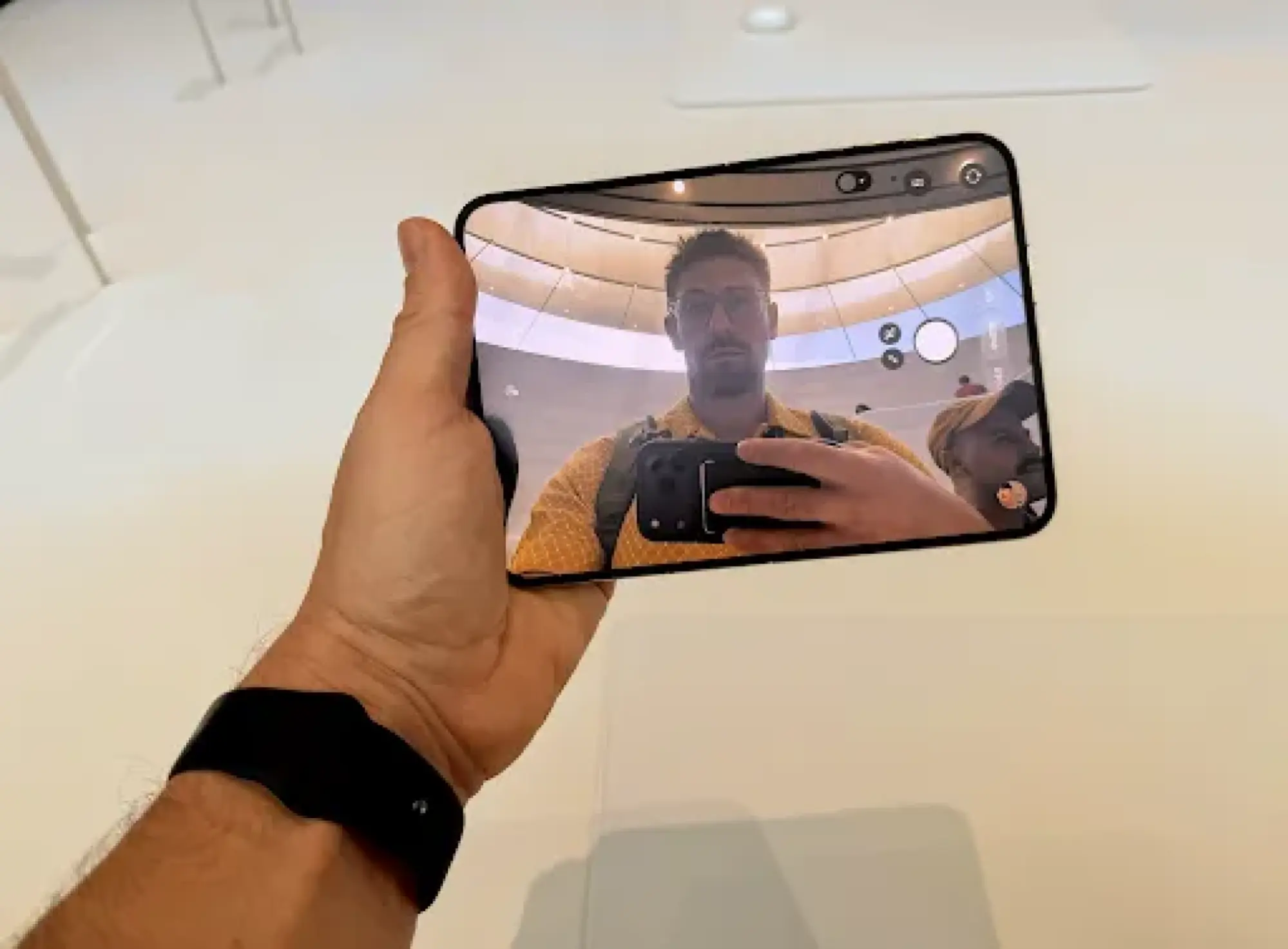
- Stan Schroeder (Mashable): On the ground in Cupertino, Schroeder captured the device’s thin profile and tested its inner display as a massive camera viewfinder for selfies, highlighting the practical advantages of the folding form factor.
- Max Weinbach & iJustine: Tech creator Max Weinbach dubbed the device the "bar none best foldable," expressing surprise at the quality of the under-display camera. Meanwhile, Justine Ezarik (iJustine) tested media consumption, streaming vertical video feeds and episodes of Netflix’s Wednesday across the expansive inner real estate.
- The Creators and Streamers: YouTube streamer IShowSpeed captivated his live-chat audience by repeatedly folding and unfolding the device with theatrical enthusiasm, demonstrating the sheer novelty the hardware holds for digital-native audiences.
- Geoff Keighley: Journalist Geoff Keighley highlighted the slick transition animations between the outer and inner screens, later testing multi-perspective gaming enabled by the multi-angle hinge.
Late Afternoon: Critical Analysis
As the initial excitement settled, tech journalists began stress-testing the display under varied lighting conditions. Gizmodo Senior Editor Ray Wong captured video angles showing that while the screen appears continuous straight-on, a faint vertical crease becomes apparent when tilted toward overhead light sources, sparking intense online debate among consumers and analysts.

Supporting Data and Technical Observations
While aesthetic impressions varied, technical evaluations highlighted several engineering triumphs and design compromises:
- Hardware Thickness: Early testers universally praised the thinness of the device. Unlike clunkier foldable predecessors that felt like two phones taped together, the iPhone Duo maintains a slim profile that mirrors traditional flagship devices when closed.
- The Crease Debate: The visibility of the central crease drew polarized reactions. Some users, such as tech commentator TCanDaMan, declared the crease "really seamless," while others sided with Ray Wong’s observation that physics still applies: “Can definitely see the screen crease at certain angles.” General consensus points out that while Apple’s hinge mechanism minimizes the crease significantly better than many first-generation competitors, lighting angles dictate its visibility.
- Software and Continuity: The seamless continuity between the outer cover screen and the inner tablet display received high marks. Animations when unfolding do not stutter, addressing long-standing criticisms of early foldable software optimization.
Official Responses and Creator Reactions
The reactions from the tech community spanned absolute awe, nostalgic comparisons, and cautious skepticism:
- Praise for Innovation: Max Weinbach’s sentiment that the device is the best foldable on the market was echoed by several creators who praised Apple’s restraint in waiting until the technology matured enough to enter the space.
- Nostalgic Comparisons: Not everyone was swept up in futuristic wonder. Several online commentators drew amused comparisons to Microsoft’s ill-fated Surface Duo or Nintendo’s classic dual-screen handheld, the Nintendo DS, noting that dual-screen productivity is an old idea wrapped in modern execution.
- The Magic vs. Reality Discourse: Commenting on the inevitability of physical limitations on flexible glass, creator Mario Sundar summed up the community’s realization regarding the crease: "They are magicians, not Gods!"
Implications for the Smartphone Market
The arrival of the iPhone Duo carries profound implications for the mobile industry at large:

- Mainstream Validation of Foldables: For years, foldables have occupied a high-end enthusiast bubble. Apple’s entry with a $1,999 price tag signals to the rest of the industry—and to everyday consumers—that the form factor has graduated from a novelty gimmick to an established, premium tier of consumer electronics.
- Competitive Pressure: Competitors like Samsung and Google, which have dominated the foldable space for half a decade, now face an ecosystem rival with unmatched brand loyalty and developer support. App developers who previously ignored foldable optimizations will now race to adapt their software for iOS split-screen and multi-angle layouts.
- Price and Accessibility: At $1,999, the iPhone Duo remains firmly in luxury territory. However, if Apple’s historical product trajectory holds true, technologies pioneered in this device—such as ultra-thin hinges and advanced under-display cameras—will eventually trickle down to standard iPhone models and more affordable folding iterations in the years to come.
Consumers eager to experience the iPhone Duo firsthand will not have to wait long. The device officially hits store shelves and customer doorsteps on October 23, when real-world durability, battery performance, and daily usability tests will truly put Apple’s latest masterpiece to the ultimate test.
 rifanmuazin
 Ali Ikhwan
 Muslim
