

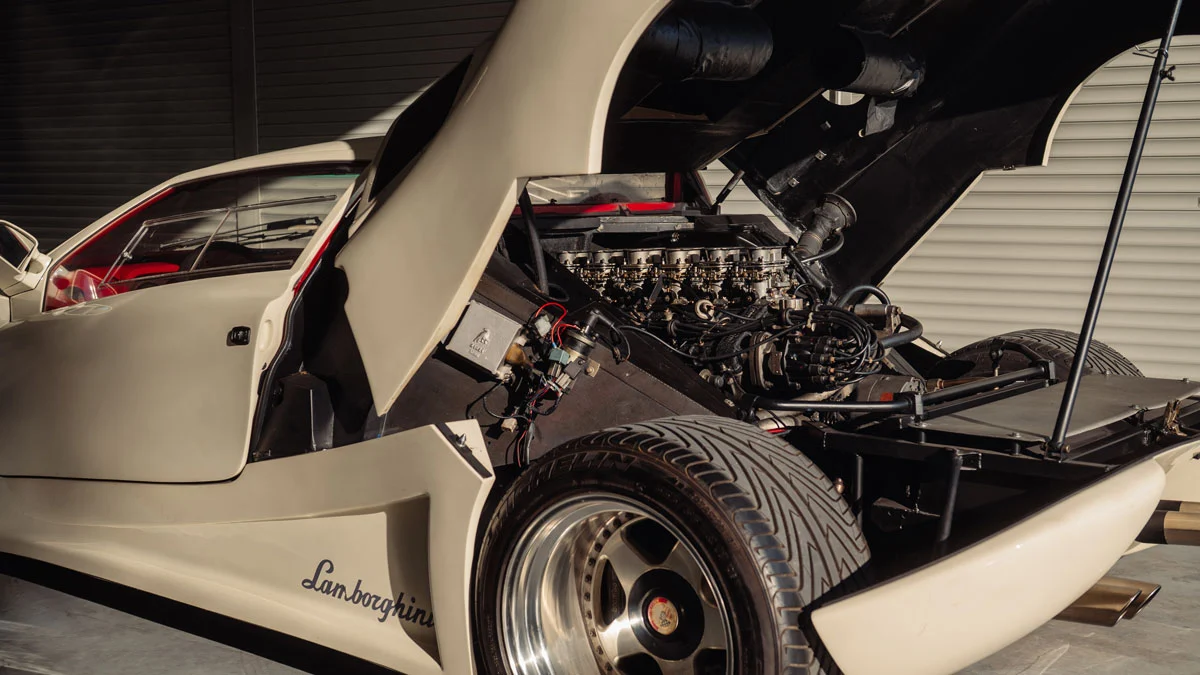
In the rarefied atmosphere of the supercar world, where multi-million-dollar vehicles are often produced in runs of several hundred, true exclusivity is defined by a lack of volume. Few cars embody this "benchmark of obscurity" more than the Monte Carlo Automotive (MCA) Centenaire. A low-slung, V-12-powered apparition from the Principality of Monaco, the Centenaire remains one of the most enigmatic chapters in automotive history. Built between 1990 and 1992, the model was restricted to a mere 16 examples, making it not just a rare find, but a piece of automotive folklore.
As the automotive world turns its eyes toward the upcoming Zoute Concours Auction in Knokke-Heist, Belgium, on October 9, a unique opportunity has emerged. A vital piece of this history—the second of only five original prototypes—is crossing the auction block. Finished in its evocative original Ivory White with a vibrant red leather interior, this vehicle is a rolling testament to the national colors of Monaco and the ambitious vision of its founder, Fulvio Maria Ballabio.
The Genesis: A Principality’s Ambition
To understand the Centenaire, one must look back to 1985, when Fulvio Maria Ballabio, a former Formula 2 and Le Mans driver with deep ties to the Italian motorsport establishment, founded Monte Carlo Automotive. The company was conceived with a singular, grand objective: to create a homegrown supercar for the Principality of Monaco.

The project was timed with meticulous intent. The name "Centenaire" was chosen to commemorate the 100th anniversary of the Automobile Club de Monaco, the legendary organizers of the Monaco Grand Prix. The endeavor enjoyed the enthusiastic, high-level support of a young Prince Albert II, who viewed the project as a potential flagship for the Principality’s industrial and technological prowess. It was, in many ways, the quintessential passion project—a blend of high-society expectations, racing pedigree, and the bold, often reckless, optimism of the late 1980s.
A Technical Trailblazer
While its design may be considered polarizing today, the engineering under the skin was nothing short of revolutionary. Ballabio leveraged his connections to assemble a "dream team" of Italian motorsport legends. The technical direction was spearheaded by Carlo Chiti, a man whose fingerprints were all over the iconic Ferrari 156 "Sharknose" Formula 1 car. He was joined by Pierluigi Corbari, formerly of Alfa Romeo’s sporting division, and Guglielmo Bellasi, a constructor and expert in carbon-composite materials.
This team spent five years refining the Centenaire’s architecture. Their primary innovation was the use of a lightweight carbon-fiber monocoque—a feature that, in 1990, was practically unheard of for a production road car. When it debuted in May 1990, the Centenaire technically became the first supercar in the world to feature a full carbon-composite chassis. It predated the production version of the Jaguar XJR-15 and the legendary McLaren F1, the latter of which would not make its grand entrance until 1992.

At its heart beat a Lamborghini-sourced 5.2-liter V-12 engine, the same powerplant that defined the Countach 5000 QV. Producing 455 horsepower, the engine was mated to a ZF six-speed manual transmission, ensuring that the driving experience was as raw and visceral as its aesthetics suggested.
A Chronology of a Forgotten Icon
The timeline of the MCA Centenaire is a fascinating study in the volatility of the early 1990s.
- 1985–1990: Development phase. Ballabio and his team work in secrecy, drafting designs and engineering the carbon-fiber monocoque.
- May 1990: Official unveiling of the Centenaire. The car is met with intrigue, but the global economy begins to show signs of strain.
- 1990–1992: Limited production. Only 16 units are completed before the "supercar bubble" bursts, forcing the company to cease manufacturing operations.
- 1992: The prototype currently up for auction is moved to the Lamborghini Museum in Sant’Agata Bolognese, where it remains for a decade.
- 2007: Ballabio retrieves the prototype and commissions a refresh, including a repaint in Alpine Blue, ahead of its appearance at the Rétromobile show in Paris.
- 2014: The car is sold to the Cannes-based specialist firm Autodrome, led by the renowned collectors, the Levy brothers.
- 2016: A meticulous restoration is undertaken by the Parisian coachbuilder Établissements Lecoq to return the car to its factory-original Ivory White finish and restore the red leather interior.
- October 2024: The car enters the global auction market via Broad Arrow Auctions, estimated to fetch between $1 million and $1.35 million.
Design Philosophy: Polarizing by Design
The aesthetic of the Centenaire is, by modern standards, unconventional. Ballabio himself is credited with the design, which features a bulbous rear end, a high-mounted rear wing, and a noticeably stubby nose. Measuring approximately 158 inches in length and 79 inches in width, it is significantly more compact than the Countach, yet possesses a wider stance.

The cabin is a time capsule of the era: a "sea" of diamond-quilted red leather, tight-fitting bucket seats, and a Momo steering wheel. The dashboard is adorned with Jaeger dials—supplied by Lamborghini—that include a speedometer calibrated to 200 mph. The tactile experience of shifting gears via the long, polished-aluminum lever is often cited by those familiar with the car as the defining feature of its analog nature.
Official Perspectives: The Market’s "Unknown" Gem
"In the global car-collecting hobby, it is becoming exceedingly rare to bring a car to market that is truly unknown to even the most discerning collector," says Jean-Louis Baldanza, a consignment consultant for Broad Arrow Auctions. "The MCA Centenaire is such a car—exceptionally rare, yet so influential in the history of supercar development."
Baldanza emphasizes that the current auction lot is not merely a car, but a historical document. The provenance file accompanying the vehicle includes original MCA correspondence, period photographs of the car inside the Lamborghini factory, and the original contract between Ballabio and Lamborghini for the engine supply. With fewer than 1,600 kilometers (under 994 miles) on the odometer, the car remains in a state of preserved, near-pristine condition.

"This wild and pioneering car will appeal to any collector of the rarest of rare supercars," Baldanza notes. "And with it will come a sure ticket to any renowned concours event, from Pebble Beach to Villa d’Este."
Economic and Historical Implications
The story of the MCA Centenaire serves as a poignant reminder of the fragility of independent supercar manufacturers. In the early 1990s, the global market for high-performance vehicles experienced a catastrophic contraction. The influx of speculative capital that had fueled the "supercar boom" of the 1980s vanished, leaving many boutique manufacturers without the necessary cash flow to survive.
MCA was a victim of this timing. Despite having the technology (the carbon-fiber chassis), the power (the Lamborghini V-12), and the backing of royal prestige, the macroeconomic conditions of the era rendered their business model untenable.

However, from a historical perspective, the Centenaire’s legacy is secure. It serves as the missing link between the coach-built supercars of the 1970s and the high-tech, carbon-fiber era that dominated the late 1990s and 2000s. Its existence proves that the spirit of innovation in Monaco was not just about casinos and grand prix racing, but also about a sincere, if brief, attempt to join the ranks of Italy’s elite manufacturers.
The Verdict for Collectors
As the hammer falls in Knokke-Heist, the result will likely be viewed as a litmus test for the "obscure collector" market. A car that is essentially a prototype, backed by a fascinating, if tragic, corporate history, sits in a unique position. It is not a Ferrari or a Lamborghini in the traditional sense, yet it contains the DNA of both.
For the winning bidder, the Centenaire represents more than just an acquisition; it represents the stewardship of a piece of automotive history that very few people have ever even seen in person. Whether viewed as an aesthetic outlier or a misunderstood masterpiece of engineering, the 1990 MCA Centenaire remains an undeniable, irreplaceable icon of the supercar golden age. It is a ghost from the Principality, finally stepping into the light of the auction stage to claim its rightful, if belated, place in the pantheon of motoring greatness.
 Dwi Wanna
 Azzam Bilal Chamdy
 Reynand Wu
