

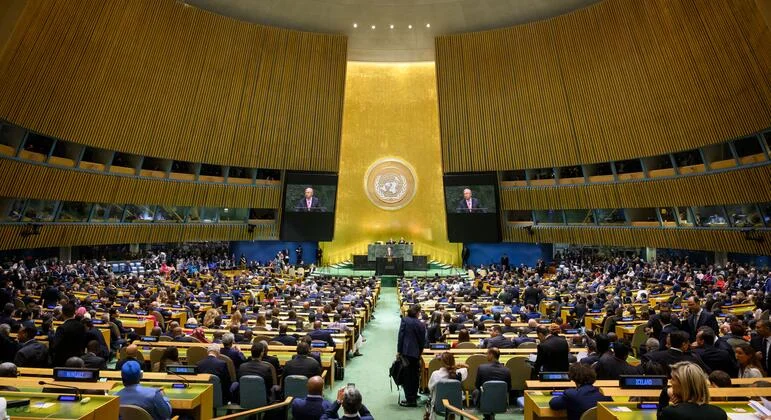
As the 193 Member States concluded their annual General Debate at the United Nations General Assembly, a singular, urgent refrain echoed through the halls of the iconic New York headquarters: the United Nations is at a crossroads. For decades, the organization has served as the bedrock of international order, but as the global landscape shifts toward multipolarity, member states are increasingly questioning whether the architecture built in the ashes of World War II is still capable of managing the volatile realities of the 21st century.
From the halls of the Security Council to the bureaucratic corridors of the Secretariat, the consensus is stark—reform is no longer a matter of administrative preference; it is a prerequisite for survival.
The Mandate for Modernity: Why Reform is Inevitable
The UN’s current institutional structure is a relic of 1945. While the world has transformed through decolonization, technological revolution, and the rise of the Global South, the decision-making power at the top of the UN hierarchy remains frozen in a post-war configuration.
Secretary-General António Guterres set the tone for the assembly with a sobering reminder of the organization’s fundamental purpose: "The United Nations exists because power requires rules—and humanity needs a place where power answers to principle." However, as delegates noted throughout the week, the distance between that principle and the actual exercise of power is widening.
The central tension of this year’s debate was the disconnect between "representation" and "legitimacy." If the UN is to maintain its credibility as a global arbiter of peace and justice, it must reflect the world as it exists today, not as it was defined eight decades ago.
Chronology of a Crisis: From Inception to Impasse
- 1945: The UN Charter is signed, establishing the Security Council with five permanent members (P5) holding veto power: the United States, the United Kingdom, France, Russia, and China.
- 1960s–1990s: Successive waves of decolonization lead to a massive increase in UN membership, primarily from Africa, Asia, and Latin America, sparking the first calls for structural adjustment.
- 2005 World Summit: Reform of the Security Council is discussed at the highest levels but ultimately stalls due to disagreements over veto power and regional expansion.
- 2023–2024: The "UN80 Initiative" is launched, aimed at reinvigorating the organization ahead of its 80th anniversary.
- September 2024 (General Debate): The rhetoric reaches a fever pitch as nations explicitly link the UN’s lack of reform to its diminishing influence in global conflict resolution.
The Battle for the Security Council: Who Holds the Keys?
The Security Council, tasked with the primary responsibility for international peace and security, has become the primary site of systemic gridlock. The most contentious issue is the continued exclusion of the African continent from permanent membership—a glaring omission in an era where African nations comprise a significant portion of the UN’s active peacekeeping and development agenda.
Kenya’s representative delivered perhaps the most biting critique of the week, stating, "The equality proclaimed in this Assembly ends at the doors of the Security Council."
This sentiment was mirrored by Guyana, which argued that the Council must embrace the emerging multipolarity of the 21st century. "We need a Security Council that reflects the geopolitical realities of today, not the power structures of 1945," the delegation insisted, specifically calling for permanent representation for Latin America and the Caribbean.
The UN leadership has aligned itself with this view. Secretary-General Guterres famously declared that a Security Council without permanent African seats is "unjust and indefensible." Similarly, General Assembly President Khalilur Rahman emphasized the urgency of the moment, warning that "Africa cannot be asked to wait indefinitely for its rightful place on the Council."
Divergent Paths: The Politics of Structural Change
While there is near-universal agreement that the status quo is unsustainable, the "how" of reform remains a subject of intense geopolitical friction.
The Radical Approach
Spain has emerged as a vocal proponent of a wholesale overhaul. Its delegation argued that mere expansion is insufficient, calling for the total abolition of the veto power currently held by the P5. The logic is clear: the veto has frequently paralyzed the Council, preventing it from acting in the face of humanitarian catastrophes and allowing permanent members to shield themselves and their allies from accountability.
The Status Quo Defense
Conversely, Russia, a permanent member, has adopted a more cautious, preservationist stance. While acknowledging the need for broader representation from Asia, Africa, and Latin America, Moscow has warned against any reforms that might "undermine the intergovernmental nature of the UN system" or erode the existing prerogatives of the permanent members. This reflects a deep-seated fear among the P5 that a truly representative Council would dilute their influence and render the UN less predictable.
Trust as a Currency: The Crisis of Credibility
Beyond the mechanics of voting and membership, the debate touched on a more ephemeral but vital issue: trust. Hungary’s contribution to the debate struck a chord with many smaller nations, asserting that "the United Nations cannot demand trust; it must earn it."
The erosion of trust is linked directly to the perception of "selective application." When international law is applied inconsistently—where certain nations are sanctioned for violations while others operate with impunity—the UN’s moral authority suffers. Delegates from multiple regions expressed concerns that the UN is increasingly viewed as a tool of the powerful rather than a forum for universal justice.
Operational Reform: Efficiency vs. Empowerment
The debate over "what the UN should be" extended to its operational capacity. Through the UN80 Initiative, the organization has sought to address the bureaucratic "silos" and overlapping mandates that often hinder its effectiveness.
However, the vision for a "leaner" UN is contested:
- The Efficiency Advocates: Switzerland and Costa Rica led the call for prioritized mandates and measurable results, suggesting that the UN must prove its value through concrete, on-the-ground impact.
- The Resource Skeptics: Other nations, including China and Guyana, warned that the "reform" discourse is often a coded language for budget cutting. They argued that the UN is frequently given massive, global responsibilities but is denied the commensurate resources to carry them out.
- The Retrenchment Model: The United States presented a distinctively aggressive approach to reform, touting a 15 percent budget cut for 2026 and the elimination of over 4,000 bureaucratic positions. This "retrenchment" model posits that the UN must be forced to do more with less, even as it signals a growing U.S. skepticism regarding international involvement in areas deemed domestic prerogatives.
Implications: A System at Risk
The overarching message from this year’s General Assembly is that the "purpose-built" nature of the United Nations is failing under the weight of modern global crises. From the climate emergency to the rapid proliferation of artificial intelligence and the resurgence of great-power conflict, the issues that now define the global agenda do not respect the borders or the institutional silos of 1945.
If the UN fails to reform, it risks becoming an increasingly performative body—a place where speeches are made and resolutions are passed, but where actual power resides elsewhere. As President Rahman starkly noted: "Outside these walls, people are not asking whether the United Nations still exists. They are asking whether it works."
Conclusion: The Necessity of Multilateralism
Despite the deep divisions over veto power, budget allocations, and geopolitical influence, a surprising thread of unity remained. No nation suggested abandoning the UN entirely. The recognition remains that in a hyper-connected, volatile world, the alternative to a flawed UN is not a perfect nationalistic vacuum; it is a chaotic, ungoverned global landscape.
As the curtains closed on the debate, the words of Guyana served as a final guiding principle for the year ahead: "This is why we must not abandon multilateralism because it is imperfect; we must renew it because humanity still needs it."
The path forward is clear, yet perilous. For the UN to survive its next decade, it must transition from a 20th-century peacekeeping body into a 21st-century problem-solving machine—one that is accountable, representative, and, above all, capable of delivering results for the people it serves. The debate has concluded, but the real work of transformation has only just begun.
 Muslim
 Jia Lissa
 Pevita Pearce
