

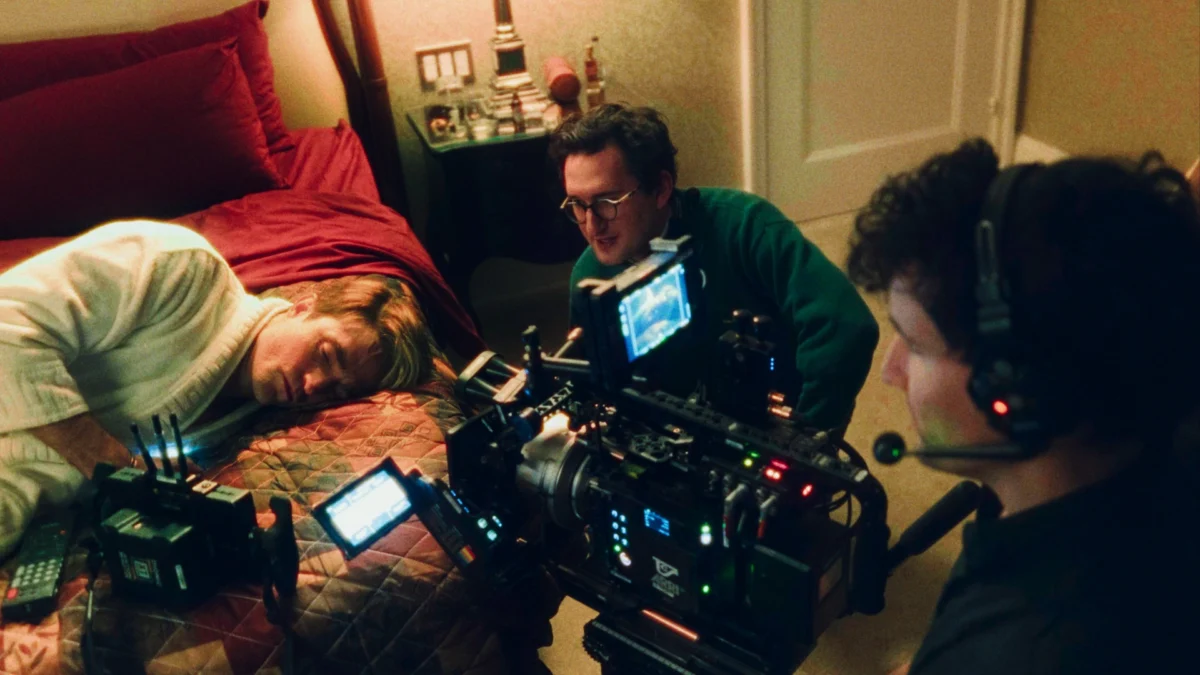
When documentary filmmaker Lance Oppenheim transitioned from the non-fiction realm to narrative feature directing, he knew his debut project, Primetime, required a lead actor capable of walking a razor’s edge. The film—a surreal, high-octane exploration of media ethics, performative justice, and the dark obsession surrounding the iconic television series To Catch a Predator—demanded a performer who could disappear into the skin of a fictionalized version of Chris Hansen.
What he got in Robert Pattinson was something far more transformative. According to those close to the production, Pattinson didn’t just play the role; he deconstructed the very concept of the "televised savior," delivering a performance so idiosyncratic that it has already secured the actor a position in the top five of the current Oscar race for Best Actor.
The Genesis: A Project Reborn
The road to Primetime was far from straightforward. The screenplay, penned by Ajon Singh, had languished in the corridors of Hollywood for years. Despite its provocative premise—an unflinching look at the collision between investigative journalism and public spectacle—it struggled to find a champion willing to navigate its tonal complexities.

The project’s fortunes shifted dramatically when Robert Pattinson and his production partner, Brighton McCloskey, encountered the script. Recognizing the potential for a cinematic "fever dream," the duo moved to acquire the material. However, they realized the film needed a director with a unique visual language—someone who understood the voyeuristic nature of documentary filmmaking and could translate that into a scripted narrative. They turned to Lance Oppenheim.
"I have Rob to credit for really bringing me into this whole thing," Oppenheim noted during a recent post-screening Q&A at the Directors Guild of America. "The way we were able to collaborate on it, I feel like it went deeper than any collaboration I’ve had with anybody, period. It was a total immersion."
A Chronology of Obsession
Pattinson’s connection to the project was not merely professional; it was deeply personal, rooted in a childhood and young-adulthood fascination with the cultural phenomenon that was To Catch a Predator.

"From the second I read the script, I think it was just kismet," Pattinson shared during the discussion. "I was a big fan of the show when I was a teenager and in my early 20s. The most fascinating thing I found was the reaction amongst friend groups. The split between how people were watching the show was always so fascinating to me. I thought there was some kind of energy in the subject matter, which is very intriguing to people and very powerful."
Following the initial development phase, the team entered a rigorous pre-production period where the aesthetic of the film was born. Oppenheim and Pattinson sought to move away from the traditional, sanitized biopic format, aiming instead for the chaotic, kinetic energy of 1970s and 80s thrillers. They cited directors like Oliver Stone and Brian De Palma as primary influences, envisioning Primetime as a "roller-coaster ride" that would leave audiences questioning the thin line between moral crusade and psychological breakdown.
The Performance: "Jerry Maguire Meets Dracula"
Perhaps the most discussed aspect of the film is the sheer eccentricity of Pattinson’s portrayal. During the DGA panel, Oppenheim recounted a pivotal moment during the second week of filming that perfectly captured the friction and creative sparks between director and star.

"I remember the second week of production, he asked how I felt it was going," Oppenheim recalled. "And I was like, ‘I feel like you’ve gotten the Chris Hansen part really good. You’re doing the voice, the mannerisms, the posture, the things that feel iconic… but I also feel like you’re doing Jerry Maguire and Dracula.’"
The director admitted the comment left the star momentarily bewildered. "I think I confused him," Oppenheim laughed. "Because he was like, ‘I thought I was doing Mel Gibson and Braveheart.’"
This creative friction allowed Pattinson to push boundaries that few A-list actors would dare to approach. From precise, unnerving character beats—like a signature finger-gun gesture or a jarring, clinical mouthwash spit-take—Pattinson’s performance is a masterclass in controlled mania.

"I don’t know what’s going on in Rob’s mind," Oppenheim added, gesturing to the screen. "But he’s making brilliant choices. There’s no other actor in the history of movies that would be making choices like Rob does in this movie."
Supporting Data: The Road to the Oscars
The critical and industry reception of Primetime has been overwhelmingly positive, with the film’s unique visual style and Pattinson’s performance becoming the primary talking points of the season. GoldDerby’s expert and user predictions currently place Pattinson firmly within the Top 5 for Best Actor, a testament to the Academy’s growing appreciation for his daring career trajectory.
| Ranking | Contender | Film |
|---|---|---|
| 1 | John Malkovich | Wild Horse Nine |
| 2 | Matt Damon | [Unannounced Title] |
| 3 | Andrew Scott | [Unannounced Title] |
| 4 | Robert Pattinson | Primetime |
| 5 | Tom Cruise | [Unannounced Title] |
This placement is particularly significant given that A24, the studio behind the film, has historically championed unconventional, auteur-driven projects. The synergy between a director known for documentary intimacy and a lead actor willing to embrace the absurd appears to have created a perfect storm for awards consideration.

A Producer’s Perspective
Beyond his acting, Pattinson’s role as a producer proved instrumental in the film’s creation. He was deeply embedded in the post-production process, working closely on the editing, the soundscape, and the film’s overall aesthetic. This multifaceted involvement gave him the leverage to experiment on set, a luxury he utilized to the fullest.
"I didn’t have a fear of trying anything," Pattinson explained. "Also, Lance has got 25,000 cameras going, so you have to be ready for anything. It’s also a good thing about being a producer because you have to let me do at least one thing."
This playful, collaborative back-and-forth between the director and his producer-star allowed for a level of artistic freedom rarely seen in modern studio filmmaking. By removing the traditional hierarchy, they were able to pivot quickly, allowing the film to take the "massive swing" that Oppenheim had envisioned from the very beginning.

Implications for Future Media Criticism
The release of Primetime arrives at a moment of intense cultural reflection regarding the ethics of "true crime" and the commodification of trauma. By centering the narrative on the performative nature of the host, the film invites viewers to interrogate their own participation in the consumption of such media.
If the film succeeds as both an awards-season darling and a cultural touchstone, it will likely be because of its refusal to offer easy answers. It does not treat the source material with reverence; it treats it with the surgical, slightly distorted lens of a fever dream.
As the industry looks toward the upcoming awards ceremony, Primetime stands as a reminder of what happens when a star of Pattinson’s caliber and a filmmaker of Oppenheim’s curiosity converge. It is a film that demands to be seen, not for its accuracy, but for its audacity—a rare, visceral portrait of a man, a mission, and the absolute collapse of the wall between the person and the persona.

Whether it takes home the gold remains to be seen, but the impact of this collaboration has already left an indelible mark on the landscape of contemporary cinema. As Oppenheim aptly put it, "We wanted this to be a biopic that isn’t a biopic." In that, they have succeeded entirely.
 Reynand Wu
 Nana
Nana
