

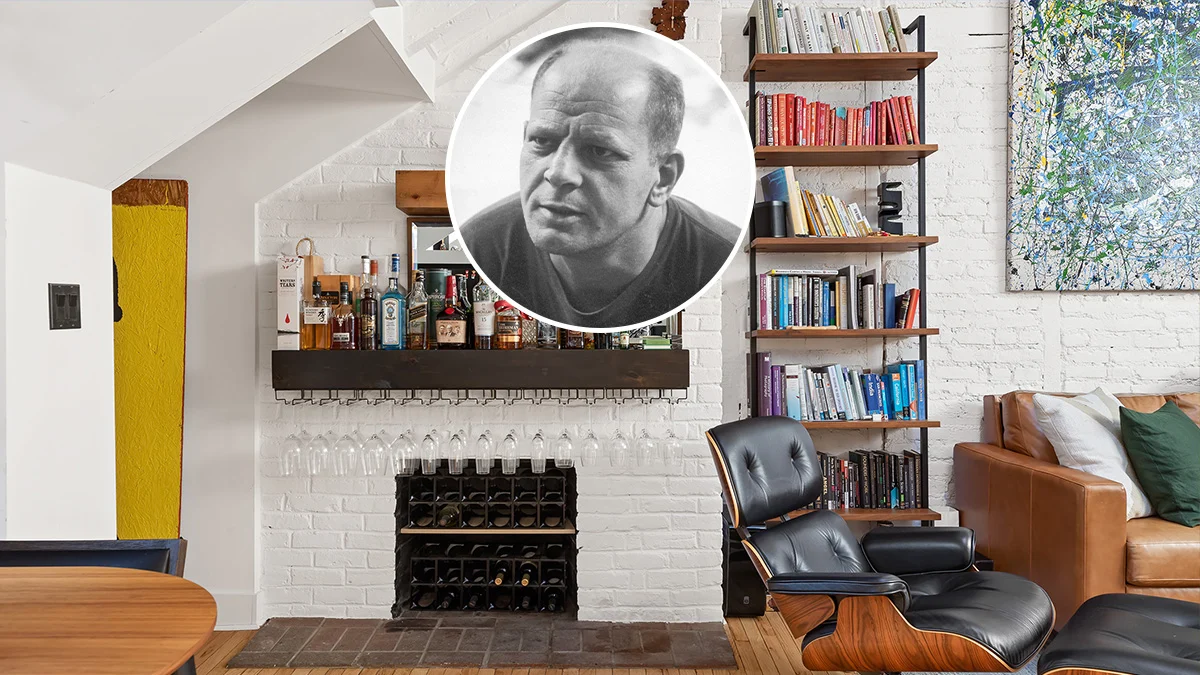
Long before Jackson Pollock became a household name—the titan of Abstract Expressionism whose sprawling, chaotic, and rhythmic canvases would eventually redefine the boundaries of modern art—he was a struggling 20-year-old artist navigating the harsh realities of the Great Depression. In the early 1930s, the future icon was not living in the sprawling Long Island barn where he would later pioneer his revolutionary "drip" technique. Instead, he was carving out a meager existence in a cramped, two-room walk-up in the heart of Manhattan’s West Village.
Today, that unassuming apartment at 46 Carmine Street has hit the market for $1.99 million, offering a rare, tactile connection to the formative years of one of America’s most influential artistic voices.
The Humble Roots of an American Icon
Between 1932 and 1933, 46 Carmine Street served as the epicenter of a young Pollock’s life. He shared the top-floor residence with his older brother, Charles—an artist in his own right—and his sister-in-law, Elizabeth. The living arrangement was far from the romanticized, spacious artist lofts that would come to define the New York art scene of later decades. The two-room unit was a utilitarian space: Charles claimed the front room as his studio, while Jackson worked in the back.
During this period, Pollock was a student at the Art Students League, honing his craft under the tutelage of the legendary Thomas Hart Benton. He was a long way from the fame that would arrive in the 1940s. These were the "starving artist" years, characterized by financial insecurity, intense creative exploration, and a deep, immersive study of regionalism and mural painting under Benton. While the world remembers Pollock for the frenetic, gestural energy of his later work, his time on Carmine Street was a quiet incubation period—a time when the seeds of his eventual stylistic break were being sown in the shadows of Greenwich Village.

A Chronology of Creative Evolution
To understand the significance of the 46 Carmine Street property, one must view it within the broader timeline of Pollock’s meteoric rise.
- 1932–1933: The Carmine Street years. Pollock lives with Charles and Elizabeth, focusing on his studies at the Art Students League and struggling to find his own artistic language amidst the economic collapse of the Great Depression.
- 1935–1943: Pollock works for the WPA (Works Progress Administration) Federal Art Project, a vital period for his development as a muralist and his exposure to the collective energy of the New York art community.
- 1945: Pollock marries Lee Krasner, a pivotal partnership that would sustain him both personally and professionally.
- 1947: The breakthrough. Pollock introduces his "drip" technique, abandoning the easel and placing his canvases on the floor, allowing paint to fall in complex, gravity-defying webs.
- 2010: The building at 46 Carmine Street is officially incorporated into the Greenwich Village Historic District, preserving the architectural integrity of the Federal-style brick townhouse that dates back to 1827.
- 2020–2024: The apartment finds a new chapter under entrepreneur Fergus Hurley, who pays homage to its history by turning the space back into a functional studio during the global pandemic.
Architectural Transformation and Preservation
While the walls of 46 Carmine Street have witnessed the birth of artistic ambition, the space itself has undergone a dramatic transformation since the 1930s. Spanning approximately 690 square feet, the one-bedroom residence is now a light-drenched haven that belies its humble beginnings.
The apartment today features soaring 14-foot ceilings and four expansive skylights that flood the living area with natural light—an essential feature for any artist. The interior blends historical charm with modern luxury, boasting exposed brick walls, refined hardwood floors, and a sleek, updated kitchen and bathroom. A mezzanine loft adds a versatile dimension to the home, serving as a functional home office or a contemporary studio space, effectively reclaiming the room’s original purpose as a site of creation.
The building’s inclusion in the Greenwich Village Historic District ensures that its exterior—a quintessential example of early 19th-century Manhattan architecture—remains a protected landmark, preserving the aesthetic fabric of a neighborhood that has long served as a beacon for bohemians and creatives.

The Contemporary Legacy: Fergus Hurley’s Artistic Tribute
The current owner of the property, entrepreneur Fergus Hurley, did not merely occupy the space; he engaged with its history. After moving from Ireland to New York in 2020, Hurley initially rented the apartment before purchasing it off-market in 2021.
During the isolation of the pandemic, Hurley utilized the loft space to create his own body of work. In a poignant nod to the building’s history, he painted a large-scale abstract piece, drawing inspiration from Pollock’s gestural style. The medium itself was deeply rooted in the city’s modern history: Hurley utilized salvaged wooden boards that had covered SoHo storefronts during the 2020 George Floyd protests. By repurposing the detritus of urban unrest into a form of abstract expression, Hurley effectively bridged the gap between the artistic spirit of the 1930s and the social consciousness of the 2020s.
While Hurley is now listing the property with Shane Boyle of Compass for $1.99 million as he splits his time between Miami and San Francisco, the spirit of the space remains. The painting he created, while not part of the initial real estate transaction, remains a subject of potential negotiation, serving as a physical manifestation of the home’s enduring creative pulse.
The Broader Context: Pollock’s Enduring Market Value
The listing of the Carmine Street apartment arrives at a moment of renewed public interest in the Pollock-Krasner legacy. The Metropolitan Museum of Art is currently hosting Krasner and Pollock: Past Continuous, a comprehensive exhibition that features over 120 works by the duo. The show, which runs through January 31, 2027, has provided a scholarly and emotional framework for reassessing the lives of these two icons.

This cultural focus often translates into tangible market value. Properties associated with major artistic figures—so-called "provenance real estate"—carry a premium that goes beyond the square footage or the neighborhood’s standard market rate. For a buyer, the purchase is not just an investment in Manhattan real estate; it is an acquisition of a piece of the American art canon.
Implications for Future Ownership
As the real estate market in the West Village continues to command record-breaking prices, 46 Carmine Street stands out as a unique asset. It is a rare opportunity to own a property that possesses both architectural distinction and a profound historical narrative.
The next owner will inherit more than just an updated, light-filled condo. They will possess a physical space where a young, uncertain, and hungry Jackson Pollock began to wrestle with the concepts that would eventually challenge the status quo of the art world. While the next occupant may not be sharing the back room with a sibling or struggling to make rent during a national depression, they will be stepping into a lineage of creativity.
Whether the apartment is used as a residence, a creative studio, or a pied-à-terre, its value is anchored in the legacy of what happened within those four walls. In a city that is constantly tearing down its past to build the future, 46 Carmine Street remains a testament to the fact that greatness often begins in the most modest of surroundings. The apartment serves as a reminder that the "masterpieces" of tomorrow are currently being created in rooms that might seem small today, but which will one day be viewed as the hallowed grounds of art history.
 Ali Ikhwan
 Siti Muinah
 Dwi Wanna
