

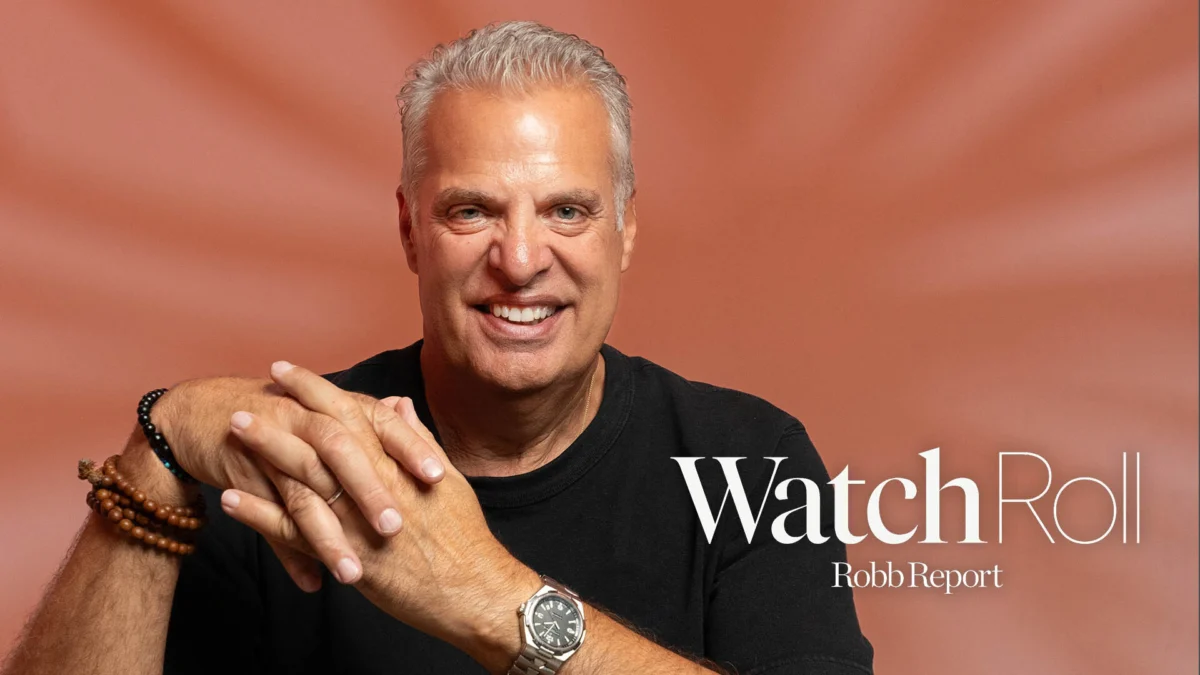
Published on October 13, 2026
For Eric Ripert, the kitchen of Le Bernardin—a sanctuary of culinary precision and world-renowned seafood—demands a specific kind of rhythm. It is a place of heat, pressure, and absolute temporal exactitude. Yet, when the apron comes off and the service concludes, the man who has spent decades redefining fine dining finds his creative focus shifting from the plate to the wrist. Ripert, a culinary icon, possesses an insatiable appetite for high horology, curating a collection of timepieces that rivals his impeccable taste in ingredients.
In the debut episode of Watch Roll, a new series by Robb Report exploring the private collections of the world’s luxury elite, we take an intimate look at the watches that define Ripert’s personal journey. From sentimental gifts to hard-won treasures, his collection is a masterclass in balance, utility, and refined aesthetics.
The Intersection of Culinary Art and Horology
To understand Ripert’s collection, one must first understand his philosophy: the pursuit of perfection. Whether it is the delicate sear on a scallop or the mechanical movement of a tourbillon, Ripert views craftsmanship through a lens of profound respect. For the chef, a watch is not merely a tool to track the lunch rush; it is a companion, a piece of art, and a repository of personal history.
"Every time I have a beautiful watch, I’m like, ‘This is it. My collection is finished,’" Ripert admits with a knowing laugh. "And then I see another beautiful watch." This relentless pursuit of excellence has led him to acquire rarities from the most prestigious houses in Switzerland, including Vacheron Constantin, Rolex, and Cartier.
Chronology of a Collector: From First Gift to Boutique Triumph
The narrative of Ripert’s collection is not one of mere accumulation, but of milestones marked by time.
The Sentimental Foundation: The Cartier Santos Vendome Rond
The cornerstone of his collection dates back to his formative years. Upon graduating from culinary school, Ripert was gifted a 32 mm Cartier Santos Vendome Rond by his mother. It was more than a timepiece; it was an investment in his future.
"She surprised me by saying, ‘I have a little gift for you, and I know you like watches, and now you’re gonna have a Cartier,’" Ripert recalls. Despite the rigorous environment of the professional kitchen, where stainless steel surfaces and sharp blades are the norm, Ripert refused to leave the watch in a locker. He wore it daily. "I know that some of the cooks were looking at me weird," he notes. "I had no problem wearing it, and I was like, ‘I don’t care. It’s my watch, and I enjoy it.’"
The First Purchase: The 1964 Rolex Air-King
As his career ascended, so did his horological ambitions. Ripert’s first self-purchased watch was a 1964 Rolex Air-King (Ref. 5500) with a striking blue dial. Acquired in Paris, the watch served as a proxy for his birth year—1965. While he reserves his more robust pieces for the kitchen, the Air-King remains his go-to for social engagements and public appearances, representing a pivotal moment of independence in his professional life.
The Kitchen Workhorse: The Vacheron Constantin Overseas
Perhaps the most impressive aspect of Ripert’s relationship with his watches is his insistence on wearing them while working. His current daily driver in the kitchen is the Vacheron Constantin Overseas (Ref. 47040/B01a-9094).
For 30 years, this 42 mm stainless steel masterpiece has withstood the "kitchen debacles" of a Michelin-starred environment. "I’m able to read the time with ease," he says. The watch has survived heat, humidity, and the physical intensity of service, proving that high horology and high-pressure work environments are not mutually exclusive.

Supporting Data: Why These Pieces Matter
The value of Ripert’s collection lies not just in market appreciation, but in technical significance. His ownership of the Vacheron Constantin Historiques American 1921—a gift from his long-time business partner, Maguy Le Coze, to commemorate his 20th anniversary at Le Bernardin—highlights a penchant for distinct design.
The American 1921, with its signature diagonal time display and 18-karat yellow gold case, is an unconventional piece that speaks to Ripert’s own creative audacity. "I love the originality of the watch and the design," he reflects. It is a piece that demands attention, much like the signature dishes that have kept Le Bernardin at the pinnacle of the culinary world for decades.
The Hunt: The Persistence of a Connoisseur
Perhaps the most dramatic tale in Ripert’s collection is the acquisition of the Vacheron Constantin Traditionnelle Tourbillon Retrograde Date Openface (Ref. 6010T/00P-H055). This was not a passive purchase; it was a conquest.
Upon spotting the rare, limited-run watch in a Vacheron boutique, Ripert was informed that it was essentially unavailable—the brand had only two in the United States. Undeterred, Ripert leaned into his legendary persistence. "I was very persistent… I didn’t want to leave the store without the watch," he says. His refusal to accept a "no" resulted in him walking out with the piece, proving that the same drive required to maintain a three-star Michelin restaurant is equally effective when securing rare horological specimens.
Implications for the Luxury Landscape
Ripert’s collection serves as a case study for the modern collector. He bridges the gap between the "tool watch" ethos of the mid-20th century and the high-complication fascination of the 21st.
The Cultural Shift
For many years, the luxury watch industry marketed timepieces as items to be preserved in safe-deposit boxes or worn only during leisure. Ripert’s collection challenges this. By wearing a Vacheron Constantin in the heat of a professional kitchen, he asserts that a watch’s true value is realized only through experience. It implies a "wear your collection" philosophy that is gaining significant traction among younger, more utilitarian-minded collectors.
The Professional-Horological Nexus
There is a profound psychological link between the precision of a chef and the precision of a watchmaker. Both operate in realms where a fraction of a second or a single degree of temperature can be the difference between success and failure. Ripert’s collection is an extension of his culinary discipline—a physical manifestation of the order he maintains in his professional life.
Conclusion: A Living Legacy
Eric Ripert’s watches are more than just mechanical devices; they are a timeline of his life. From the gift of a mother to the rewards of a business partnership, and finally, to the fruits of his own relentless ambition, his collection tracks his evolution from a young, aspiring chef to a global culinary legend.
As Watch Roll continues its series, it is unlikely we will find a collector with a more authentic connection to his pieces. Ripert doesn’t just collect watches; he lives with them. And in doing so, he ensures that every tick of the movement is a reminder of a life lived with intensity, style, and an uncompromising standard of quality.
Whether it is the vintage charm of a 1964 Rolex or the modern, complex engineering of a tourbillon, Ripert’s watch box remains a testament to the fact that when it comes to the finer things in life, the best time to enjoy them is always now.
 Ali Ikhwan
 Ammar Sabilarrohman
 Dwi Wanna
