

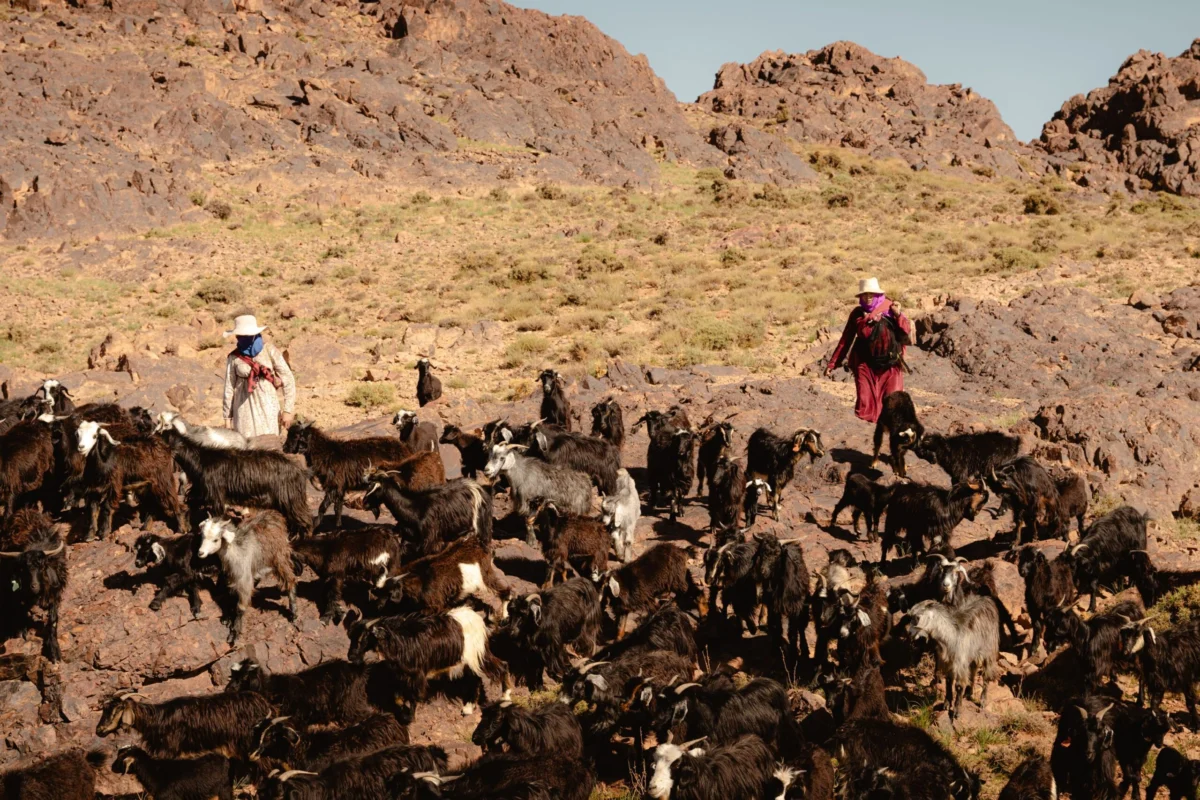
In the shimmering, arid expanse of Jebel Saghro, where basalt towers pierce the sky like the serrated teeth of a dormant giant, a persistent chorus of shrill bleats and guttural baas echoes against the canyons. To the untrained eye, the onyx-coated goats are virtually invisible, perfectly camouflaged against the volcanic, sun-scorched terrain. But for Telhou Belâawane, the matriarch of the Berber family navigating these crags, every animal is a vital thread in a centuries-old tapestry.
I squint against the relentless midday sun, searching the horizon. High on a jagged peak, the vibrant flash of Telhou’s red djellaba serves as a beacon. She is leading her herd through the "Land of Thirst"—a name that feels visceral in the heat—marking a migration that has defined the Aït Atta people for millennia. This is not merely a hike; it is transhumance, a seasonal migration that is as much a testament to human resilience as it is a vanishing way of life.

The Pillars of Transhumance: A Cultural Legacy
Jebel Saghro, stretching from the High Atlas Mountains toward the Saharan fringe, serves as the ancestral heartland of the Aït Atta, a historically powerful Amazigh (Berber) tribe. The term "Amazigh" translates to "free people," a moniker that resonates deeply when witnessing a family that refuses to be tethered by the modern world’s rigid expectations.
Twice a year, these families undertake a grueling 180-mile journey, moving their livestock from the lush summer grazing grounds of the High Atlas to the winter pastures of Jebel Saghro. This cyclical rhythm of movement is a profound act of environmental adaptation. However, this ancient practice is currently facing an existential crossroads. Climate change, characterized by severe, prolonged droughts, has diminished the quality of the pastures, while government mandates requiring children to attend school until age 16 have depleted the workforce necessary to maintain the herds. Where once 80 families from the Aït Slilou sub-tribe made this pilgrimage, today, only a handful remain.

The Evolution of Luxury: The "Keepers" Initiative
My presence in this remote corner of Morocco is facilitated by Black Tomato, a travel operator that has recently launched an ambitious project titled The Keepers. As the digital age renders information instant and ubiquitous, Black Tomato co-founder Tom Marchant posits that true luxury is no longer found in thread counts or marble lobbies, but in the rare, disappearing knowledge of the world’s last custodians of tradition.
The Keepers collection offers five immersive itineraries, ranging from learning to read the ocean’s tides with a mariscador on Chile’s Chiloé Island to studying under a 28th-generation Daoist master in Chengdu, China. The Morocco experience is designed to turn the traveler from a passive observer into an active participant.

Before my arrival, the Belâawane caravan was a lean, self-sufficient unit: 200 goats, two herding dogs, three donkeys, and the family. To accommodate the logistics of a sustainable, low-impact, yet comfortable expedition, Black Tomato expanded the caravan to include five mules, a chef, logistics staff to manage an eco-friendly mobile camp, and a team of mule handlers—many of whom are local men who have been forced by economic shifts to abandon their own nomadic lives for sedentary village work.
A Chronology of the Trek: Life on the Move
Day One: The Ascent into the "Land of Thirst"
The journey begins at the edge of the Dadès Valley in the village of Tagdilt. I meet Zaïd Oukhazaid, our head mule handler, whose gap-toothed smile and infectious warmth immediately bridge the language barrier. Though our verbal communication is limited to rudimentary English and broken French, the common language of travel—shared laughter and mutual respect—is more than sufficient.

"The nomads dictate the days," explains Noureddine (Nouri) Bachar, my translator. "We are here to support their journey; they do not change their route to support ours."
We hike into a Martian-like landscape, a desolate beauty of flat-topped mesas and dry riverbeds. Reaching the Tircht pass at 6,100 feet, we find the team has already established the camp within a traditional stone azib—a pen used by generations of Aït Atta to shelter their livestock. As the sun dips behind the cliffs, we gather in a goat-hair tent for a meal of harira soup. In this space, the hierarchy of the modern world evaporates. The men discuss the day’s route, while the women, having handled the arduous task of moving the goats all day, finally rest.

Day Two: The Rhythms of the Herd
The dawn is heralded by the rhythmic braying of donkeys. After a breakfast of baghrir (crepe-like pancakes) and amlou (almond butter), we set off. I shadow Telhou and her 17-year-old daughter, Sa’dia. Witnessing Sa’dia navigate near-vertical scree slopes in simple loafers, draped in a gold-striped dress, is a humbling reminder of human capability. She possesses a physical grace and spatial awareness that makes my high-tech hiking gear feel like an unnecessary crutch.
The trek is 7.5 miles, cresting at 8,200 feet. We see no other souls, save for one other nomadic family with a small caravan of camels. The isolation is profound, reinforcing the gravity of the family’s mission: to find sustenance for the herd, which represents their entire wealth.

Day Three: The Human Connection
By the third day, the boundary between "guest" and "family" has blurred. A goat is sacrificed in my honor, and we partake in a communal, hand-to-mouth meal. The conversation turns to the shifting political landscape of Morocco, specifically the appointment of the first female prime minister. When I ask Telhou her thoughts, her simple response—"I am a woman, too"—speaks volumes about the quiet shifts occurring even within the most traditional spheres of society.
I spend the afternoon learning to toss dough for aghroum and trying (and failing) to use a slingshot to corral a stray kid named Mittens. By the time I succeed, the physical exhaustion is total, but the psychological clarity is absolute.

The Implications of a Vanishing Life
The struggle of the Belâawane family is not unique. It is a mirror held up to global pastoralism. From the Swiss Alps to the American West, the "nomad way" is under siege by the twin pressures of climate change and urbanization. When a young generation is introduced to the conveniences of electricity and running water, the romanticized hardships of the trail lose their appeal.
However, the Keepers initiative suggests that there is value in documenting and supporting these traditions. By providing an economic incentive for families like the Belâawanes to continue their migration while hosting respectful, small-scale travelers, the project hopes to provide a lifeline to a dying practice.

Conclusion: Earning the Keep
On our final day, as I successfully bring a straying Mittens back to the herd, Telhou offers me a gesture of inclusion that transcends the transaction of the trip. "She is a nomad at heart," she tells Nouri.
As I prepare to leave the desert, I am left with a poignant realization: the ultimate luxury in our hyper-connected, screen-saturated world is the ability to disconnect and engage with the fundamental elements of life—the terrain, the herd, and the people who hold the memory of the earth. Whether this experiment in "cultural tourism" can truly save the nomadic way of life remains to be seen, but for the Belâawane family, it provides a bridge—a way to share their heritage with the world before the path becomes overgrown with the dust of history.

Trip Details: Black Tomato offers this immersive experience starting at $12,950 per person for a 6-day, 5-night itinerary, including local guides, logistics, and accommodations. For more information, visit www.blacktomato.com.
 Asro
 Sagoh
