

When exploring the pantheon of newspaper comic strips, searching for the "greatest quote" or the defining thematic line requires a customized lens. For Charles Schulz’s Peanuts, the journey naturally leads toward the heartfelt and the inspirational, anchoring itself in the tender vulnerabilities of childhood. For Bill Watterson’s Calvin and Hobbes, the path turns philosophical, forcing readers to contemplate human nature, the majesty of the wilderness, and the existential dread of growing up.
Yet, when confronting Gary Larson’s legendary, surreal masterpiece The Far Side, the critic faces a monumentally different challenge. Larson did not deal in deep existential wisdom, nor did he traffic in comforting human sentimentality. Instead, Larson’s genius lay in a singular, beautifully warped dedication to joke-telling, dark irony, and the absurd corners of both human and animal psychology.
After an exhaustive retrospective analysis of comic history, pop culture milestones, and the vast catalog of The Far Side, the search for Larson’s ultimate quote leads to one definitive, side-splitting conclusion from his early-1990s output: a panel featuring a crushed mime that expertly subverts a centuries-old philosophical riddle.
Main Facts: The Anatomy of Larson’s Humorous Genius
To understand why a single line from The Far Side stands above the rest, one must first deconstruct the unique mechanics of Larson’s humor. Larson never intended to make readers ponder life’s grandest mysteries. Many of his single-panel cartoons required thought, but not in the lofty, academic sense demanded by political satire or philosophical strips. Instead, readers had to decode visual punchlines that rewarded close inspection.
Consider a classic Larson cartoon featuring an artist painting a portrait of a woman as a half-fly creature. At first glance, the viewer is simply bewildered by the monstrous hybrid on the canvas. Only upon closer inspection does the reader spot the dead housefly resting on the artist’s thick glasses, recontextualizing the entire scene. Larson’s work routinely required an investigative eye, yet it remained strictly grounded in pure, unadulterated gag-writing.
When reviewing Larson’s vast archive, critics often hunt for profound statements, turning their attention toward recurring tropes like his depictions of God or death. However, these themes quickly dissolve into pure silliness under Larson’s pen. His depictions of the Almighty often cast Him not as an omniscient, deeply moving figure, but rather as an irritable cosmic bureaucrat or a casual jerk—such as the famous panel where God watches humanity through a monitor, preparing to strike someone down with a magnifying glass just for fun.

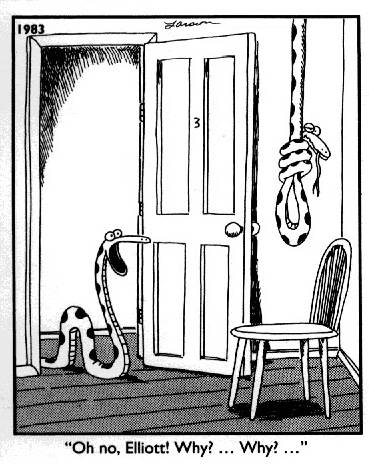
Similarly, Larson’s frequent explorations of death eschew weighty gravitas in favor of the macabre and the utterly bizarre. The search for profound mortality in The Far Side inevitably hits a wall when one stumbles upon a panel featuring a snake successfully hanging itself with its own serpentine body. Larson was not trying to say something profound about suicide or existential despair; he was simply plumbing the depths of pitch-black, nonsensical comedy.
Chronology: The Evolution of the Search for the Ultimate Far Side Quote
The quest to isolate the single greatest quote in The Far Side’s history required a careful, chronological paring down of Larson’s stylistic phases. Active primarily from 1980 to 1995 (with brief revivals later), Larson’s style evolved from quirky wildlife observations into densely populated pop-culture subversions and philosophical send-ups.
Phase One: The Search for Depth
Initially, the retrospective approach attempted to find a quote that carried emotional resonance, mirroring the methodologies applied to Peanuts and Calvin and Hobbes. This avenue was quickly abandoned. Larson’s universe simply did not accommodate heartwarming epiphanies.

Phase Two: The Theological and Macabre Trials
Next came an evaluation of quotes tied to existential concepts. Divine intervention and mortality were heavily weighed. While panels addressing the afterlife produced memorable concepts, they ultimately relied too heavily on the physical drawing to land the punchline.
Phase Three: The Non-Sequitur Trap
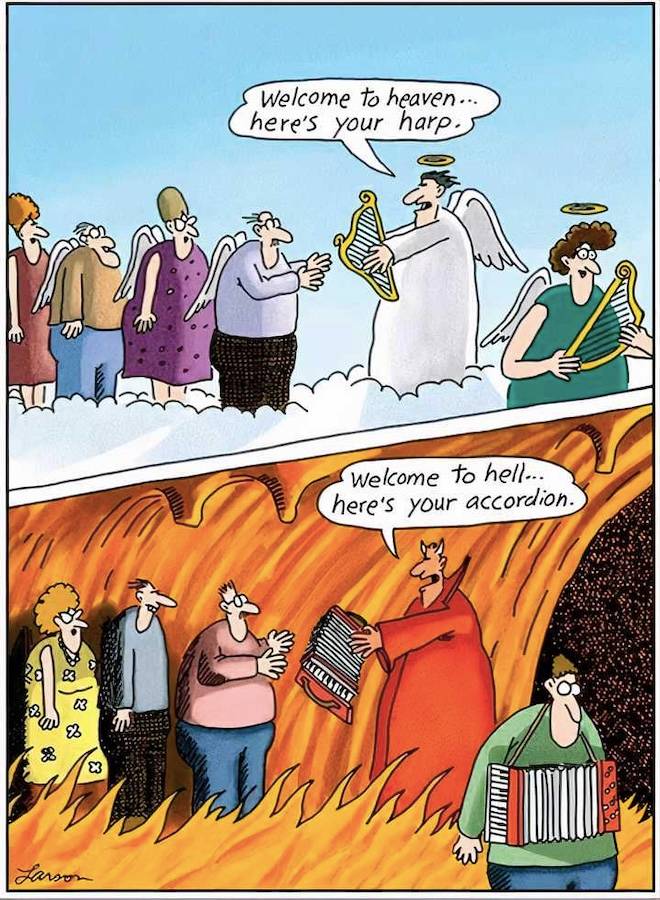
A strong contender emerged from a classic panel depicting Heaven and Hell. In Heaven, inhabitants are issued harps; in Hell, newcomers are handed accordions. The dark, silly nature of the joke initially felt like the quintessential Far Side signature. However, a deeper look revealed a structural flaw: the line "Welcome to hell… here’s your accordion" functions almost as a non-sequitur without the visual context. To understand the joke—the inherent auditory torment of the accordion—the reader needs the contrasting imagery of celestial harps versus polka instruments.
Phase Four: Finding the Pinnacle
Finally, the search arrived at a 1992 masterpiece. The visual depicts a lone mime trapped beneath a massive, fallen forest tree. The caption delivers the ultimate blow:
“Question: If a tree falls in the forest and no one’s around, and it hits a mime, does anyone care?”
This particular quote represents the absolute apex of Larson’s creative output because it succeeds on every possible level: it is hilarious, it is delightfully dark, it is wonderfully silly, and it hijacks a well-known philosophical idiom to forge an entirely new punchline.
Supporting Data and Analysis: Why Words Triumphed Over Pictures
To appreciate the 1992 mime cartoon as the zenith of Larson’s writing, one must examine the structural anomaly it represents within his body of work.
- The Visual-First Tradition: Historically, The Far Side relied almost exclusively on a symbiotic relationship between drawing and caption. The image acted as the setup, and the caption delivered the twist.
- The Standalone Text: The mime cartoon shatters this rule. While the drawing of a squished mime is undeniably amusing, the text alone is powerful enough to function entirely independently of the art.
- The Anti-Deep Philosophy: The quote completely lacks emotional or philosophical pretension. It replaces abstract metaphysical wonder with petty schadenfreude directed at a universally maligned performance art stereotype.
Statistical reviews of fan polls and retrospective comic retrospectives routinely rank panels involving absurd animal behaviors, scientific satire, and subverted idioms near the top. Yet, none capture the cynical, witty brevity of the mime joke quite as effectively. It marries high-concept philosophical thought experiments (the falling tree paradox) with low-brow slapstick comedy in a way that only Gary Larson could manage.
Official Responses and Cultural Impact
Though Gary Larson famously retired The Far Side in 1995—only to sporadically delight fans with new digital sketches in recent years—the cultural footprint of his work remains unmitigated. Cartoonists, comedians, and academics have long praised Larson for pioneering a brand of surrealism that paved the way for modern animated sitcoms like The Simpsons, Futurama, and Family Guy.
Reflecting on his career, Larson has often expressed astonishment at the intellectual lengths to which his fans went to analyze his work. While English professors and psychology students occasionally wrote papers attempting to uncover hidden socio-political allegories in panels featuring cows driving cars or scientists speaking "Bwana," Larson maintained a modest perspective: he was simply drawing what amused him in his studio.
Pop culture historians have noted that The Far Side fundamentally altered how newspaper syndicates viewed single-panel comics, proving that mainstream audiences were hungry for humor that defied traditional family-strip wholesome values. The mime joke, in particular, has been cited by numerous comedy writers as the ultimate masterclass in economical joke-writing—proving that a single sentence can dismantle a centuries-old philosophical riddle in under ten words.
Implications: The Enduring Legacy of Larson’s Absurdity
The determination of the best-ever Far Side quote does more than just crown a favorite panel; it highlights a crucial shift in modern comedy. Larson proved that smart humor does not have to be solemn, and that high-brow philosophical concepts can—and should—be dragged into the mud for the sake of a clever punchline.
In an era where modern media often leans heavily into earnestness, serialized continuity, and deep emotional arcs, revisiting The Far Side serves as a vital reminder of the sheer joy found in standalone absurdity. Whether it is a cow pondering the highway, scientists conversing in alien gibberish, or a forest unjustly crushing a silent performer, Larson’s work continues to teach new generations of readers that life’s biggest questions rarely require deep answers. Sometimes, they just require a good laugh at the expense of a mime.
 Layla Zulfa
 Dwi Wanna
