

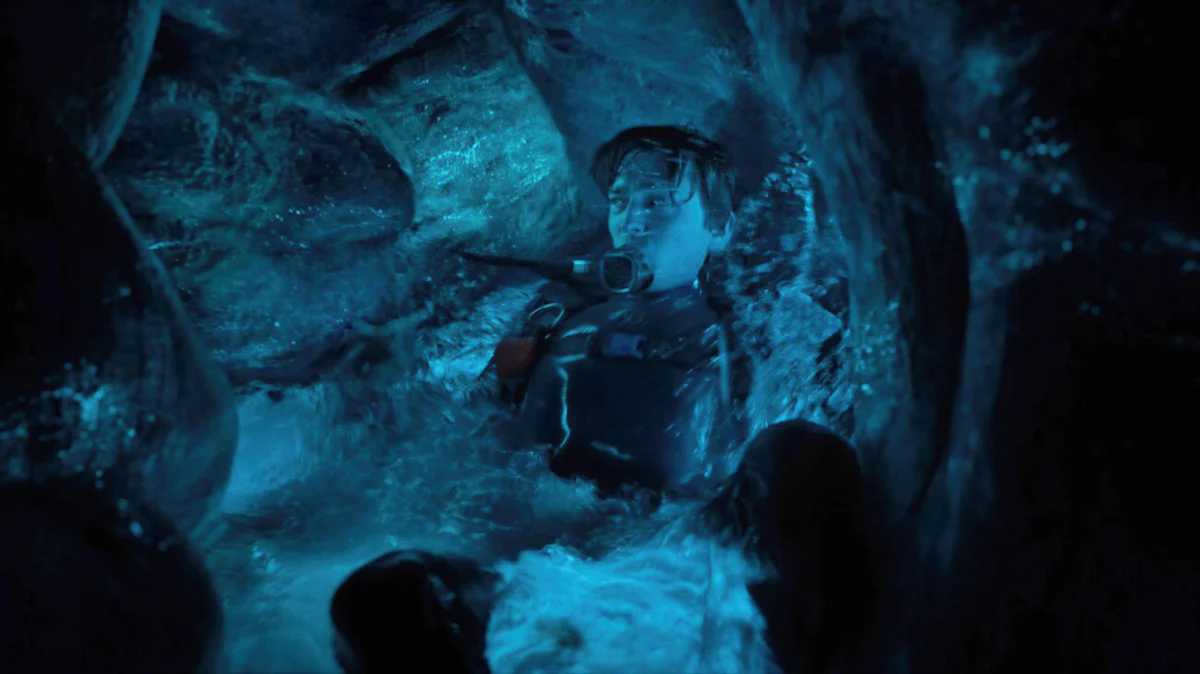
In the visceral, high-stakes drama Whalefall, the protagonist Jay Gardiner—portrayed by Austin Abrams—finds himself in the most claustrophobic environment imaginable: the interior of a rogue sperm whale. While the narrative follows Jay’s harrowing, soul-searching quest to recover the remains of his father, the true hero of the production may well be the technical team that brought the whale’s anatomy to life.
For production designer Ramsey Avery, the challenge was not merely artistic; it was an exercise in biological engineering and cinematic innovation. The task was to create a series of sets that were easily captured in a screenplay’s "Final Draft" format but presented a logistical nightmare to realize in three-dimensional space. The result is a masterclass in the synthesis of practical effects and cutting-edge digital integration, a feat that required constant cross-continental collaboration between New Zealand’s WETA Workshops and soundstages in Los Angeles.
The Architecture of Anatomy: Designing the Stomach
The project began with a fundamental question: How do you build a stomach that feels both organic and cinematic? Avery, whose previous credits include the visually stunning The Rings of Power, knew that traditional set-building techniques would fall short. To achieve the necessary level of immersion, the team constructed five distinct iterations of the whale’s stomach, alongside a mouth, an esophagus, and a complex puppet of a giant squid.
"You don’t get challenges like this," Avery told IndieWire. "Pretty much everybody came at it with a sense of, ‘Oh, this is going to kill us, but we’re going to have fun while we’re doing it anyway.’"

The research process was nothing short of grotesque. Avery spent weeks immersed in the study of decaying marine life, analyzing orthoscopic images of endoscopic procedures performed on whales, dolphins, and large livestock. Despite the squeamish nature of the material, the team remained undeterred, conducting four rigorous camera tests to calibrate the scale and responsiveness of the sets.
Chronology: From Concept to Bioluminescent Reality
The creation of Whalefall was a multi-stage, iterative process that demanded a high degree of patience and technical experimentation.
Phase 1: The Research and Testing Period
During a crucial four-to-five-week window, the core creative team worked in a part-time, distributed capacity while fulfilling other professional obligations. This was the incubator phase, where the team tested various materials—silicone, latex, and even heavy-duty upholstery—to mimic the texture of living tissue.
Phase 2: The Practical Rigging
The sets were designed as dynamic characters. Different rigs were developed for different emotional beats:

- The Gimbal Rig: Designed to replicate the massive, surging movements of a whale in deep-sea transit.
- The "Washing Machine" Rig: A rotational setup that provided a disorienting, visceral sense of movement.
- The Fine-Detail Rig: Calibrated for close-up work, allowing for subtle, rhythmic shivers that mirrored the whale’s internal processes.
Phase 3: The Digital Integration
As shooting commenced, the production faced a unique hurdle: the sets were constantly moving, making traditional post-production scanning impossible. VFX supervisor Guillaume Rocheron rose to the challenge by inventing a custom infrared binocular camera. This device attached to the primary film cameras, allowing the VFX team to capture a live, moving 3D scan of the set that perfectly matched the perspective of every shot.
Supporting Data: The Mechanics of Immersion
The sheer scale of the operation is evidenced by the logistical footprint of the production. Sets were shipped across the Pacific Ocean from New Zealand to Los Angeles, requiring meticulous coordination.
The "character" of the stomach was further enhanced by an inventive lighting strategy. The team utilized LED strings to provide interior illumination, but to achieve the bioluminescent quality of deep-sea life, they turned to a low-tech solution. By painting set surfaces with a mixture of seltzer water or ginger ale and illuminating them with black light, they created an organic "glow" that appeared to drip down the walls.
"He invented the camera, he wrote the code, and figured out a way to capture that constant motion," Avery said of Rocheron’s contribution. "So we had both the actor with the right light on his face interacting actually realistically, physically, entirely with a moving set that was always the right size and shape."

Official Responses and Collaborative Spirit
The ethos of the Whalefall production was defined by a flat hierarchy where everyone—from the VFX leads to the physical set-builders—was a participant in the problem-solving process. Ben Milson, a key figure at WETA, was instrumental in translating emotional beats into physical motion, determining how the walls of the stomach should contract or expand to reflect Jay’s internal state.
"I was the first guinea pig and the WETA guys were all in there, too, figuring out the action and pushing and pulling [the stomach]," Avery recalled. "It was a truly collaborative effort, and we just worked well together—and that was across two continents."
The team’s ability to remain agile under pressure ensured that the practical constraints never stifled the narrative. By jury-rigging tools from plywood and pool noodles to create small shivers, or using the full weight of a grip to create massive spasms, the team turned the set into an active participant in the film’s tension.
Implications: The Future of Hybrid Filmmaking
Whalefall stands as a testament to the fact that, even in an era dominated by CGI, there is no substitute for the tactile quality of a physical set. The film’s success relies on the seamless marriage of these two worlds: the tangible, squelchy reality of silicone and latex, and the invisible, digital wizardry that allows for fluid, organic environments.

This production model suggests a path forward for high-concept, contained thrillers. By investing in custom, reactive environments, filmmakers can provide actors with a grounded reality that elevates their performance, while using modern digital tools to enhance—rather than replace—the physical world.
As audiences witness the final product in theaters, they are seeing more than just a man inside a whale; they are seeing the culmination of a global, interdisciplinary effort that prioritized innovation over comfort. Whalefall is not merely a survival story; it is a profound look at the lengths to which a creative team will go to blur the line between the artificial and the living.
In the final assessment, the "beast" of Whalefall was not built from cold, hard geometry, but from the collaborative, human-centric effort of hundreds of people working in concert across vast distances. As Avery noted, the project was "people all the way down."
Whalefall is now playing in theaters.
 Lina Irawan
 Iffa Jayyana
 Evan Lee Salim
