

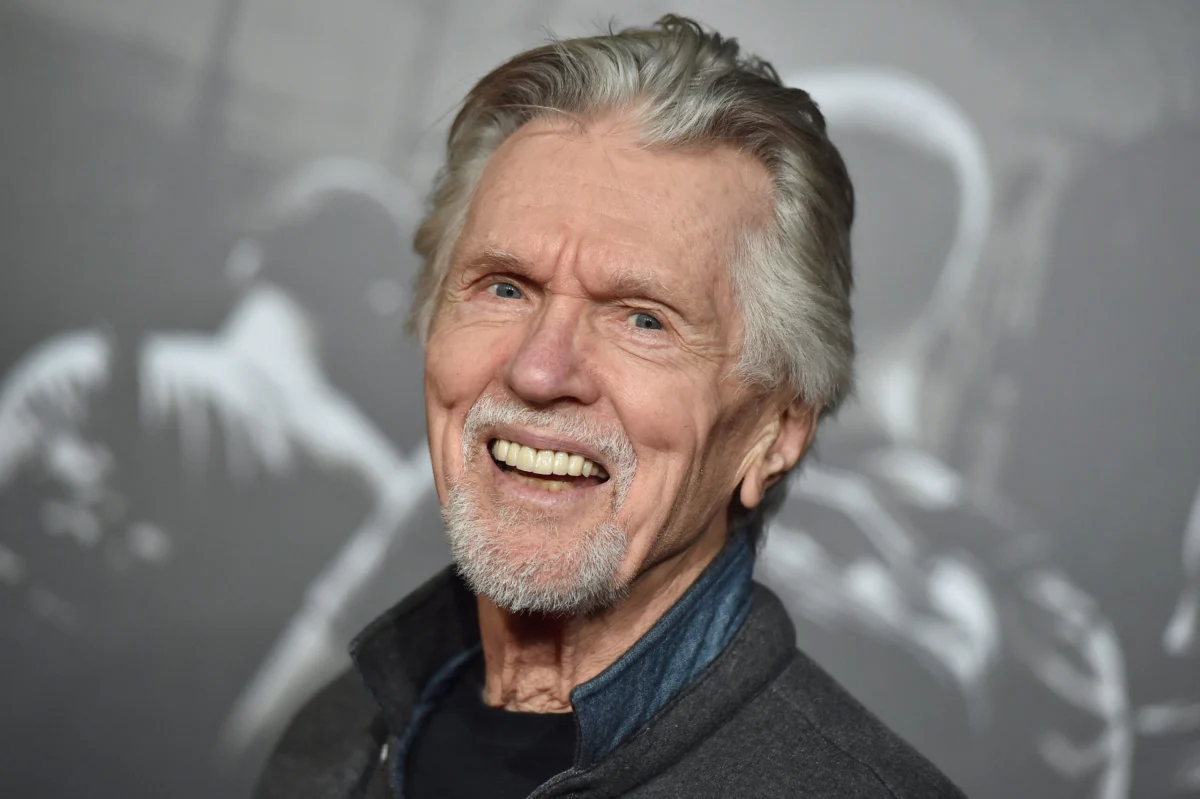
Tom Skerritt, the quintessential American character actor whose career spanned over seven decades and helped define the transition of Hollywood from the studio era to the modern blockbuster, has died. He was 93.
According to a statement released by his management, Skerritt passed away on Wednesday of natural causes. His death marks the conclusion of a remarkable professional journey that saw him share the screen with the greatest icons of the 20th and 21st centuries, while simultaneously carving out a unique identity as an actor who prioritized substance, authenticity, and, in his later years, deep humanitarian service.
A Legacy of Professionalism and Presence
To audiences, Tom Skerritt was the ultimate "steady hand." Whether playing a weary spaceship captain, a stern but loving father, or a principled small-town sheriff, Skerritt possessed a gravitational pull that allowed him to anchor high-concept films without ever overshadowing the ensemble. His filmography—a staggering list of over 100 screen credits—is not merely a record of longevity but a map of American cinematic history.
"While the world knew Tom through his remarkable acting career, we knew him for his humor, curiosity, wisdom, generosity, and the love he brought into our lives," the Skerritt family stated in a poignant tribute. "He cared deeply about imagination, creativity, storytelling, service, veterans, the natural world, and helping others find and share their own voices. We are incredibly grateful for the love and support being shown by his friends, colleagues, and fans."
A Life in Chronology: From Detroit to the Silver Screen
Born Thomas Roy Skerritt on August 25, 1933, in Detroit, Michigan, Skerritt’s path to fame was unconventional. Before finding his place in the spotlight, he served his country in the U.S. Air Force, an experience that would later shape his deep-seated commitment to supporting veterans. Following his military service, he pursued higher education at Wayne State University and the University of California, Los Angeles, honing the intellectual curiosity that would define his later work.
His ascent began in earnest in the early 1960s. He made his feature film debut in the 1962 Korean War drama War Hunt, starring alongside John Saxon and a young Sydney Pollack. It was a modest beginning, but it placed him in the orbit of the industry’s most compelling storytellers.
The Breakthrough: The Robert Altman Era
The year 1970 served as the true catalyst for Skerritt’s stardom. Cast as the surgeon Duke Forrest in Robert Altman’s anti-war satirical masterpiece MASH*, Skerritt found himself at the center of a cultural phenomenon. Though he was only 37 and shared billing with heavyweights like Donald Sutherland and Elliott Gould, his performance stood out for its dry wit and understated charisma. It was a role that established his persona: the reliable professional who could navigate absurdity with a straight face.

The Iconic Captain of the Nostromo
If MASH introduced him to the mainstream, Ridley Scott’s 1979 horror-sci-fi hybrid Alien cemented his status as a legendary screen presence. Playing Dallas, the captain of the ill-fated commercial towing vehicle Nostromo*, Skerritt provided the film with its moral and professional center.
Interestingly, while Skerritt was the top-billed star of the production—receiving billing over a then-rising Sigourney Weaver—his character’s demise served as the narrative pivot point that shifted the film into the realm of survival horror. His ability to project both authority and vulnerability made the terrors of the Xenomorph feel all the more visceral for the audience.
A Career of Versatility and Longevity
Throughout the 1980s and 1990s, Skerritt’s career was a masterclass in variety. He moved effortlessly between genres, contributing to the DNA of some of the most influential films of the era:
- 1980s: He featured in David Cronenberg’s visceral adaptation of Stephen King’s The Dead Zone (1983), provided the emotional backbone in Herbert Ross’s Steel Magnolias (1989), and played Commander Mike "Viper" Metcalf in the generation-defining blockbuster Top Gun (1986).
- 1990s: He showcased his ability to handle prestige drama in Robert Redford’s A River Runs Through It (1992), played a pivotal role in the hit sports drama The Rookie (2002), and brought gravitas to the high-concept science fiction of Contact (1997).
His television work was equally distinguished. His portrayal of Sheriff Jimmy Brock in the David E. Kelley series Picket Fences (1992–1996) earned him a Primetime Emmy Award in 1993, followed by a nomination the following year. The series was a critical darling, winning back-to-back Screen Actors Guild Awards for Outstanding Performance by an Ensemble in a Drama Series in 1995 and 1996.
Even in his ninth decade, Skerritt showed no signs of slowing down. His most recent project, the 2025 Western Broke, saw him sharing the screen with Wyatt Russell, proving that he remained as vital and sharp as he had been in his youth.
Supporting Data: The Impact of a Multi-Hyphenate Talent
Beyond the screen, Skerritt was a mentor and an activist. He co-founded The Film School in Seattle, a mission-driven organization designed to provide aspiring filmmakers with the tools and mentorship necessary to succeed in a changing industry.
His philanthropic work, particularly for veterans, was profound. Through The Red Badge Project, Skerritt worked to help service members process trauma, anxiety, and PTSD through the power of storytelling. In a 2016 TED Talk, he articulated his belief that the act of "telling one’s story" was a necessary step in the healing process for those who had returned from the front lines. This commitment extended to environmentalism, where he championed river conservation efforts through partnerships with the Wildlands Festival and the American Rivers organization.

Official Responses and Reflections
The outpouring of grief from the Hollywood community reflects the high esteem in which Skerritt was held. Colleagues have noted that his on-screen persona—the man you could trust in a crisis—was an accurate reflection of his off-screen character.
"Tom wasn’t just an actor; he was a lighthouse," said one longtime associate. "He navigated the shifting tides of the entertainment business for seven decades without losing his sense of wonder or his integrity."
The Implication of His Departure
The passing of Tom Skerritt signifies more than the loss of a celebrated actor; it is the closing of a chapter on a specific generation of Hollywood talent. Actors like Skerritt, who cut their teeth in the independent-minded cinema of the late 60s and 70s, brought a level of technical craft and psychological depth that transformed American movies.
His career demonstrates the viability of a "working actor’s" life—one defined not by the pursuit of fame, but by the accumulation of craft, the nurturing of community, and the dedication to causes greater than oneself. As the film industry continues to evolve in the face of rapid technological change, the legacy of someone like Skerritt—who believed in the sanctity of the written word and the power of human connection—serves as an enduring blueprint for the next generation.
Tom Skerritt is survived by his wife, Julie Tokashiki, whom he married in 1998. He also leaves behind a large and loving family, including his children Andy, Erin, Matt, Collin, and Emiko; his grandchildren Sara, Maddison, Sunny, Louisa, and Georgia; and his great-grandchildren, Marigold and Ravi.
He was a man who lived seven decades in the public eye, yet maintained a private grace that few in his position ever achieve. As the curtains close on a life well-lived, the stories he told, the veterans he supported, and the films that define his memory will continue to endure.
 Jia Lissa
 Lina Irawan
 Iffa Jayyana
