

By International Affairs Correspondent
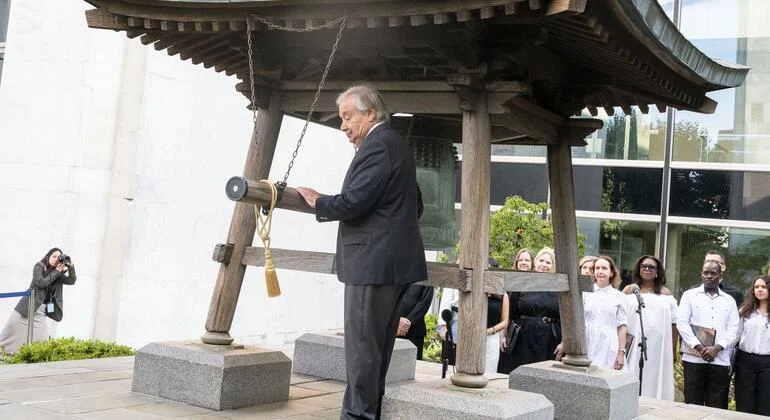
In a poignant ceremony held at the United Nations Headquarters in New York, Secretary-General António Guterres delivered a sobering address that served as both a warning to the international community and a final, personal plea for global unity. Standing before the iconic Japanese Peace Bell, Guterres, who is set to conclude his tenure at the end of the year, challenged world leaders to move beyond rhetoric and commit to the “hard work” of building sustainable, lasting peace.
As geopolitical tensions reach levels not seen in decades, the Secretary-General’s remarks come at a critical juncture. With conflicts deepening across multiple continents and the erosion of international cooperation, his message resonates as a desperate call for a paradigm shift—from reactive crisis management to proactive, foundational investment in human security.
The State of Global Peace: A Reality Check
The atmosphere at the UN headquarters was heavy with the weight of current events. Guterres’s remarks served as a precursor to the upcoming International Day of Peace on September 21, observed this year under the theme, “Investing in Peace: For Everyone, Everywhere, Every Day.”
“Peace is never a passive achievement,” Guterres declared, his voice echoing through the courtyard. “It requires hard work and decisive action. Yet, today, that action is faltering.”
The Secretary-General’s assessment of the global landscape was stark. He pointed to the widening and deepening of conflicts that are currently tearing at the fabric of societies globally. From the resurgence of regional wars to the systemic breakdown of diplomatic channels, the mechanisms designed to ensure stability are increasingly viewed as ineffective. “Violence and division are tearing apart communities,” he said. “The dialogue and solidarity that solutions require are missing in action.”
The Erosion of Multilateralism
The current global climate is defined by what many analysts describe as "polycrisis"—a convergence of climate change, economic instability, and geopolitical fragmentation. Guterres noted that the inability of the international community to reach a consensus on basic humanitarian principles is a symptom of a broader malaise. The “missing in action” solidarity he lamented refers to the increasing tendency of nations to prioritize domestic political survival over collective global security.
Chronology of the Peace Bell: A Legacy of Universal Aspiration
The Japanese Peace Bell, which served as the backdrop for the Secretary-General’s address, is more than a mere ornament. It is a symbol of the UN’s foundational commitment to a world free from the scourge of war.
1954: A Gift from the People
Presented to the United Nations by the UN Association of Japan on June 8, 1954, the bell carries a unique history. It was cast from coins donated by delegates from 60 nations, alongside various metal contributions from individuals across the globe. Housed in a wooden structure modeled after a traditional Shinto shrine, the bell represents the collective hope of a post-World War II generation to prevent a recurrence of global catastrophe.
The Symbolism of the Bell
Renzo Sawanda, then the Japanese observer to the UN, famously stated during the presentation: “The bell embodies the aspiration for peace not only of the Japanese but of the peoples of the entire world. Thus, it symbolized the universality of the United Nations.”
The Ritual of Renewal
For seven decades, the bell has served as a touchstone for the organization. It is rung twice annually: on the first day of Spring at the vernal equinox, and to commemorate the International Day of Peace. This ritual is a reminder that peace, like the changing of seasons, must be nurtured through deliberate, repetitive effort. As Guterres rang the bell for his final time as Secretary-General, the act took on a historical significance, marking the end of a tenure defined by the struggle to maintain order in an increasingly chaotic world.
The People’s Path: Where Governments Fail, Citizens Lead
While the Secretary-General offered a scathing critique of current governance, he also provided a roadmap for hope. He highlighted the role of “volunteers, advocates, civil society leaders, and peacekeepers” as the true architects of modern stability.
The Grassroots Alternative
“Where governments are failing to deliver peace, people are showing another way,” Guterres noted. He emphasized that in communities where state institutions have collapsed, it is often civil society that steps in to bridge divides and heal wounds. This "bottom-up" approach to peacebuilding is, according to the Secretary-General, the most resilient form of stability.
By raising their voices against injustice and facilitating local-level reconciliation, these individuals are proving that peace is not just the absence of conflict—it is the presence of social cohesion.
A Mandate for World Leaders: Investing in Human Potential
As world leaders prepare to convene at the UN General Assembly in the coming weeks, the Secretary-General’s call to action is centered on a specific economic and social policy framework. He argues that peace is an investment, not a luxury.
The Pillars of Sustainable Peace
To build lasting stability, Guterres urged governments to focus on four critical domains:
- Health and Nutrition: A society that cannot feed or treat its citizens is a society susceptible to unrest.
- Education: Promoting critical thinking and inclusive curricula acts as a firewall against radicalization and extremist rhetoric.
- Social Protection: Establishing robust safety nets ensures that the most vulnerable are not left behind during times of economic transition.
- Institutional Trust: Strengthening the systems that people interact with daily—judiciary, local government, and public services—is essential for restoring faith in the state.
“They must safeguard human rights and dignity,” Guterres urged. “Recommit to the proven tools of peace—diplomacy, dialogue, negotiation—and end the wars that are currently bleeding the world’s resources.”
Implications for Global Policy and Security
The implications of Guterres’s speech are profound for the international order. By calling for a pivot toward “investing in peace,” he is challenging the current global trend of increased military spending.
The Cost of Conflict
Supporting data from the UN and independent think tanks suggests that the cost of conflict has risen exponentially. From the displacement of millions of people to the destruction of critical infrastructure, the economic burden of war is a primary driver of the global poverty crisis. Guterres’s argument is essentially an economic one: it is cheaper and more effective to invest in social stability than it is to fund the aftermath of humanitarian disasters.
The Diplomatic Challenge
The Secretary-General’s call for a return to “diplomacy and negotiation” is a direct challenge to the rise of unilateralism. In an era where some major powers are retreating from international treaties and favoring protectionist policies, the call to “stand with us” is an invitation to rebuild the multilateral architecture that has governed the world since 1945.
Conclusion: A Legacy of Standing for Peace
As the echo of the Japanese Peace Bell faded, the message was clear: the international community is at a crossroads. The transition period in UN leadership, combined with the escalating geopolitical volatility, makes this moment uniquely dangerous—and uniquely full of potential for reform.
Guterres, reflecting on his final year, remained steadfast in his commitment to his vision. “This is the last time I will ring the Peace Bell,” he said, his tone one of quiet resolve. “But I will always stand with the champions of peace around the world.”
The challenge now lies with the heads of state who will gather in New York. The Secretary-General has set the agenda: move from the rhetoric of division to the hard, unglamorous work of building institutions, investing in people, and prioritizing the human rights that provide the only viable foundation for a secure future. Whether they choose to heed this call or continue the current trajectory of conflict will define the international landscape for the next decade.
For now, the Peace Bell stands as a silent witness, waiting for the world to decide if it will follow the path of destruction or the path of investment, solidarity, and peace.
 Lina Hope
 Asro
Asro
 Layla Zulfa
