

The central-northern region of Venezuela remains a landscape of sorrow and fragile resilience more than two weeks after a pair of catastrophic earthquakes—measuring magnitudes 7.2 and 7.5—tore through the nation on June 24. The seismic event, which turned bustling urban centers into scenes of devastation, has left thousands dead, tens of thousands injured, and an entire population grappling with the profound trauma of sudden, total loss.
Amidst the dust and the crushing weight of collapsed concrete, stories of unimaginable survival are emerging. For Dayra Morales, a 20-year-old survivor who plummeted six floors during the collapse of her apartment building, her survival is being hailed as a "miracle"—one that has taken on even deeper significance with the recent discovery that she is pregnant.
The Chronology of Destruction: June 24 and Its Aftermath
The nightmare began on the morning of June 24. For 24-year-old Roberto Rodríguez, the day started with a routine return home. He was steps away from his apartment when the earth groaned and the first of the two massive tremors struck.
"I saw the building collapse, floor by floor," Rodríguez recounted, his voice heavy with the memory. "You could hear people screaming and calling for help."
As the structure disintegrated, debris rained down. Rodríguez managed to escape the immediate footprint of the collapse, shouting warnings to neighbors, but the destruction was absolute. His partner, Dayra Morales, was not as fortunate. She was trapped beneath the heavy slab of their apartment building, pinned from the waist down. The ensuing two hours were a frantic, desperate race against time as neighbors worked with their bare hands to pull her from the wreckage.
While Morales survived, the cost of the disaster for the couple was staggering: Rodríguez lost both his father and his younger sister in the collapse. This narrative of survival intertwined with profound loss is the defining characteristic of the current crisis in Venezuela.
Following the initial quakes, the scale of the destruction became clear. Thousands of buildings were reduced to rubble, and the regional infrastructure—already strained—was pushed to a breaking point. Over the subsequent two weeks, the focus shifted from immediate rescue to the long-term management of a massive humanitarian crisis, with thousands of displaced people seeking refuge in improvised tent cities and sports complexes.
The Human Toll: Supporting Data and Displacement
The statistics behind the Venezuelan earthquake are as staggering as they are heartbreaking. Official reports indicate that nearly 5,000 people have perished, while more than 16,000 individuals have sustained injuries requiring urgent medical intervention. Perhaps most distressing are the thousands who remain unaccounted for, leaving families in a state of agonizing limbo.
Approximately 18,000 people have been rendered homeless, forcing them into temporary shelters. The José María Vargas sports complex has become a focal point for this humanitarian effort, currently housing over 1,000 displaced individuals. However, across the nation, more than 100 temporary shelters have been established to accommodate over 20,000 survivors.
These shelters, while life-saving, present their own set of challenges. Overcrowding is rampant, with some tents housing between 15 and 25 families. The lack of privacy, combined with limited access to essential services and the trauma of family separation, has created an environment of escalating psychosocial distress.
A Miracle of Life: Resilience in the Face of Tragedy
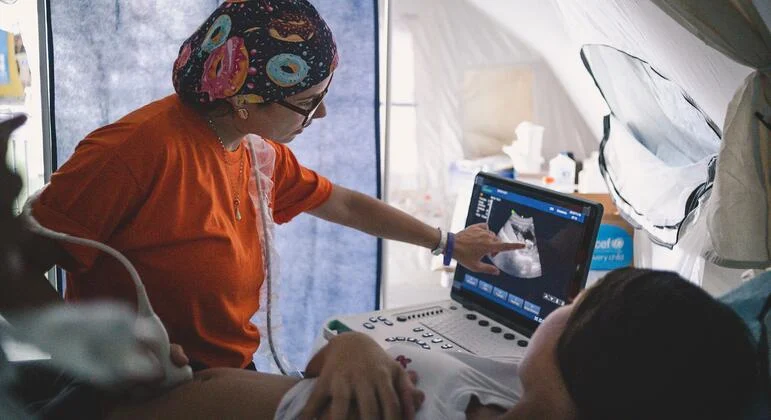
It was within the confines of the José María Vargas sports complex that a flicker of hope emerged. On July 2, a date that coincidentally marked the birthday of her late father, Dayra Morales underwent medical examinations at a clinic supported by the United Nations Population Fund (UNFPA). The results brought a shock that left the couple breathless: Morales was pregnant.
"Nothing happened to the baby, even after she fell from the sixth floor of a 12-story building and was trapped from the waist down under so much rubble," Rodríguez said. "I consider it a true miracle."
For survivors like Morales, the support provided by international agencies is not just a logistical necessity; it is a lifeline. UNFPA has scaled up its operations to provide essential sexual and reproductive health services across three major hubs: Caracas, La Guaira, and Miranda. These services include prenatal consultations, the distribution of contraceptive methods, STI testing, and, crucially, emergency obstetric referrals for women in critical need.
Community Networks and the Leadership of Women
In the crowded, dusty corridors of the temporary shelters, the structure of society is being rebuilt from the ground up. Yoseys Escalona, 40, a resident of the José María Vargas complex, has become an unofficial leader within her tent.
"In the tent I’m staying in, 12 families live together," Escalona explained. She describes her group as "one family," noting that it is the women who have taken the initiative to organize resources, support the bereaved, and manage the daily logistics of survival. "We are always looking for ways to help and support one another. So many women keep moving forward despite the pain, even after losing their homes, even after losing a family member."
These informal networks are vital, as they bridge the gap between official aid distributions and the daily needs of families who have lost everything. However, the reliance on these networks highlights the severity of the crisis; women, who are often the backbone of community care, are currently managing the weight of the disaster while simultaneously processing their own grief.
Official Responses and the Protection of the Vulnerable
Recognizing the heightened risks in disaster settings, humanitarian organizations are focusing heavily on the prevention of gender-based violence (GBV). Eugenia Sekler, head of the UNFPA office in Venezuela, emphasized that the protection of women and girls is a non-negotiable priority in the humanitarian response.
"As in all humanitarian crises, strengthening gender-based violence prevention and ensuring safe access to survivor-centred services is critical," Sekler stated. UNFPA is actively distributing medical supplies to health providers for the clinical management of survivors of sexual violence, conducting safety assessments in shelters, and working with the Venezuelan government to implement more robust protective measures.
These efforts are bolstered by educational initiatives. Volunteers like Escalona have been trained to identify signs of abuse and are now acting as conduits of information, ensuring that survivors know how to access psychological counseling, legal aid, and medical treatment.
Implications: The Long Road to Recovery
The immediate response phase is now transitioning into a complex, long-term recovery effort. The economic and social ramifications of the earthquake will be felt for years. The sheer number of people who have lost their livelihoods, homes, and family structures creates a vulnerability that cannot be solved by temporary shelter alone.
UNFPA has issued an appeal for $10 million to sustain its emergency response efforts for the next three months. This funding is essential not only for the delivery of medical equipment and reproductive health supplies but also for the long-term stabilization of the affected populations.
As Escalona looks toward the future, her perspective remains sobering. "There are mothers here who have lost everything," she said. "And when I say everything, I mean everything: their home, their mother, their children, and their husband. Some are completely alone. Now they don’t have a home, they have nothing, but they’re alive."
The story of the Venezuelan earthquakes is a testament to the fragility of human existence, but it is also a testament to the endurance of the human spirit. While the physical rubble may eventually be cleared, the psychological and societal scars will require a sustained, global commitment to heal. For now, the focus remains on the survival of the most vulnerable—the mothers, the children, and those like Dayra Morales, who carry the future of a nation in their womb, even when their world has been shaken to its core.
 Lina Hope
 Layla Zulfa
