

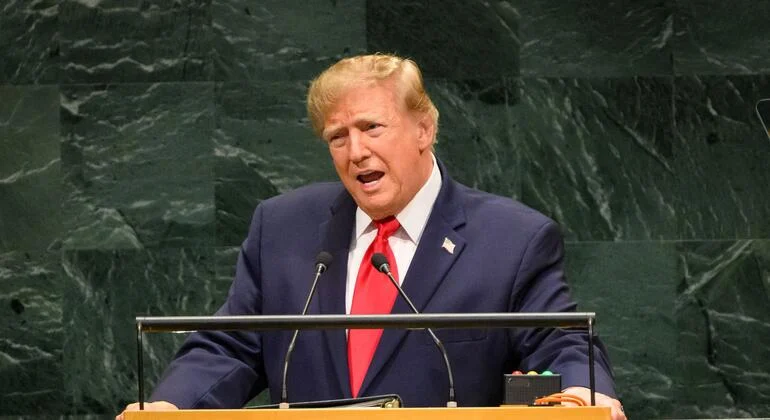
UNITED NATIONS, NEW YORK — In a wide-ranging and combative address before the General Assembly, President Donald Trump unveiled an ambitious, and at times provocative, vision for American foreign policy. From the strategic demolition of Iranian nuclear facilities to a bold initiative to rebrand artificial intelligence as "superintelligence," the President’s speech served as a manifesto for a more assertive, unilateral, and technology-focused era of U.S. leadership.
The Iranian Pivot: From "Operation Midnight Hammer" to Economic Isolation
The cornerstone of the President’s address was his uncompromising stance on the Islamic Republic of Iran. Labeling the nation "the number one sponsor of terror," Trump declared that his administration had successfully neutralized a threat that had lingered for over half a century.
"For 51 years, the fanatical Iranian regime has spread carnage and chaos across the entire Middle East and beyond," the President stated. "I will never allow Iran to have a nuclear weapon."
Central to his narrative was the disclosure of a previously unpublicized military action, which he termed Operation Midnight Hammer. Trump claimed that following Tehran’s rejection of an American offer for economic cooperation, the U.S. military launched a precise, devastating strike. "The U.S. military obliterated their nuclear programme beneath mountains of rubble," he asserted.
The President described a binary path for the future: either the total destruction of the Islamic Republic—"driving them into hell with no chance of survival"—or a diplomatic resolution. Despite his harsh rhetoric, he struck a note of guarded optimism regarding future negotiations. "I believe we’ll make a deal," he said, though he stopped short of detailing the terms. For now, he called upon the international community to maintain a policy of "complete economic isolation" against Tehran.
Chronology of Intervention: Resolving Global Flashpoints
Moving beyond the Middle East, the President articulated a vision of an American administration acting as a global arbiter, claiming to have successfully mediated eight high-stakes conflicts since returning to office. The list of resolved disputes, as cited by the President, included:
- Southeast Asia: Border tensions between Cambodia and Thailand.
- The Balkans: The long-standing friction between Kosovo and Serbia.
- Central Africa: Disputes involving the Democratic Republic of the Congo (DRC) and Rwanda.
- South Asia: The volatile relationship between Pakistan and India.
- The Caucasus: The conflict between Armenia and Azerbaijan.
- The Levant: The conclusion of the war in Gaza.
Furthermore, Trump noted that his administration is currently engaged in intensive efforts to broker a final settlement to the Russia-Ukraine conflict. "It’s time to stop the killing," he urged, framing the U.S. as a necessary broker for peace in an increasingly fractured world.
The Western Hemisphere: A Shift in the Americas
The President’s address signaled a significant hardening of policy toward the Western Hemisphere. Highlighting the detention of President Nicolás Maduro, Trump celebrated a U.S. military operation in Venezuela as a turning point for the nation. He announced that the U.S. is now pivoting toward a new economic relationship with Caracas, anchored by a major bilateral oil agreement designed to usher in what he termed "a much better future for the Venezuelan people."
Turning to Mexico, the administration’s rhetoric remained uncompromising. The President confirmed the designation of drug cartels as foreign terrorist organizations, demanding that Mexico "reclaim control of its soil from the enemies of humanity."
In the North, the President touted a significant strategic expansion, announcing an agreement with Denmark and Greenland. This pact, he explained, grants the United States "permanent control over security and all other needs" on the Arctic territory, a move intended to bolster NATO’s defensive posture in the North Atlantic and the increasingly competitive Arctic region.
The Technological Frontier: Defining "Superintelligence"
Perhaps the most unconventional portion of the President’s speech was his focus on the rapidly evolving landscape of artificial intelligence. Trump argued that the industry’s current terminology was inherently flawed.
"The use of the word ‘artificial’ makes intelligence fake," the President argued. "It is not fake. It’s actually amazing." He proposed a formal rebrand of the technology as "superintelligence," emphasizing that leadership in this field will be the ultimate arbiter of 21st-century power.
"Whoever wins superintelligence wins," he declared. The President outlined a policy of aggressive encouragement for domestic innovation, balanced by a rigorous federal monitoring program to mitigate existential risks. He underscored that the competition for technological dominance would define the geopolitical landscape for decades to come.
Confronting International Institutions: A Critique of Global Governance
The President reserved his sharpest criticism for international organizations, which he accused of overstepping their mandates. He directed particular vitriol toward the International Criminal Court (ICC), describing the body as an institution "full of evil people" that possesses no jurisdiction over the United States. He urged other nations to join the U.S. in withdrawing from the court.
The UN Human Rights Council also faced censure, with the President accusing it of harboring an anti-American bias while failing to hold other regimes accountable for systemic abuses. Similarly, he criticized UNESCO and the International Maritime Organization, arguing that such bodies frequently promote "global governance initiatives" that infringe upon national sovereignty.
Implications and Global Responses
The address has triggered a flurry of analysis among diplomats and political strategists. Supporters of the administration view the speech as a long-overdue assertion of national interest, arguing that the President’s "peace through strength" model has delivered tangible results in conflict zones where international bodies have stalled.
However, the international response has been characterized by caution and concern. Critics of the administration argue that the President’s focus on unilateral action and his dismissal of international institutions like the ICC and the UN Human Rights Council risk further alienating traditional allies. The disclosure of Operation Midnight Hammer has also prompted calls for further clarification regarding the scope and legality of U.S. military engagements in the Middle East.
Economic analysts are currently parsing the implications of the proposed Venezuelan oil deal and the Arctic security pact with Greenland. While the administration frames these as strategic victories, some geopolitical experts suggest they could spark significant pushback from regional powers and further complicate energy market dynamics.
Conclusion: A Future of "Courage and Resolve"
In his concluding remarks, President Trump reiterated his belief in the efficacy of national sovereignty over globalist structures. He urged member states to confront global challenges with "courage and resolve," painting a picture of a world where nations act in their own best interests while cooperating on a bilateral basis to achieve shared prosperity.
"Together, we can create a future for our people that is brighter, more hopeful, and more magnificent than ever before," the President stated. As the General Assembly session continues, the ripple effects of his address are expected to dominate discussions in the corridors of the United Nations for the foreseeable future, setting the stage for a period of intensified diplomatic and technological maneuvering.
 Asro
Asro
 Layla Zulfa
