

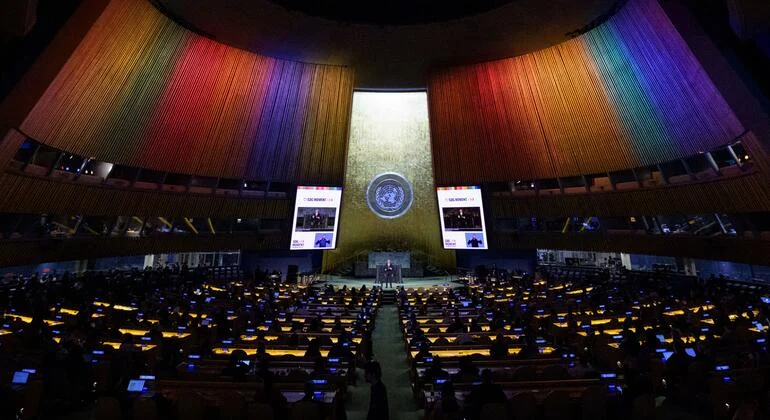
With less than four years remaining until the 2030 deadline for the Sustainable Development Goals (SDGs), the global community finds itself at a precarious crossroads. While international progress reports paint a sobering picture of stagnation and systemic failure, pockets of profound success—most notably in the West African nation of Benin—serve as a clarion call that the ambitious 2030 Agenda remains achievable if political will is matched by innovative fiscal policy.
As world leaders gather at the United Nations headquarters in New York for the annual "SDG Moment" ahead of the General Assembly’s High-Level Week, the narrative is split between the harrowing reality of a $4 trillion annual financing gap and the undeniable power of localized, strategic implementation.
Main Facts: The State of the 2030 Agenda
The 17 SDGs, adopted by all UN Member States in 2015, were designed to be the world’s "to-do list" for a more equitable, peaceful, and sustainable future. However, as of 2026, the progress report is stark. Out of 139 targets with sufficient data, only 36 per cent are currently on track or showing moderate progress. Conversely, nearly half of the targets (49 per cent) are moving far too slowly, and 15 per cent have actually regressed, falling below the baselines established over a decade ago.
The headwinds are formidable. The world is currently on a trajectory to warm by approximately 2.8 degrees Celsius by the end of the century—nearly double the 1.5-degree threshold deemed necessary to avoid catastrophic climate change. Simultaneously, food insecurity continues to plague billions, and one in ten people globally remains trapped in the cycle of extreme poverty.
Chronology: A Decade of Ambition and Obstacles
- 2015: The UN General Assembly adopts the 2030 Agenda for Sustainable Development, setting 17 goals to end poverty, protect the planet, and ensure peace.
- 2021: Benin takes a pioneering step in sustainable finance by issuing Africa’s first SDG-focused bond, signaling a new era of domestic revenue mobilization.
- 2021–2025: Despite global economic volatility, Benin successfully leverages its SDG bond to overhaul water infrastructure and stimulate job growth through new industrial zones.
- 2025: Official Development Assistance (ODA) records a staggering 23 per cent decline, exacerbating the debt crises in developing nations and widening the global financing gap.
- 2026: The UN SDG Moment serves as a critical checkpoint, with leaders acknowledging that while some gains in connectivity and sanitation have been made, the momentum is stalling under the weight of conflict, debt, and climate instability.
Benin as a Beacon: The Power of Domestic Revenue
Amidst the gloom, the testimony of Aristide Medenou, Benin’s minister of economic cooperation, provided a rare moment of optimism during the UN summit. Benin’s strategy is built on a fundamental economic truth: sustainability cannot be funded by external aid alone.
For the past ten years, Benin has systematically increased its domestic revenue by 0.5 per cent of GDP annually. This fiscal discipline allowed the country to issue Africa’s first SDG bond in 2021. The results have been transformative. By earmarking these funds for social infrastructure, the nation has seen access to drinking water skyrocket from 40 per cent to 80 per cent in just five years. Furthermore, the establishment of a specialized industrial zone in 2021 has generated 25,000 jobs, providing a concrete example of how the SDGs can serve as a engine for economic development rather than a bureaucratic burden.
"If a country is not able to increase the domestic revenue, the country cannot go forward in implementing the SDGs," Mr. Medenou stated. His message to the global assembly was clear: the path to 2030 requires governments to move beyond aid-dependency and cultivate the internal capacity to fund their own survival.
Supporting Data: Where Progress Has Been Made
While the overall picture is one of concern, the past decade has not been devoid of victory. The data reveals that when international cooperation is sustained, human lives improve tangibly.
- Sanitation and Health: Since the adoption of the SDGs, nearly one billion people have gained access to safely managed drinking water, and 1.2 billion have gained access to improved sanitation facilities.
- Connectivity and Energy: Global electricity access has risen from 87 per cent in 2015 to 92 per cent today. Even more dramatic is the digital transformation, with internet access expanding from 40 per cent to 74 per cent of the global population.
- Medical Advances: Consistent, targeted efforts have successfully reduced child and maternal mortality rates and prevented millions of new HIV infections globally.
Despite these successes, the "financing gap" remains the primary barrier. With debt payments in many developing nations now exceeding the entirety of their social service budgets, the financial architecture of the world is effectively working against the SDGs.
Official Responses and the Call for Reform
UN Secretary-General António Guterres was blunt in his assessment during the High-Level Week. He acknowledged that while progress was never guaranteed—having to be "earned through the determination of people, communities and countries"—the current state of global affairs is unacceptable.
"The promises governments made in adopting the Goals are not being kept," Guterres noted. He identified "powerful headwinds" including geopolitical conflicts, the erosion of international solidarity, and the systemic neglect of women’s and girls’ rights. For the Secretary-General, the solutions are multi-faceted: a just energy transition, a fundamental restructuring of international debt, and the responsible use of artificial intelligence to bridge development gaps.
General Assembly President Khalilur Rahman echoed this sentiment, emphasizing the human cost of these macroeconomic failures. "For many of us, sustainability is a matter of life and death," he stated, reminding the assembly that the $4 trillion gap is not just a line item on a spreadsheet, but a barrier to basic human dignity.
The Role of Youth: A Mandate for Urgency
Perhaps the most vocal stakeholders at the summit were the UN’s Young Leaders for the SDGs, including Suzuka Nakamura of Japan and Adelin Pierre of Haiti. Their intervention moved beyond the diplomatic platitudes often heard in UN chambers.
"To the leaders in this room and around the world, you made this promise," Nakamura said, addressing the assembled heads of state. "We are asking you to keep it."
The youth representatives framed the impending 2030 deadline not as an end point, but as a test of integrity. They argued that the world’s failure to hit targets is not a reflection of the goals’ impossibility, but rather a reflection of a lack of political urgency. Their message was one of defiant hope: they are not giving up on the SDGs, and they demand that the current generation of leaders do the same.
Implications: The Path Forward
The implications of the 2026 SDG Moment are twofold. First, the "Benin Model"—combining domestic fiscal reform with innovative capital-raising instruments—offers a scalable template for other developing nations to mitigate their reliance on shrinking foreign aid.
Second, the structural failures highlighted by the Secretary-General suggest that incremental change is no longer sufficient. To achieve the goals by 2030, the international system must prioritize peace as a prerequisite for development. As Guterres emphasized, sustainable development cannot flourish in the shadow of war or the absence of global cooperation.
As the world enters the final four-year stretch, the rhetoric of the UN is shifting from "setting goals" to "emergency implementation." Whether the global community can muster the political, financial, and moral capital to pivot toward the 2030 finish line remains the defining question of the decade. The data shows it is possible; the politics remain the variable that will determine whether the world secures a future for the next generation or leaves them to inherit a broken promise.
 Lina Hope
 Asro
Asro
 Layla Zulfa
