

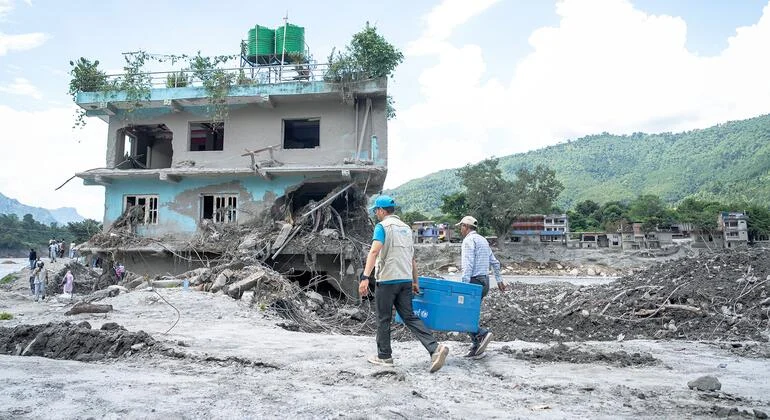
The recent catastrophic floods and landslides that have ravaged Nepal are not merely an isolated natural disaster; they are being framed by international experts as a haunting preview of the systemic climate threats looming over the entire Himalayan region. With death tolls exceeding 1,200 and entire landscapes physically reshaped, the scale of the destruction has defied conventional recovery timelines, leaving aid organizations and the Nepali government grappling with a crisis that defies previous benchmarks for disaster management.
Sara Netzer, the regional director for the United Nations Office for Project Services (UNOPS), who recently returned from the affected zones, has provided a harrowing account of the devastation. Speaking from Bangkok to journalists in Geneva, Netzer described the scenes as "apocalyptic," noting that the sheer magnitude of the destruction—and the instability of the terrain itself—has rendered traditional "build-back-better" strategies temporarily impossible.
The Anatomy of the Catastrophe: A Chronology of Collapse
The crisis began in late August, when a massive glacier collapse triggered a sequence of catastrophic flash floods and landslides. The event was not a slow-onset disaster but a sudden, violent transformation of the landscape.
Late August: The Initial Impact
The collapse of a glacier unleashed a wall of water and debris that surged through mountain valleys with little warning. In a matter of hours, the geography of the affected regions was permanently altered. Homes that had stood for generations were swept from their foundations, displaced up to 150 meters from their original locations.
Early September: The Realization of Loss
As search and rescue operations began, the true scope of the carnage became clear. Entire communities were found to have been completely obliterated. In one specific village, where approximately 1,200 people resided in 400 homes, the infrastructure was erased entirely by a deluge of mud and rock. Debris, reaching depths of five to eight meters, buried the remnants of lives: schoolbooks, eyeglasses, personal effects, and, tragically, the remains of victims.
Mid-September: The Logistical Siege
By mid-month, the physical isolation of the region became the primary challenge. With 39 out of 40 bridges in the affected area destroyed, internal movement became impossible. This forced humanitarian agencies, including the World Food Programme (WFP), to shift entirely to aerial logistics, relying on helicopters to deliver food, medicine, and clean water to cut-off populations.
Supporting Data: The Scale of Human and Physical Ruin
The statistics emerging from the UNOPS and local government assessments paint a grim picture of systemic failure.
- Human Toll: The confirmed death toll of over 1,200 is expected to rise as search teams continue to sift through deep layers of debris.
- Infrastructure Collapse: The destruction of 39 bridges has effectively severed the supply chain for emergency aid, turning the disaster area into a series of disconnected islands.
- Environmental Instability: The landscape in the affected zones is described as "Jell-O"—a technical instability caused by water saturation that prevents the soil from settling. Experts indicate that until the water table stabilizes and the ground hardens, heavy machinery cannot be deployed for reconstruction without risking further collapse.
- Displacement Patterns: Thousands of survivors are currently sheltered in "holding centers," many of which are repurposed schools. This creates a secondary crisis: the disruption of education for a generation of children already suffering from acute trauma.
Official Responses and the Challenge of Recovery
The international community, led by agencies like UNOPS, is currently focused on the immediate stabilization of the region. However, as Ms. Netzer noted, the standard two-to-three-week transition from disaster relief to reconstruction is not applicable here.
The Engineering Crisis
UNOPS has mobilized urgent funding to conduct risk mapping and engineering assessments. The fundamental problem, however, is that the river systems have changed course. Rivers have carved entirely new channels through what were previously residential areas, making it impossible to determine where it is safe to rebuild.
"The river has completely changed its course, so it’s not even clear where it is safe for these communities to rebuild and to return," Netzer explained. This requires a complete re-evaluation of land-use planning, moving away from vulnerable floodplains that were once considered secure.
The Humanitarian Priority: Children and Trauma
A significant focus of the relief effort is the welfare of children. Many have witnessed their parents or siblings swept away by the floods. The current living conditions in holding centers—crowded, lacking adequate sanitation, and characterized by uncertainty—are seen as detrimental to the mental health of these survivors. The objective is to restore school attendance as a primary vehicle for psychological stabilization, yet the lack of physical school buildings remains a major hurdle.
Implications: A Looming Regional Threat
Perhaps the most alarming aspect of the Nepal disaster is the context of climate change. The Himalayan range, often called the "Third Pole," is experiencing warming at rates significantly higher than the global average.
The Legacy of 2015
The trauma of the current floods is compounded by the memory of the 2015 earthquake, which also devastated Nepal. Many of the survivors of the recent floods are individuals who were displaced a decade ago. The psychological toll of being "twice-displaced" has created a community-wide sense of hopelessness. Survivors are questioning the viability of their ancestral lands, with many expressing deep-seated fear that the region is becoming uninhabitable.
A Warning for the Himalayas
Ms. Netzer’s testimony serves as a stark warning for neighboring nations across the Himalayan belt. The glacier collapse and subsequent flooding are consistent with climate modeling that predicts increased instability in mountain cryospheres. As permafrost thaws and glaciers recede, the geological integrity of mountain slopes and river valleys will continue to degrade.
"What we’re seeing in Nepal is something that could be repeated across the Himalayas as we look at climate change going forward," Netzer warned. "It’s a crisis that maybe today is affecting Nepal but has the likelihood of affecting another community or another country."
Policy Shifts for the Future
The implications for global policy are clear: the era of reactive disaster management is over. The "apocalyptic" destruction in Nepal suggests that the future of mountain-dwelling populations will depend on three pillars:
- Climate-Resilient Infrastructure: Moving away from traditional engineering toward designs that account for moving riverbeds and shifting soil.
- Transboundary Data Sharing: Because Himalayan river systems cross international borders, the data regarding glacial melt and upstream stability must be shared transparently between nations to allow for early warning systems.
- Managed Retreat: Authorities may eventually need to consider the difficult reality of relocating entire communities that are no longer safe to inhabit, a process that is both logistically complex and culturally devastating.
As the dust settles in Nepal, the world is left with a sobering reality. The destruction is not merely a tragedy of the present; it is a diagnostic tool revealing the fragility of the world’s mountain ecosystems. Without a radical shift in how we approach climate adaptation in high-altitude environments, the "apocalypse" witnessed in Nepal may soon become a recurring pattern in one of the world’s most vulnerable regions.
 Lina Hope
 Asro
Asro
 Layla Zulfa
