

Main Facts
In Bill Watterson’s legendary comic strip Calvin and Hobbes, the title characters rightly occupy the spotlight. Yet, decades after the strip concluded its daily syndication in 1995, the adult figures orbiting Calvin—most notably Calvin’s father—continue to resonate with readers who have grown up, entered the workforce, and faced the anxieties of modern life.
According to Watterson’s essays in the Calvin and Hobbes Tenth Anniversary Book, the author deliberately chose to leave Calvin’s parents nameless. Their primary literary function within the strip is not to serve as independent protagonists, but to provide a contrasting reality against which Calvin’s hyperactive, precocious imagination can bounce. While Calvin’s mother is characterized by her love of reading and her pragmatic, albeit frequently tested, patience, Calvin’s dad serves a dual purpose: he is both a foil to his son’s eccentricities and a sounding board for Watterson’s own philosophical musings, gripes about modern living, and bittersweet observations on the human condition.
Far from being a traditional, comforting source of standard parental wisdom, Calvin’s dad is famous for feeding his son elaborate, deadpan fabrications—such as claiming that a tiny man with a printing press lives inside every ATM. These surreal explanations do more than just torment Calvin; they provide a brilliant psychological blueprint for why Calvin is the way he is. Some parents truly get the children they deserve.
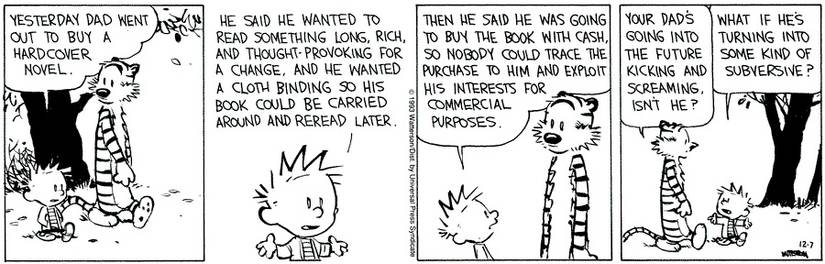
However, beneath the running gags about his cycling addictions and camping trips "that build character," Calvin’s dad frequently drops moments of surprising profundity. Two specific strips—one published on December 7, 1993, and another on May 10, 1989—stand out as masterclasses in social commentary and emotional realism. In an era defined by hyper-connectivity, data privacy concerns, and existential uncertainty, these strips feel less like artifacts of the late 20th century and more like prophetic warnings.
Chronology: The Evolution of Calvin’s Dad in Watterson’s Universe
To understand the weight of Calvin’s dad’s philosophical interventions, one must trace how Watterson utilized the adult characters across the ten-year run of the strip (1985–1995).
- 1985–1987 (The Formative Years): Early strips established the basic domestic dynamic. Calvin was a terror, his mother was perpetually on the verge of a nervous breakdown, and his dad took refuge in stoic deadpan humor and weekend hobbies. During this era, Dad’s dialogue was primarily reactionary—complaining about the weather, shoveling snow, or trying to sleep in on weekends.
- 1988–1990 (The Deepening of Inner Lives): As Watterson fought for larger Sunday layouts and greater creative freedom, the strip began to occasionally step outside Calvin’s immediate perceptual bubble. The May 1989 burglary arc marked a pivotal shift, temporarily removing Calvin from the narrative driver’s seat to focus on adult vulnerability, fear, and the unsettling nature of growing up.
- 1991–1995 (The Philosophical Satire): In the final years of the strip, Calvin’s dad evolved increasingly into Watterson’s satirical mouthpiece. Confronted with the creeping commercialization of the 1990s, the rise of mass consumerism, and the early technological shifts in modern life, Dad’s rants against modern conveniences transformed from mere "boomer humor" into sophisticated critiques of alienation and societal acceleration.
Supporting Data: Cultural Impact and Reader Reception
While comic strips are rarely subjected to traditional quantitative metrics outside of syndication numbers and book sales, the cultural footprint of Calvin and Hobbes remains staggering.
- Global Sales: Andrews McMeel Publishing has sold over 45 million copies of Calvin and Hobbes books worldwide, making it one of the best-selling comic collections in publishing history.
- Demographic Shift: Longitudinal readership data compiled by comic historians indicates that while children traditionally read the strip for the chaotic adventures of Calvin and his stuffed tiger Hobbes, adult readers consistently report shifting their empathy toward the parents—particularly identifying with Calvin’s dad’s exhaustion, love for nature, and skepticism of modern pacing.
- Enduring Relevance: Searches and discussions surrounding specific philosophical strips—such as the December 1993 anti-consumerism and anti-technology panels—have seen spikes in online forums well into the 2020s, proving that Watterson’s anxieties about a hyper-paced, data-driven society anticipated the digital age by decades.
Official Responses and Creator Intentions
Bill Watterson was famously reclusive, granting few interviews and steadfastly refusing commercial merchandising deals (such as plush toys or animated adaptations) to preserve the artistic integrity of his creation. Consequently, his "official responses" regarding the nature of the strip’s adults are preserved in his written introductions to the collections.
In the Calvin and Hobbes Tenth Anniversary Book, Watterson addressed why the parents remain anonymous:
"As for Calvin’s parents, giving them names would rob them of their universal parent status. They aren’t just Calvin’s mom and dad; they are every parent trying to navigate the glorious disaster of raising a child."
Regarding the satirical elements voiced by Calvin’s father, literary critics note that Watterson used the character to express his own ambivalence toward modern conveniences. Watterson’s own retreat from public life following the end of the strip in 1995 mirrors the isolationist, nature-loving ethos that he frequently assigned to Calvin’s dad during his grueling weekend camping trips.

Implications: Why the Dad’s Wisdom Matters More Than Ever
Dec. 7, 1993: The Anticipation of the Digital Panopticon
One of the most remarkable recurring motifs in Calvin and Hobbes is the father’s resistance to modern efficiency. While some of his complaints—such as lamenting the sheer volume of choices in the grocery store—read initially as quaint complaints about late-20th-century capitalism, others proved chillingly prescient.
The strip from December 7, 1993, captures an ongoing internal monologue about the cost of modern living. In an era before smartphones, social media algorithms, and constant geolocation tracking, Calvin’s dad was already expressing an exhaustion with the relentless acceleration of contemporary life.
Fast forward to the present day, and that strip reads like a manifesto for digital detoxing. When every keystroke, purchase, and idle glance online is harvested by data brokers, the father’s stubborn insistence on reading physical books, ignoring television, and seeking solitude in the woods feels less like crankiness and more like an act of quiet rebellion. Watterson saw the trajectory of a hyper-connected society and recognized that the human soul requires friction, privacy, and silence to survive.
May 10, 1989: The Universal Truth of Adulthood
Perhaps the most mature and emotionally resonant moment for Calvin’s parents occurs during the May 1989 burglary arc. When the family returns home to find their house ransacked—with their television and valuables stolen, though miraculously leaving Hobbes untouched—the usual comedic rhythm of the strip is shattered.
Calvin treats the break-in with typical, detached indifference, viewing it through the lens of a sci-fi adventure or a minor inconvenience. But his parents are forced to confront the violent intrusion of the outside world into their safe domestic sphere.
In the aftermath, Watterson crafts a quiet, poignant conversation between the mother and father about the illusion of adult competence. It touches upon one of the most terrifying realizations every person must eventually face: nobody truly knows what they are doing. We are all improvising, pretending to have a master plan, and hoping for the best while navigating a universe fundamentally indifferent to our safety.
This rare narrative detour highlights the genius of Calvin and Hobbes. The strip was never merely a vehicle for childish slapstick; it was a profound meditation on consciousness, loneliness, imagination, and the passage of time. And while Calvin provided the chaotic lens through which we viewed childhood wonder, it was his father who frequently reminded us of the bittersweet, fragile reality of what lies on the other side of growing up.
 Nana Muazin
 Layla Zulfa
 Basiran
