

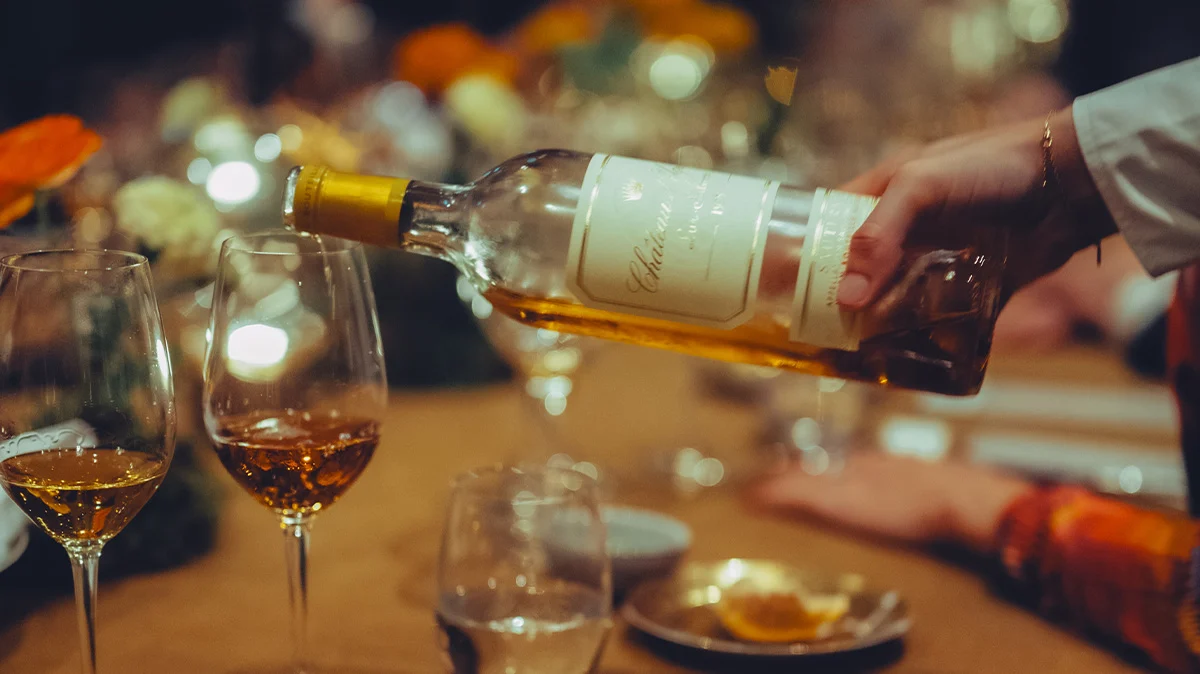
This story is from an installment of The Oeno Files, our weekly insider newsletter to the world of fine wine.
For decades, the global wine lexicon has suffered from a rigid, almost dogmatic classification system regarding dessert wines. At the top of this hierarchy sits Sauternes—the golden, honeyed nectar of Bordeaux. For most, the pairing parameters are narrow: a glass of this botrytized elixir is reserved strictly for foie gras, a wedge of pungent Roquefort, or the caramelized crust of a crème brûlée. However, a quiet revolution is taking place in the world’s finest dining rooms. Chefs, sommeliers, and winemakers are dismantling these archaic boundaries, proving that Sauternes is not merely a sugary coda to a meal, but a versatile, structural powerhouse capable of anchoring a savory gastronomic journey.
The Catalyst: A Lesson in Acid and Heat
The impetus for this paradigm shift often begins with a culinary accident. Recently, while preparing a dinner party featuring giardiniera—the sharp, vinegary Italian pickled vegetable medley—our team encountered a classic pairing failure. We had initially selected a crisp, dry white wine, expecting its acidity to cut through the brine. Instead, the result was jarring; the vegetables rendered the wine flat, metallic, and utterly unpalatable.
In a moment of experimentation, we pulled a chilled half-bottle of Château Rieussec Sauternes from the refrigerator. The transformation was immediate and profound. The wine’s vivid, high-toned acidity and residual sweetness acted as a bridge, tempering the aggressive vinegar and spicy heat of the vegetables while maintaining its own elegance. It was a revelation: the very qualities that define Sauternes—concentration, viscosity, and vibrant acidity—make it an ideal partner for dishes that would typically overwhelm a standard dry white.
A Chronology of Perception: From Dessert to Dinner
The historical pigeonholing of Sauternes is a relatively modern phenomenon. While it has long been associated with the end of a meal in the 20th century, its origins are rooted in the rich, opulent banquets of the aristocratic past, where sweet and savory flavors were often served concurrently.
In recent years, the movement to re-evaluate these wines has been championed by global culinary icons. Massimo Bottura, the visionary behind the three-Michelin-starred Osteria Francescana in Modena, has been instrumental in shifting the narrative. Bottura does not view Sauternes as an afterthought; he treats it as a primary ingredient. He suggests pairing a young Château d’Yquem—the gold standard of the region—with aged culatello, the prized Italian cured ham.
"The wine’s freshness and vibrant energy create a beautiful contrast with the depth, sweetness, and umami of the cured meat," Bottura explains. This approach challenges the "sugar-on-sugar" fallacy. By moving away from desserts and toward the complex, salt-forward profile of aged charcuterie, the wine’s aromatic complexity is finally allowed to breathe, unshackled from the cloying sweetness of a cake or custard.

Supporting Data: The Architecture of Balance
To understand why this pairing works, one must look at the "architecture" of a Sauternes. A great Sauternes is not just sweet; it is a wine of intense tension. The botrytis cinerea—the noble rot that shrivels the grapes—concentrates both sugar and acidity. It is this high level of acidity that provides the "backbone" of the wine, allowing it to withstand bold, savory, and even spicy flavors.
Michaël Peltier, a senior fine-wine specialist at Millesima in New York City, underscores the importance of age in these pairings. He suggests that while older vintages offer the tertiary notes of dried stone fruit and saffron, youthful Sauternes (under a decade old) retain a "nervous" energy that is essential for seafood.
"The energy of a young Château Suduiraut transforms a simple preparation into a celebration of balance, texture, and aroma," says Peltier. He advocates for pairing youthful bottles with lobster prepared in butter infused with ginger and cardamom. The crustacean’s natural sweetness mirrors the wine’s fruit profile, while the spices interact with the wine’s viscosity, creating a harmonious interplay that a crisp, high-acid dry wine might lack.
The Global Perspective: Hong Kong’s Culinary Lab
While Western palates are only now beginning to shed their preconceptions, the East has long been more receptive to the fusion of sweet and savory. Victor Petiot, the restaurant director of Caprice at the Four Seasons Hotel Hong Kong, notes that diners in Asia are often more comfortable with the concept of "balance through contrast" rather than "matching like with like."
At Caprice, the wine list is a testament to this philosophy, featuring a vast selection of sweet wines by the glass, including Château d’Yquem served from massive six-liter bottles. One of the restaurant’s most popular pairings is a glass of Yquem with laksa—a spicy, creamy noodle soup featuring Alaskan king crab.
"The idea is not to add sweetness to sweetness," Petiot explains. "It is to create balance within the dish. The wine’s roundness and freshness help balance the spice while complementing the texture of the dish." This is a masterclass in culinary physics: the fat from the coconut milk and the spice of the curry are perfectly neutralized by the weight and sugar of the Sauternes, while the wine’s acidity cleanses the palate, preparing it for the next bite.
Official Responses and Future Directions
Lorenzo Pasquini, CEO of Château d’Yquem, believes that the future of Sauternes lies in returning to its roots as an everyday table wine. "The most traditional pairing would be with the meal that every French family would have on Sunday for lunch: roast chicken," Pasquini says.

Under his leadership, the estate has aggressively pursued this mission through high-profile collaborations with chefs like Mauro Colagreco of Mirazur. These residencies are not designed to showcase the wine as a dessert pairing, but as a component of a multi-course gastronomic journey. Pasquini argues that a dish does not need to imitate the wine. "The most interesting combinations often come from the tension between different elements: richness and freshness, intensity and delicacy, salinity and a touch of bitterness."
Implications for the Connoisseur
The implications of this shift are significant for the fine wine market. As Sauternes is liberated from the dessert-only category, its utility in the cellar grows exponentially. No longer must a collector wait for the final course to reach for an Yquem or a Suduiraut; it becomes a viable option for the appetizer or the main course.
Massimo Bottura reinforces this, noting that Sauternes can accompany an entire gastronomic arc, "changing character while remaining unmistakably itself." Even when returning to the classic pairing of foie gras, he elevates the concept by suggesting a Filetto alla Rossini—pan-seared filet mignon topped with foie gras and black truffle—paired with an aged vintage. The depth of the older wine mirrors the earthiness of the truffle and the richness of the meat, proving that even when we return to tradition, we can do so with a more sophisticated understanding of the wine’s potential.
Ultimately, the move toward pairing Sauternes with savory dishes is a move toward culinary freedom. It requires the diner to set aside the "rules" and trust their palate. As Bottura notes, pairing food and wine is like composing music: "You need contrast and tension, but above all, you need balance. When food and wine listen to each other, something magical happens."
For those willing to break the box, the reward is an untapped world of flavor, where the golden wines of Bordeaux are no longer a footnote, but the symphony itself.
 Evan Lee Salim
 Asep Darmawan
 Laily UPN
