

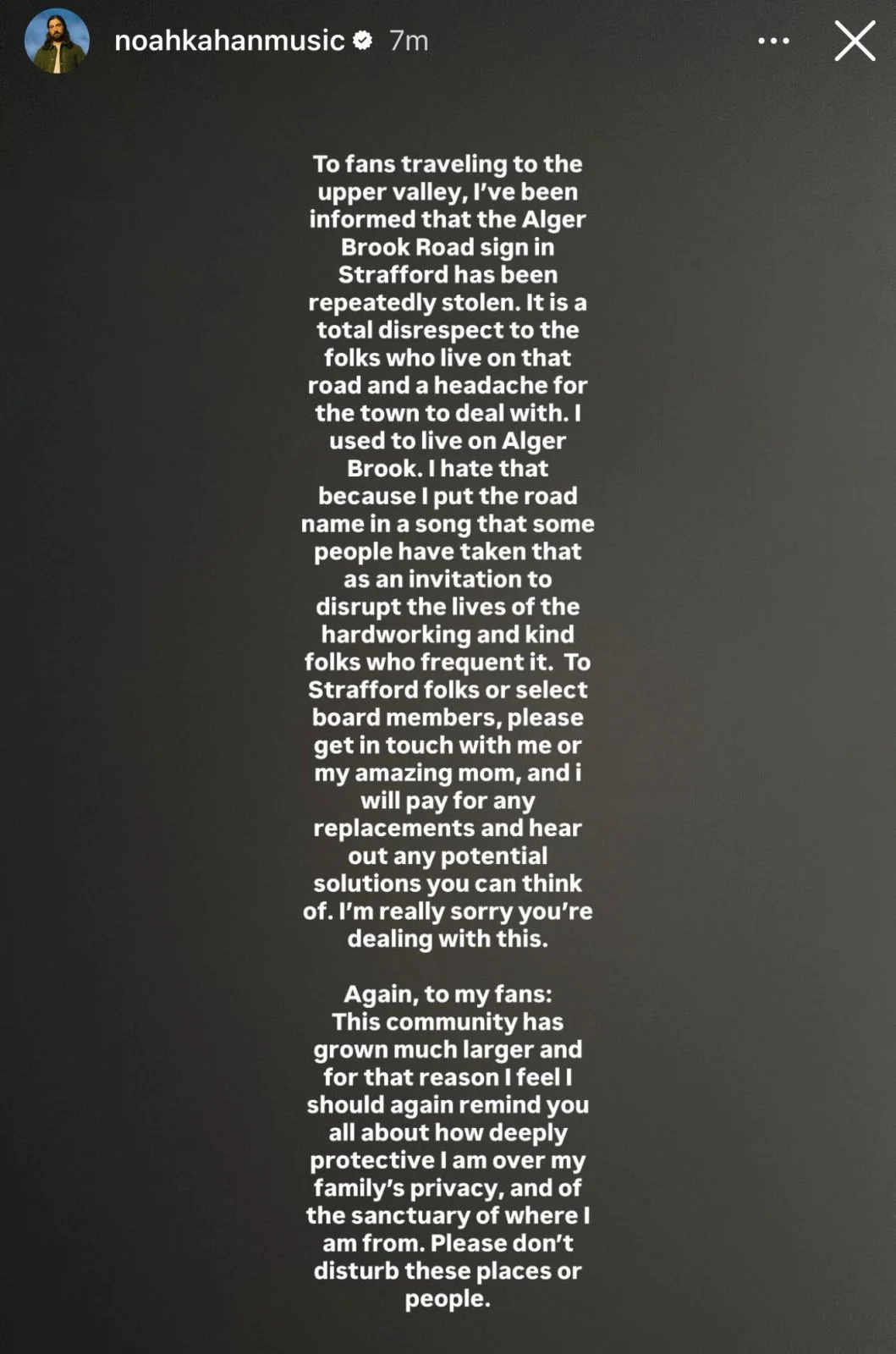
In an era where the boundary between parasocial devotion and physical boundary-crossing has become increasingly blurred, singer-songwriter Noah Kahan has found himself in the uncomfortable position of policing the behavior of his own fanbase. The Vermont-born musician, whose 2022 breakout album Stick Season catapulted him to international superstardom, issued a firm and emotional plea this week to his supporters: stop stealing the road sign for Alger Brook Road.
The sign, located in the quiet Vermont town of Strafford, has become an accidental pilgrimage site for fans of Kahan’s folk-inflected indie pop. However, the recurring disappearance of the municipal property has forced the artist to address the unintended consequences of his songwriting, transforming a poetic reference into a logistical and ethical headache for the very community that raised him.
The Intersection of Art and Geography: Main Facts
The controversy centers on the lyrics to the title track and the closing moments of Stick Season. In the song "The View Between Villages," Kahan paints a vivid, melancholic picture of his home state with the line, "Past Alger Brook Road, I’m over the bridge / A minute from home, but I feel so far from it."
For fans of the album—which became a cultural touchstone for its raw, unflinching look at small-town isolation and the complexities of leaving home—the specific mention of Alger Brook Road turned a mundane piece of infrastructure into a tangible connection to the music. What began as a handful of curious listeners visiting the area has snowballed into a trend of souvenir hunting. The physical removal of the road sign is not merely a harmless act of fandom; it is a crime that imposes financial and administrative burdens on the town of Strafford.
Kahan, visibly frustrated by the situation, took to his Instagram stories on Friday to address the issue head-on. He clarified that he once lived on the road, and that his lyrical tribute was intended to honor the landscape, not to commodify it for tourism.
A Chronology of the “Stick Season” Phenomenon
To understand how a quiet, rural road in Vermont became a target for theft, one must look at the meteoric rise of Stick Season.
- October 2022: Noah Kahan releases Stick Season, an album that resonates deeply with listeners, specifically for its themes of nostalgia, mental health, and the claustrophobia of rural living.
- Late 2023–2024: As the album gains massive critical acclaim and commercial traction, "The View Between Villages" emerges as a fan favorite. Social media platforms like TikTok and Instagram begin to feature videos of fans "finding" the locations mentioned in the songs.
- Early 2025: Local residents in Strafford report the first instances of the Alger Brook Road sign being tampered with or removed. Initial reports are treated as isolated incidents of youthful mischief.
- Mid-2026: The frequency of the thefts increases alongside Kahan’s massive North American stadium tour. With thousands of fans traveling to catch his live performances, a subset of the fanbase begins making pilgrimages to the Upper Valley region.
- June 2026: After reports from town officials confirm that the signage has been replaced multiple times, Kahan publicly denounces the behavior, pleading with his audience to cease the disruption of his home community.
The Anatomy of the Theft: Supporting Data and Context
While the act of stealing a road sign may seem trivial to some, it represents a significant disruption to public services. In rural towns like Strafford, budgets for road maintenance and municipal signage are often tight. Each time a sign is removed, the local Department of Public Works must dedicate time and taxpayer funds to order a replacement, manufacture it, and install it.
Moreover, road signs are critical safety infrastructure. Beyond the legal implications—which include potential charges for theft or destruction of public property—the removal of such signs can cause confusion for emergency services. In the event of a medical emergency or fire, seconds matter; having a clearly marked intersection is a necessity for first responders navigating the winding, often unmarked roads of the Vermont countryside.
Kahan’s frustration is grounded in his deep personal connection to the region. He noted in his statement that he considers these roads to be the "sanctuary" where he was raised. By turning the road into a destination for "fan tourism," the perpetrators are, in Kahan’s view, desecrating the very atmosphere that allowed the music to exist in the first place.
Official Responses and the "Mother-to-Mother" Bridge
One of the more poignant aspects of Kahan’s response was his decision to bypass bureaucratic red tape by offering a personal connection. Recognizing that he is a global celebrity, he sought to humanize the process of restitution.
"I hate that because I put the road name in a song that some people have taken that as an invitation to disrupt the lives of the hardworking and kind folks who frequent it," Kahan wrote. He expressed a desire to communicate directly with local town officials to devise a strategy that prevents further theft.

In a moment that highlights his "small-town roots," Kahan suggested that if the town needed to contact him directly regarding the financial cost of replacing the signs or to coordinate a solution, they should reach out to his mother. This gesture served as a powerful reminder that behind the massive stadium tours and the platinum records, Kahan remains connected to the specific, local network of his upbringing. It was an attempt to show that he is still accountable to the community, and that his fame does not exempt him from the responsibilities of being a neighbor.
Broader Implications: The Burden of Modern Fandom
The situation involving Noah Kahan and the residents of Strafford is a microcosm of a larger issue in modern celebrity culture: the "location-tagging" effect. In the age of geotagging, social media has transformed private, quiet, or local spaces into global points of interest.
When a musician or influencer shares a location—or even references one in a work of art—they effectively "open" that space to millions of people. This phenomenon has led to "over-tourism" in locations ranging from quiet coastal villages in Italy to small towns in rural America.
The Erosion of Privacy
Kahan took the opportunity during his public statement to reassert the necessity of boundaries. He reminded his fans that his community is not a theme park. The singer has frequently been vocal about his struggles with mental health and the pressure of fame, and his protective stance over his family’s privacy is a continuation of those values.
"My community has grown much larger and for that reason I feel I should again remind you all about how deeply protective I am over my family’s privacy, and of the sanctuary of where I am from," Kahan emphasized. "Please don’t disturb these places or people."
The Responsibility of the Artist
The situation raises a difficult question: Does an artist have a responsibility for how their audience interacts with the physical world?
While it is unreasonable to suggest that an artist should not write about their home, Kahan’s proactive response suggests a modern model of accountability. Rather than ignoring the issue or distancing himself from it, he is using his platform to educate his fanbase on the ethics of travel and the importance of respecting local residents. He is essentially asking his fans to consume his art through the medium of music, rather than by consuming the physical reality of the place that inspired it.
Moving Forward: The 2026 Tour and Beyond
As Kahan continues his extensive 2026 North American tour, which spans from the Rogers Stadium in Toronto to the Rose Bowl in Pasadena, the pressure on his fanbase to act with decorum will likely continue to grow.
The tour, which includes high-profile stops at iconic venues like Fenway Park and Wrigley Field, is a testament to his massive appeal. However, as the scale of his success increases, so does the responsibility of the community he has built. If the fans of Stick Season truly identify with the ethos of the album—which is, at its core, an ode to the sanctity of one’s origins—they must reconcile that identification with the preservation of those very origins.
For the residents of Strafford, the hope is that the message will sink in. For the fans, it serves as a sobering reminder: the music is the memory, but the road is a living, breathing part of someone else’s life. As Kahan’s career continues to climb toward even greater heights, the "view between villages" will hopefully return to being just that—a view, meant to be appreciated from a distance, and left exactly as it was found.
 Asro
Asro
 Lina Irawan
 rifanmuazin
