

Seventy years ago, Blancpain made a definitive statement that would echo across generations of watchmaking history: shrinking a women’s watch should never mean compromising its mechanical integrity.
When the original Ladybird made its debut in 1956, it housed the smallest round mechanical movement produced in series at the time. This triumph of extreme miniaturization transformed a technical challenge into an artistic foundation, paving the way for some of the Swiss manufacture’s most imaginative, jewelry-inspired timepieces.
Now, Blancpain is returning to the radical, avant-garde ethos of the midcentury Ladybird "Bullet" with the newly unveiled Lady B. Marking a powerful new chapter for the collection, the Lady B bridges the gap between historical reverence and contemporary sculptural design, proving that haute horlogerie can be both playful and uncompromisingly complex.
Main Facts: The Anatomy of the Lady B
At its core, the Lady B is a masterclass in modern micro-mechanics wrapped in a midcentury-inspired aesthetic. Eschewing the conventional approach of simply scaling down a men’s watch for a smaller wrist, Blancpain has engineered a polished, spherical case that resembles a polished pebble or an objet d’art.
Key Specifications:
- Case Dimensions: 19 mm in diameter and 13.2 mm in thickness.
- Case Construction: A sophisticated two-part construction requiring over 30 technical drawings to resolve. Notably, it features no conventional lugs.
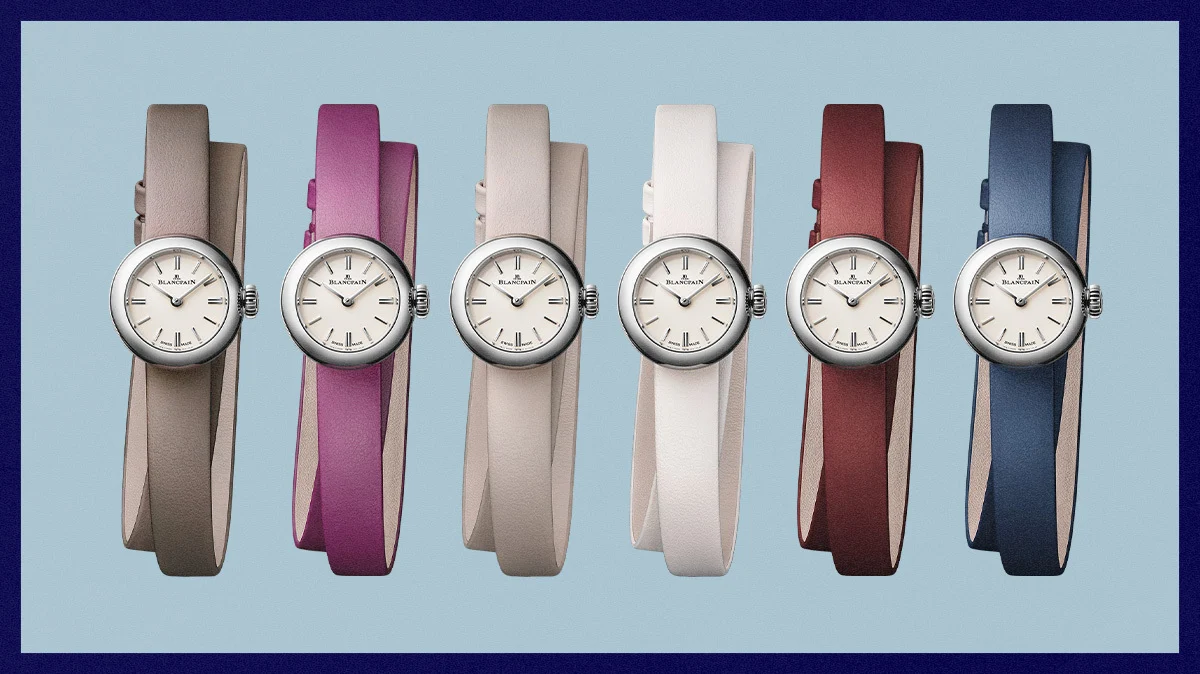
- Strap System: A 10 mm double-tour calfskin strap threads directly through a narrow channel machined into the back of the case, preserving its seamless, sculptural profile while allowing tool-free strap changes.
- Movement: Powered by Blancpain’s automatic Caliber 615 (measuring 15.7 mm in diameter and 3.9 mm thick), comprising 180 components, 29 jewels, a 3-Hz frequency, and a 38-hour power reserve.
- Modern Upgrades: Features a silicon balance spring for enhanced magnetic resistance and traditional Côtes de Genève finishing.
- Pricing & Availability:
- Stainless Steel: $12,600 (featuring an opaline dial).
- 18-Karat Red Gold: $19,200 (featuring an opaline dial).
- Strap Options: Double-tour calfskin available in white, light beige, dark beige, burgundy, fuchsia purple, and classic blue.
Chronology: A Timeline of Visionary Watchmaking
To fully appreciate the weight of the Lady B release, one must trace the historical milestones that shaped Blancpain’s women’s watch portfolio.

1912: The Journey Begins
A 16-year-old girl named Betty Fiechter steps into the Blancpain manufactory as an apprentice. Her keen intellect, passion for mechanics, and business acumen would soon alter the trajectory of the historic brand.
1933: Breaking the Glass Ceiling
Following the passing of founding family leadership, Betty Fiechter acquires Blancpain, becoming the first woman to ever own and lead a Swiss watch manufacture. Operating in an era when Swiss women did not yet possess the right to vote, Fiechter successfully manages a company of over 200 employees, expanding its international footprint and championing women’s mechanical timepieces as objects worthy of true horological engineering.
1953: The Birth of the Fifty Fathoms
Working closely with her nephew, Jean-Jacques Fiechter, Betty helps conceptualize and launch the legendary Fifty Fathoms, cementing Blancpain’s indelible mark on dive-watch history.
1956: The Ladybird and the "Bullet" Era
Just three years after the Fifty Fathoms, Blancpain introduces the Ladybird collection. Powered by the groundbreaking R55 hand-wound caliber (measuring a minuscule 11.85 mm across and 3.7 mm thick), the Ladybird sets a new benchmark. Its tiny footprint liberates designers, resulting in hidden watch iterations concealed inside bracelets, cocktail rings, cuffs, and pendants.
1995: Introduction of Caliber 615
Blancpain introduces the automatic Caliber 615. Over the next three decades, this movement undergoes continuous refinement, eventually serving as the mechanical engine for the 21st-century revival of the brand’s smallest proportions.

2024–2026: The Modern Renaissance
Following various homages—including a high-profile Marilyn Monroe tribute released in the summer—Blancpain bypasses conventional redesigns. Instead, the brand looks directly to the daring spirit of 1956, culminating in the official launch of the Lady B.
Supporting Data: The Engineering Behind the Miniature
The creation of the Lady B was far from a simple aesthetic exercise. Developing a spherical wristwatch housing a high-performance automatic movement required solving complex geometric and physical equations.
| Feature | Vintage Ladybird Bullet (1956) | Modern Lady B (Present) |
|---|---|---|
| Movement | R55 (Hand-wound) | Caliber 615 (Automatic) |
| Movement Dimensions | 11.85 mm wide, 3.7 mm thick | 15.7 mm wide, 3.9 mm thick |
| Case Form | Bullet / Pebble-like | Spherical, two-part construction |
| Component Count | Minimalist micro-engineering | 180 components, 29 jewels |
| Power Reserve | Standard historical duration | 38 hours |
| Materials | Precious metals / Gem-sets | Stainless Steel & 18-Karat Red Gold |
The Caliber 615 represents a bridge between eras. While measuring a mere 15.7 mm across, it packs 180 distinct components into a compact space. The integration of a silicon balance spring addresses modern magnetic interference—a ubiquitous hazard in daily life involving smartphones, laptops, and magnetic clasps—while manual anglage and Côtes de Genève ensure that the interior craftsmanship matches the exterior polish.
Official Responses and Design Philosophy
Blancpain’s leadership and design teams emphasize that the Lady B is not an attempt to recreate a museum piece, but rather an exploration of midcentury optimism translated into modern materials.
In design circles, the bubble-like contours of the 1956 Ladybird Bullet are frequently compared to the organic architecture and furniture of the period. Think of Eero Saarinen’s Tulip chair or Charles and Ray Eames’ molded plywood creations. Space-age curves were sweeping through global culture, influencing everything from automobile manufacturing to haute couture.

By reviving this rounded, sculptural geometry, Blancpain’s modern designers sought to capture that same forward-looking optimism.
"Creating its deceptively simple form required more than 30 technical drawings," notes the brand’s development team. The challenge lay in engineering a two-part case that measures 19 mm across and 13.2 mm thick while completely omitting traditional lugs. By channeling the 10 mm double-tour calfskin strap directly through the case body, the watch maintains an uninterrupted, fluid silhouette that sits effortlessly on the wrist as both a functional timepiece and a striking piece of jewelry.
Implications: What the Lady B Means for Women’s Horology
The launch of the Lady B carries significant implications for the broader landscape of luxury watchmaking, particularly concerning how brands cater to female collectors.
1. Rejection of the "Shrink It and Pink It" Tropes
For decades, the luxury watch industry often treated women’s timepieces as an afterthought, taking existing men’s calibers and wrapping them in pastel dials or quartz movements. The Lady B forcefully rejects this lazy paradigm. By prioritizing high-end mechanical automatic movements inside ultra-compact, architecturally daring cases, Blancpain reaffirms that women collectors demand—and deserve—the same level of horological substance as men.
2. Honoring Forgotten Pioneers
The narrative surrounding the Lady B brings much-needed light back to Betty Fiechter. As one of the earliest female powerhouses in Swiss watch manufacturing, her contributions were historically overshadowed by male executives of her era. By tying the engineering feats of the Lady B directly to Fiechter’s legacy, Blancpain educates a new generation of enthusiasts on the vital role women played in shaping mid-century watchmaking.

3. A Shift Toward Sculptural Versatility
At a time when sports watches and integrated steel bracelets dominate market trends, the Lady B offers a refreshing counter-narrative. Its pebble-like case and versatile double-tour strap options (ranging from understated light beige to vibrant fuchsia and classic blue) position the watch as a chameleon. It transitions seamlessly from formal evening wear to avant-garde daily wear, appealing directly to collectors seeking individuality over cookie-cutter trends.
Conclusion
The Blancpain Lady B is more than just a nod to the past; it is a bold declaration of intent for the future. By merging the historical bravery of Betty Fiechter with state-of-the-art micro-mechanics and midcentury design sensibilities, Blancpain has crafted a timepiece that defies easy categorization.
Whether chosen in luminous stainless steel or warm 18-karat red gold, the Lady B stands as a brilliant reminder that true luxury is not measured solely in millimeters, but in the boundless creativity unlocked when technical mastery meets uncompromising design.
 Evan Lee Salim
 Asep Darmawan
 Laily UPN
