

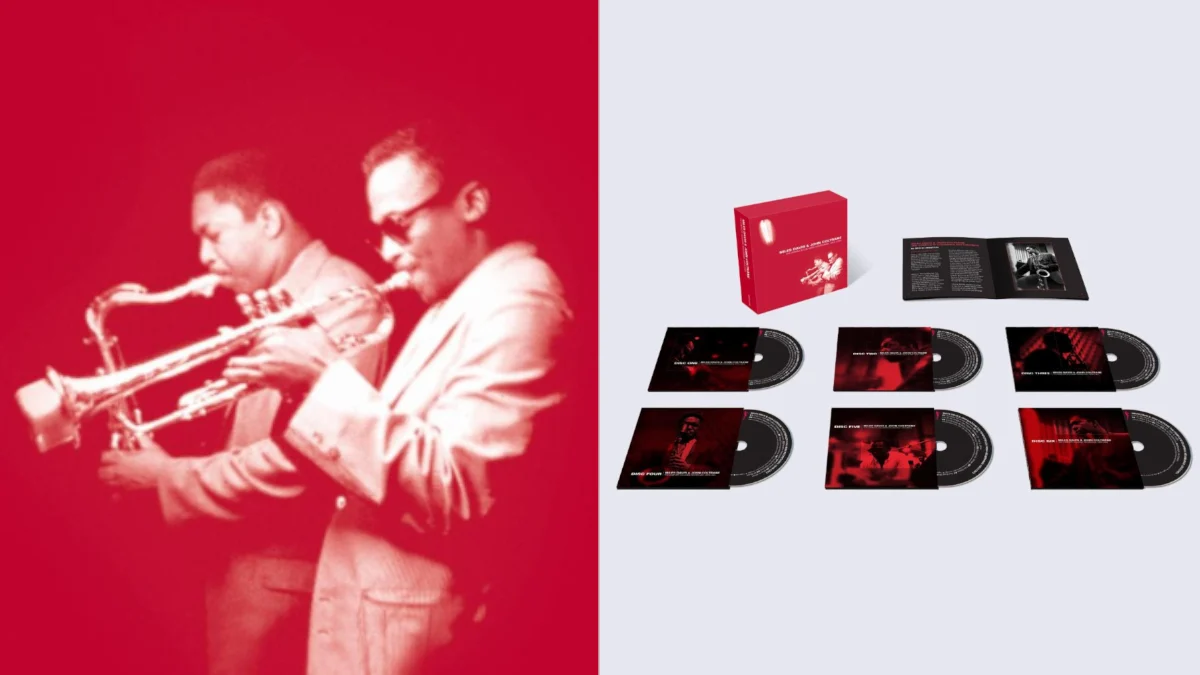
In the pantheon of 20th-century art, few creative partnerships burn as brightly, intensely, and briefly as the musical union between trumpeter Miles Davis and saxophonist John Coltrane. Together, they forged a sonic lexicon that fundamentally redefined modern jazz, pivoting from the intricate, blistering speeds of hard bop to the expansive, modal frontiers that forever changed how music was improvised and consumed.
Now, in celebration of the centennial year of both artists—who were both born in the landmark year of 1926—Columbia Records and Legacy Recordings have officially announced a massive, definitive reissue of one of the most celebrated archival projects in recorded music history: Miles Davis & John Coltrane — The Complete Columbia Recordings (1955-1961).
Slated for release on November 6, the monumental collection will be made available for pre-order in two distinct, premium physical formats: a sprawling 9xLP vinyl box set and a comprehensive 6xCD edition. Additionally, for fans looking for a curated entry point into this legendary partnership, a companion double-LP compilation titled The Best Of Miles Davis & John Coltrane (1955-1961) will also hit shelves. This latest archival rollout follows on the heels of January’s celebrated reissue of Miles Davis — The Complete Live at the Plugged Nickel 1965, further cementing a stellar year for connoisseurs of classic jazz preservation.
The Main Facts: Inside the Box Set
Originally assembled and released to universal acclaim in 2000, The Complete Columbia Recordings (1955-1961) stands as a monumental achievement in music curation. Produced by the late, revered jazz historians and producers Michael Cuscuna and Bob Belden, the collection swept the Grammy Awards in 2001, taking home trophies for Best Historical Album and Best Album Notes.
The core of the collection encompasses an astonishing 58 tracks spanning the foundational years of Davis and Coltrane’s creative peak. Listeners will find material drawn from towering studio masterpieces that defined an era, including ’Round About Midnight, Milestones, Jazz at the Plaza, Someday My Prince Will Come, and the immortal Kind of Blue—widely regarded as the best-selling jazz record of all time.

Beyond core studio albums, the comprehensive set captures rare collaborative moments that occurred outside primary sessions, drawing from projects like Miles and Monk at Newport, Birth of the Blue, Basic Miles, and Circle in the Round. Crucially, the collection preserves 18 rare alternate takes, false starts, and studio dialogue tracks that were unearthed for the original 2000 edition and remain unavailable anywhere else, offering an unfiltered, fly-on-the-wall perspective of two masters at work.
Physical Formats and Packaging
True to the collector-focused nature of the original release, both the 9xLP and 6xCD iterations are packaged as luxury physical artifacts designed to honor the aesthetic weight of the music:
- The 9xLP Vinyl Set: Housed in a sturdy, premium slipcase, the vinyl edition features individually designed LP jackets for each record. It comes accompanied by a 60-page adaptation of the original oversized companion book, packed with rare photographs, historical essays by original producer George Avakian and Kind of Blue drummer Jimmy Cobb, critical insights by Bob Blumenthal, and the legendary original liner notes penned by pianist Bill Evans for Kind of Blue.
- The 6xCD Set: For compact disc enthusiasts, the 6xCD package includes six individually designed mini-jackets housed in a deluxe slipcase, accompanied by an exhaustive 116-page booklet diving deep into the history, sessions, and cultural impact of the collaboration.
A Chronology of Collaboration: 1955–1961
To understand the weight of this collection is to trace the rapid evolution of jazz across the mid-20th century. The timeline captured within these box sets marks one of the most fertile creative periods in American musical history.
1955–1956: The Birth of the First Great Quintet
The partnership formally solidified in 1955 when Miles Davis, looking to assemble a powerhouse ensemble following his triumphant performance at the Newport Jazz Festival, recruited a relatively unknown tenor saxophonist from Philadelphia named John Coltrane. Alongside rhythm section members Red Garland (piano), Paul Chambers (bass), and Philly Joe Jones (drums), the group became known as the First Great Quintet.
During sessions for Columbia Records—undertaken partly to fulfill a remaining contract obligation with Prestige Records—the quintet recorded material that would make up ’Round About Midnight (released in 1957). Tracks like "Two Bass Hit," "Ah-Leu-Cha," and the title track displayed a telepathic interplay between Davis’s cool, economical phrasing and Coltrane’s burgeoning "sheets of sound" technique.

1958: Modal Expansion and Milestones
As the decade progressed, the musical landscape began to shift. By 1958, Coltrane had rejoined Davis (following a brief hiatus prompted by Coltrane’s personal battles with addiction) alongside the addition of alto saxophonist Cannonball Adderley, expanding the group into a sextet.
The resulting album, Milestones, signaled a radical departure from traditional chord-based improvisation. The title track introduced modal jazz—relying on scales rather than rapid chord changes—giving soloists unprecedented freedom. Alternate and studio takes included in the box set, such as the studio dialogue on "Sweet Sue, Just You" and alternate passes of "Straight, No Chaser," document a band actively discovering a new musical grammar in real-time.
1959: Kind of Blue and the Apex
The pinnacle of the Davis-Coltrane collaboration arrived in March and April of 1959 during the sessions for Kind of Blue. Recorded with pianist Bill Evans (and Wynton Kelly on "Freddie Freeloader") replacing Red Garland, the album became a cultural touchstone.
Discs in the collection featuring "So What," "Blue in Green," and "Flamenco Sketches" capture a band operating at an ethereal peak. These sessions marked the twilight of Coltrane’s tenure with Davis; seeking his own musical destiny as a bandleader, Coltrane departed shortly thereafter to form his own legendary quartet, though brief live crossovers—such as their 1960 European tour recordings featured on the latter discs of the collection—continued to capture lightning in a bottle.
Supporting Data & Tracklist Overview
The sheer scale of The Complete Columbia Recordings is best visualized through its exhaustive configurations, offering completists an unprecedented look into the studio vaults.

9xLP Vinyl Set Tracklist Summary
- LP 1-2: Early hard bop workouts, alternate takes of "Two Bass Hit," "Ah-Leu-Cha," "Budo," and "Dear Old Stockholm."
- LP 3-4: Studio chatter, deep dives into ’Round About Midnight sessions, "Billy Boy," "Straight, No Chaser," and the transitional modal experiments of Milestones.
- LP 5-6: The expansion into the sextet era featuring Cannonball Adderley, including "On Green Dolphin Street," "Stella by Starlight," and foundational tracks from Kind of Blue ("So What," "Blue in Green").
- LP 7: The conclusion of the Kind of Blue master takes ("Flamenco Sketches," "All Blues") alongside tracks from Someday My Prince Will Come.
- LP 8-9: Rare live recordings and stage performances, including introductions by Willis Conover and live renditions of "If I Were a Bell," "Oleo," and "My Funny Valentine."
The 2xLP Companion: The Best Of Miles Davis & John Coltrane (1955-1961)
For listeners seeking a curated journey rather than an exhaustive archival deep-dive, the newly announced double-LP highlights package distills the box set down to its absolute cultural essentials:
- Side A: "Two Bass Hit," "Dear Old Stockholm," "Bye Bye Blackbird"
- Side B: "’Round About Midnight," "Straight, No Chaser (alternate take)"
- Side C: "Milestones," "So What"
- Side D: "Blue in Green," "Someday My Prince Will Come"
Official Responses and Industry Reception
The announcement of the centennial reissue has sent ripples of excitement through the global jazz community, musicology departments, and vinyl collecting circles alike.
In a joint statement accompanying the press release, representatives from Columbia Records and Legacy Recordings emphasized the cultural imperative of keeping these masterworks accessible in high-fidelity formats for younger generations. "Miles Davis and John Coltrane did not merely record music; they charted the emotional and intellectual boundaries of human expression during a time of immense social change," the labels noted. "As we approach a century since their births, returning to these master tapes reminds us why their dialogue remains as vital, urgent, and modern today as it was in the mid-20th century."
Archivists and producers who worked on legacy Miles Davis material over the decades have frequently pointed to the Columbia vaults as a sacred trust. The decision to press the 58-track collection back onto heavyweight vinyl and CD underscores a broader industry trend toward high-end, premium physical reissues that treat historical jazz recordings with the curatorial reverence typically reserved for classical masterworks.
Implications for Music History and Modern Collectors
The arrival of The Complete Columbia Recordings 1955-1961 in November 2026 carries profound implications for both music historians and contemporary consumers.

In an era dominated by algorithmic streaming playlists and compressed digital files, physical box sets of this magnitude act as cultural anchors. They force a slower, more deliberate form of listening—encouraging audiences to sit with the liner notes, examine the original photography, and trace the minute sonic evolutions between an alternate take and a master recording.
Furthermore, the timing of the release—framing the centennial of two giants born in 1926—serves as a vital reminder of the collaborative friction that pushes art forward. Davis was notoriously demanding, a musical director who constantly pushed his sidemen out of their comfort zones. Coltrane, intensely studious and spiritually driven, absorbed those challenges and transformed them into a springboard for his own avant-garde revolution later in the 1960s.
As pre-orders for the 9xLP and 6xCD sets go live, music lovers are handed a rare opportunity: the chance to own the definitive chronicle of two titans walking the same musical path, building a bridge from the smoky clubs of the 1950s into the timeless eternity of modern art.
 Asro
Asro
 Lina Irawan
 rifanmuazin
