

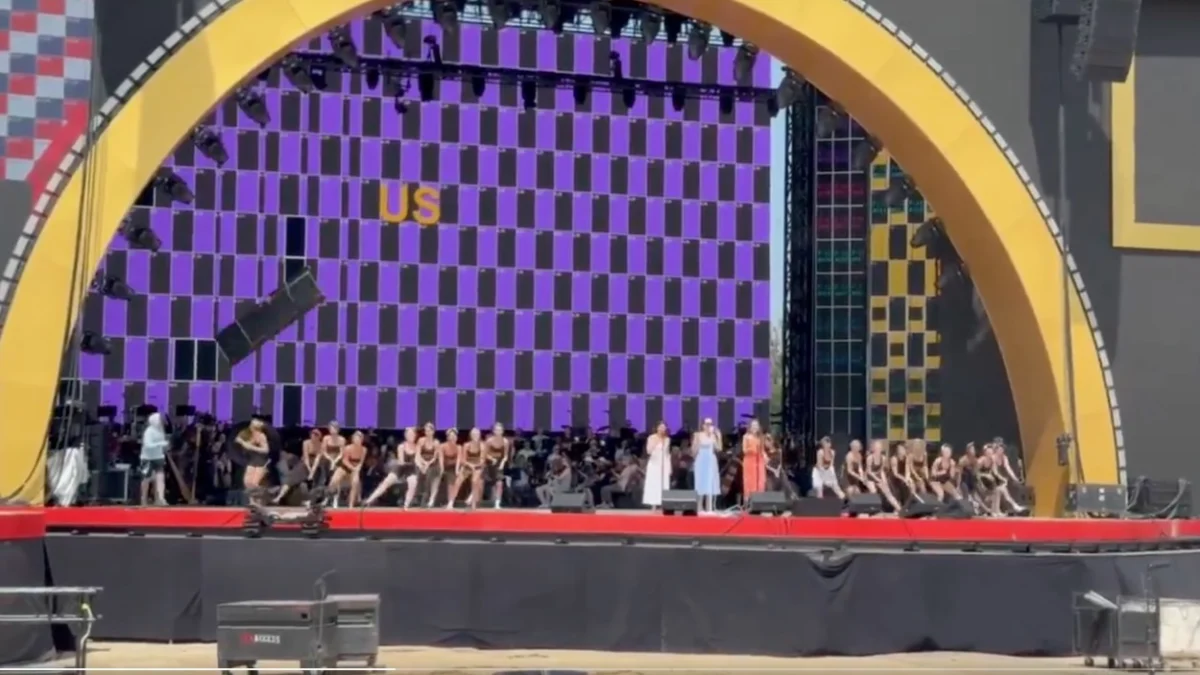
The Great American State Fair, an event envisioned as a cornerstone of summer entertainment and national celebration, has found itself embroiled in a series of operational crises that threaten to overshadow its intended purpose. What was marketed as a grand showcase of American culture has instead become a cautionary tale of logistical mismanagement, safety hazards, and mounting public scrutiny. The situation reached a breaking point on Thursday afternoon when a structural failure on the event’s "Salute Stage" nearly resulted in a catastrophic injury involving a group of young dancers.
This incident, while fortunately devoid of casualties, serves as the latest in a troubling pattern of mishaps—ranging from disappointing attendance figures to exorbitant vendor pricing and a cascade of high-profile musical cancellations—that have plagued the fair since its inception. As the event heads into a critical weekend, organizers face not only the pressure of stabilizing the site but also the logistical nightmare of preparing for extreme weather and a highly anticipated, potentially volatile political appearance.
A Near-Miss: The Structural Collapse
The incident occurred on Thursday afternoon during rehearsals for a July 4th celebration hosted by the organization Freedom 250. A group of young performers was practicing on the Salute Stage when a significant portion of the overhead equipment and structural rigging detached, plummeting to the stage floor.
Video footage shared widely on social media platforms, including a post by Aaron Parnas, captured the immediate aftermath of the structural failure. The clips show the debris scattered across the performance area, mere feet from where the dancers had been positioned only moments earlier. Witnesses described a chaotic scene, characterized by the sound of metal shearing and the frantic evacuation of the performers.
"It was a sound like a thunderclap," one bystander noted. "We saw the rigging give way, and the dancers scattered. It was a miracle that nobody was directly beneath it when it hit the floor."
Emergency responders and on-site medical staff were dispatched immediately. While a thorough inspection revealed that no injuries were sustained, the psychological toll on the performers—and the obvious liability concerns for the organizers—have cast a long shadow over the remainder of the event’s programming.
Chronology of a Disastrous Opening Week
To understand the gravity of the recent stage collapse, one must examine the broader context of the Great American State Fair’s rocky debut. The event has been defined by a "death by a thousand cuts" trajectory since the gates first opened.
- Pre-Opening Phase: Initial marketing efforts were met with skepticism, but ticket sales were bolstered by promises of a star-studded lineup and national-level production value.
- The Attendance Gap: By the end of the first 48 hours, industry observers noted that the fairgrounds appeared sparsely populated. The lack of foot traffic resulted in a sterile, lackluster atmosphere that failed to generate the promised "buzz."
- The Economic Backlash: As attendance faltered, reports of "price gouging" began to circulate. Patrons expressed frustration on social media regarding the cost of standard fair food, with some items priced at nearly double the industry standard for similar regional events.
- The Musical Exodus: The most significant blow to the fair’s reputation came when a string of scheduled musical acts canceled their performances. While organizers cited "scheduling conflicts" and "logistical challenges," industry insiders suggest that the performers’ management teams were wary of the poor turnout and the underlying technical issues surfacing on-site.
- The Thursday Collapse: The near-miss on the Salute Stage occurred against the backdrop of these existing frustrations, marking the transition from a failing business venture to a genuine public safety concern.
Structural and Operational Analysis
The failure of the Salute Stage raises fundamental questions about the vetting process for subcontractors and the oversight protocols employed by the Great American State Fair. In large-scale event production, safety inspections are mandated at multiple intervals: upon the initial assembly of the rigging, following the installation of lighting and sound equipment, and periodically throughout the duration of the event.
Engineering experts who reviewed the available footage suggest that the failure likely originated in the connection points between the primary truss system and the support pillars. Whether this was due to improper torque during installation, faulty hardware, or excessive load-bearing stress remains a point of contention.
"When you have a stage failure of this nature, you look at the entire chain of command," says Marcus Thorne, an event production consultant. "You look at the engineering plans, the load calculations for the weight of the lights, and the certification of the crew on the ground. If the structure wasn’t reinforced to handle the specific equipment load, you are setting the stage for a disaster."
The Impending Weekend: A "Perfect Storm"
The fair is now entering a period of extreme vulnerability. The forecast for the coming weekend is dire, with meteorologists predicting temperatures that will consistently exceed 100 degrees Fahrenheit. The combination of heat-related illness risks, the lingering trauma of the stage collapse, and the logistical strain of managing a high-profile political rally has created a "perfect storm."
Former President Donald Trump is scheduled to speak at the fair, having explicitly stated his intention to "make a really long speech just to show that I can do anything." This event alone requires a massive deployment of law enforcement, private security, and crowd-control personnel. The intersection of political tension and poor infrastructure management creates a unique set of challenges for local authorities, who are already stretched thin by the fair’s internal volatility.
Official Responses and Accountability
As of Friday morning, the Great American State Fair management team has remained largely tight-lipped regarding the specific cause of the structural failure. A brief press statement acknowledged the incident, stating: "We are relieved that all performers and staff are safe. We are currently conducting a comprehensive safety audit of all staging equipment across the fairgrounds in coordination with local fire marshals and independent engineers."
Freedom 250, the organization associated with the July 4th celebration, issued a separate statement thanking the quick reflexes of the stage crew and the dancers. However, the organization did not comment on whether they would proceed with their scheduled performances or if they would be seeking legal recourse for the damages and the threat posed to their performers.
Critics and local officials are demanding more transparency. There is growing concern that the "comprehensive audit" mentioned by management may be a performative measure aimed at pacifying the public rather than a substantive effort to fix a systemic failure in the fair’s operational standards.
Broader Implications for the Event Industry
The situation at the Great American State Fair serves as a case study for the risks inherent in rapid-scale, high-visibility event planning. The pressure to deliver a "spectacle" often results in the cutting of corners, particularly when dealing with third-party vendors and temporary structures.
- Liability and Insurance: The incident will undoubtedly lead to a surge in insurance premiums for the organizers and will likely result in a wave of litigation. Any future event of this magnitude will now face much stricter regulatory scrutiny.
- Public Trust: The brand damage sustained by the Great American State Fair may be irreparable. The psychological connection between the fair and the image of a falling stage is a powerful one, and it will be difficult for organizers to reclaim the narrative of a safe, family-friendly environment.
- Regulatory Reform: Lawmakers are already signaling that they may push for more rigorous state-level oversight for temporary event structures. This could lead to a permanent change in how fairs and outdoor concerts are permitted and inspected across the region.
Conclusion: A Future in Question
The Great American State Fair stands at a precipice. The coming days will determine whether the event can salvage its reputation or if it will be remembered as one of the most disastrous logistical failures in recent memory. The focus now shifts to the integrity of the remaining structures and the ability of the management team to provide a safe environment for both the upcoming political rally and the general public.
While the "show must go on" mentality is prevalent in the event industry, the events of this week have proven that there is a threshold beyond which the cost of doing business becomes too high. For the young dancers who narrowly escaped tragedy, the fair is already a symbol of failure. For the organizers, the challenge is no longer just about profit or attendance; it is about whether they can prove to the public—and to the authorities—that the Great American State Fair is capable of meeting the most basic standards of safety.
As the sun sets on the fairgrounds, the silence surrounding the damaged stage is heavy. The questions remain: How could this have been allowed to happen, and who will be held responsible when the dust finally settles? For now, the fair persists, but it does so under a cloud of uncertainty, with the eyes of the nation watching to see if the structure will hold—or if the entire enterprise is destined to come crashing down.
 Asro
Asro
 Lina Irawan
 rifanmuazin
