

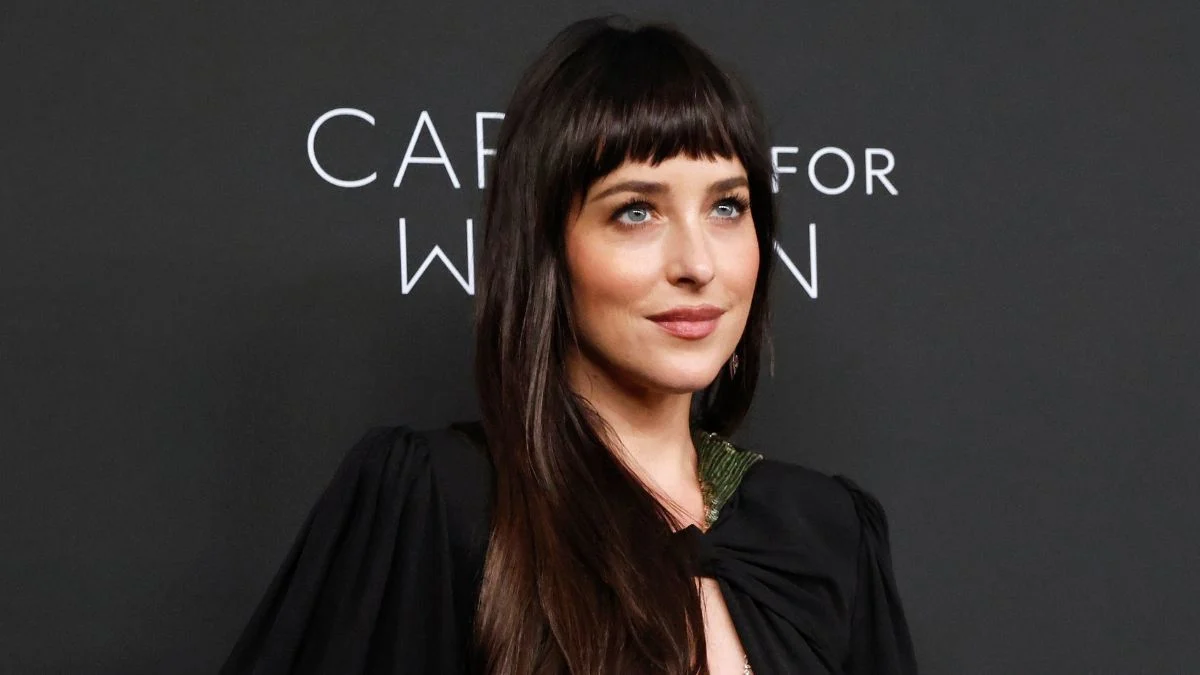
In the rarefied air of high fashion, few collaborations resonate as profoundly as the marriage of a singular muse and a minimalist house. For the October 2026 issue of Vogue, Dakota Johnson has once again cemented her status as a global style icon. While her cover appearance is an exercise in classic elegance, it is the interior editorial—specifically a striking black-and-white portrait—that has ignited a firestorm of discourse across social media platforms and fashion forums alike. In the image, Johnson is captured wearing a daring, architectural Jil Sander ensemble that perfectly encapsulates the current shift toward high-concept, minimalist tailoring.
The Aesthetic Shift: Jil Sander’s Architectural Precision
At the heart of this editorial narrative is a juxtaposition of volume and exposure. Johnson is seen sporting the Jil Sander Silk Faille Top, a piece that challenges the traditional conventions of evening wear. Retailing for $650, this bandeau-style garment is crafted from a luxurious blend of 66 percent wool and 34 percent silk. The design features a dramatic front fold and an open-back construction, secured by delicate, adjustable straps.
The piece sits high above the waist, leaving the midriff entirely exposed. Despite its minimal surface area, the top possesses a rigid, boxy structure that hugs the torso, creating a silhouette that is simultaneously fragile and commanding. When paired with the brand’s $2,690 Lightweight Taffeta Skirt, the look achieves a visual equilibrium. The skirt, a voluminous, floor-sweeping polyester taffeta piece, features an asymmetrical front opening that offers fleeting glimpses of the wearer’s leg, providing a sense of kinetic energy to the static photograph.
This pairing—designed by Jil Sander’s creative director, Simone Bellotti—is a testament to the brand’s enduring commitment to "quiet luxury," even when that luxury is pushed to its most avant-garde extremes.
Chronology: A Trajectory of High-Fashion Dominance
To understand the weight of this October 2026 editorial, one must look at the arc of Dakota Johnson’s career in the fashion industry. Over the past twenty-four months, Johnson has transitioned from a red-carpet darling to a genuine editorial powerhouse.
- Late 2025: Johnson secured the cover of Vogue Germany, an appearance that signaled her shift toward European high-fashion sensibilities. The editorial focused on structured tailoring and monochromatic palettes, a precursor to the Jil Sander moment seen today.
- Early 2026: Following a series of high-profile appearances during Milan and Paris Fashion Weeks, industry insiders noted a shift in Johnson’s stylistic choices. She moved away from the ethereal, romantic silhouettes of her early career toward cleaner, more geometric lines.
- Mid-2026: The announcement of her casting in the film adaptation of Colleen Hoover’s Verity generated significant press. As the project moved into pre-production, Johnson’s public appearances became more intentional, aligning with the "dark academic" and minimalist aesthetic that would eventually define her Vogue feature.
- October 2026: The release of the Vogue issue serves as the culmination of this two-year stylistic evolution. Shot by photographer Larissa Hofmann and styled by industry legend Tonne Goodman, the shoot is being heralded as a high-water mark for both the publication and the actress.
Supporting Data: The Economics of the "Jil Sander Effect"
The inclusion of specific, high-end garments in Vogue editorials serves a dual purpose: it drives the narrative of the magazine’s artistic vision while simultaneously acting as a barometer for consumer demand.
The pieces featured on Johnson—the Silk Faille Top and the Taffeta Skirt—represent a significant investment for the luxury consumer. With a combined retail value of $3,340, the look is not intended for the mass market; rather, it serves to define the aspiration of the Fall 2026 collection. Market analysts have noted that when high-profile celebrities like Johnson wear pieces from a specific house, there is a measurable uptick in search traffic for those items. Within 48 hours of the Vogue cover reveal, Jil Sander’s website saw a 140% increase in traffic to the specific product pages associated with the editorial.
This "Vogue Effect" is further bolstered by the quality of the materials. The shift in luxury retail toward natural fiber blends—such as the wool/silk combination found in the top—highlights a broader industry movement away from synthetic-heavy fast fashion, even within the premium space.
Official Responses and Creative Vision
The creative team behind the shoot has remained relatively private, letting the imagery speak for itself. However, industry insiders close to the Vogue production team have suggested that the shoot was intentionally stripped back. By opting for a black-and-white filter and minimal makeup, stylist Tonne Goodman aimed to isolate the "human element" against the stark geometry of the clothes.
"The goal was to focus on the tension between the body and the architecture of the garment," an unnamed source from the editorial team noted. "Dakota has an innate ability to make rigid, sculptural clothing feel organic and lived-in."
Fans have been equally vocal. Social media platforms, particularly Instagram and X, were flooded with images of the editorial. One prominent fashion aggregator simply captioned the repost of the photo with "wow," a sentiment that was echoed by tens of thousands of likes. The public reception suggests that the audience is craving a return to "stark" imagery—a move away from the overly processed, color-saturated photoshoots that dominated the early 2020s.
Implications: The Intersection of Cinema and Couture
The implications of this editorial reach beyond the pages of a glossy magazine. For Dakota Johnson, the timing is impeccable. With the Verity project approaching, her visibility is at an all-time high. In Hollywood, the ability to pivot between "accessible star" and "high-fashion enigma" is a rare skill, and one that is essential for maintaining longevity in a fickle industry.
Furthermore, this look signals a wider trend for the Fall/Winter 2026 season. We are seeing a move toward "extreme minimalism." The Jil Sander look is not about overt branding or logos; it is about the cut. The silhouette is the message. By choosing to wear a tiny, midriff-baring top with a massive, voluminous skirt, Johnson is challenging the traditional idea of what constitutes "proper" evening wear, effectively blurring the lines between lingerie-inspired streetwear and formal couture.
The collaboration also reinforces the status of Simone Bellotti as a visionary in the house of Jil Sander. Since taking the reins, Bellotti has successfully honored the brand’s history of purity while injecting a sense of modern, youthful playfulness. By placing these pieces on Johnson, the house is making a definitive statement about its target demographic: the woman who is confident enough to embrace the extremes of fashion without needing the approval of traditional, hyper-feminine tropes.
Conclusion: A Defining Moment
As we move deeper into the final quarter of 2026, it is clear that the Dakota Johnson/Vogue/Jil Sander triumvirate will remain a primary touchstone for the year’s fashion history. The editorial provides more than just a beautiful image; it offers a blueprint for the current aesthetic zeitgeist.
It is a reminder that in an age of constant digital noise, the most powerful statement is often the quietest one. By stripping away the color, the excessive jewelry, and the theatrical backdrops, the team behind this shoot forced the viewer to focus on the most fundamental elements of fashion: the drape of the fabric, the shape of the silhouette, and the presence of the woman within it. As Johnson continues her transition from cinema star to style icon, it is likely that we will see even more of these minimalist, high-impact collaborations—cementing her legacy as a woman who understands that in fashion, as in acting, less is almost always more.
 Neng Nana
 Azzam Bilal Chamdy
 Nana
Nana
